
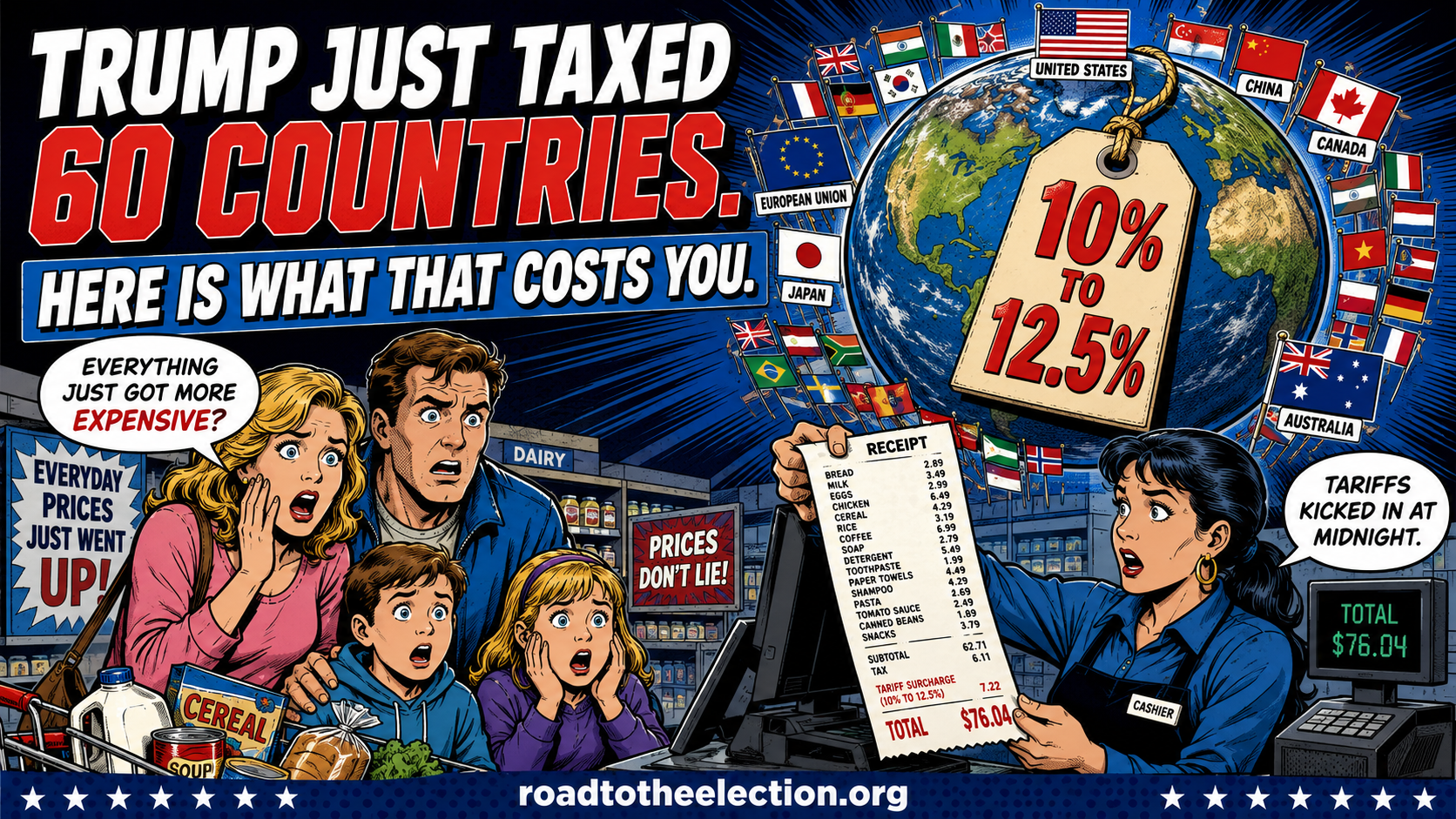
At midnight on July 25, 2026, Trump tariffs 2026 hit 60 countries at once. These are not small taxes on a few products. They cover 99% of everything the US imports from around the world. The rates are 10% to 12.5% on goods coming into the country from places like China, Canada, the European Union, Mexico, Japan, and dozens more. As CBS News reported, the official reason is forced labor. But there is a lot more to this story — and it directly affects the prices you pay at the store.
Wait — Why Did Trump Need New Tariffs? What Happened to the Old Ones?
This is where it gets interesting. Earlier this year, the Supreme Court struck down Trump’s original big tariffs — the ones he called “Liberation Day” tariffs. The Court said those tariffs were not legal because they were based on a law that does not give the president that kind of power.
So Trump switched to a backup plan. He used a different law — Section 122 of the Trade Act — to impose a temporary 10% tariff on most imports. That bought him time. But Section 122 tariffs expire automatically. They ran out at midnight on July 25.
So now he has switched again — this time to Section 301 of the Trade Act of 1974. This law lets the president put tariffs on countries that engage in what the US considers “unfair trade practices.”
The unfair practice Trump is citing this time is forced labor.
What Is Forced Labor and Why Is It the Reason for These Tariffs?
Forced labor means people are made to work against their will — often with no pay, in dangerous conditions, sometimes as prisoners or slaves. It happens in many countries and affects products like clothing, electronics, seafood, and agricultural goods.
The US already has a law called the Uyghur Forced Labor Prevention Act, which bans imports of goods made with forced labor from China’s Xinjiang region, where the Chinese government has been accused of forcing Muslim minorities called Uyghurs to work in factories and fields.
According to the Office of the US Trade Representative (USTR), the Trump administration investigated all 60 countries on the list and found that none of them do enough to stop goods made with forced labor from entering their trade systems. That is the legal basis for the new tariffs.
US Trade Representative Jamieson Greer said: “President Trump recognizes that decades of moral suasion have not eradicated forced labor from global supply chains.”
Which Countries Got Hit and at What Rate?
The split is simple. Countries that have at least passed a law banning forced labor imports — even if enforcement is weak — get the 10% rate. Countries that have not even passed such a law get 12.5%.
Yes, you read that right. Australia, Japan, and Norway — some of America’s closest allies — are in the 12.5% group. So is Israel. So is Brazil. The administration says no country gets a pass just because they are a friend.
One senior White House official described it as “the most sweeping international labor rights action the United States has ever taken, that any country has ever taken.”
What Products Are NOT Being Taxed?
Not everything gets hit. The administration carved out exemptions for products that are either critical to the US economy or impossible to get from other sources. These include:
- Oil and gas — exempt. No new tariffs on fuel imports.
- Fertilizer — exempt. Important for US farming.
- Electronics and AI-related products — largely exempt. This protects tech supply chains.
- USMCA products — products that qualify for duty-free status under Trump’s own North American trade deal with Canada and Mexico are protected from these new tariffs.
- Steel and aluminum — already have their own 50% tariffs. These new tariffs do not stack on top of those.
How Do These Trump Tariffs 2026 Connect to the Midterm Elections?
This is the part that matters most for election updates in the US.
Tariffs are taxes on imported goods. Americans are already dealing with inflation that hit a 3-year high of 4.2% in May 2026. Adding new taxes on imports from 60 countries — right before the November 3 midterm elections — is a risk.
As one trade publication noted directly: “Americans are already frustrated by the high cost of living. So the administration is taking a risk in rolling out new tariffs ahead of the Nov. 3 midterm elections.”
The administration’s bet is that the forced labor framing makes these tariffs politically popular — and that the exemptions on oil, gas, and electronics protect the most visible consumer prices. But if clothing, furniture, and food prices rise further between now and November, that calculus changes fast.
Republicans defending competitive House and Senate seats in November will be watching these price numbers very closely. So will the Democrats trying to take those seats away from them.
The people elected in November will decide whether these tariffs stay, get expanded, or get reversed. That makes this a direct election updates in the US story — not just a trade story.
Trump put new Trump tariffs 2026 on 60 countries at midnight on July 25. The rates are 10% to 12.5%. The reason given is forced labor. The legal basis is Section 301 of the Trade Act of 1974, which is on much stronger legal footing than the tariffs the Supreme Court struck down earlier this year.
Oil, gas, fertilizer, and most electronics are exempt. Clothing, furniture, appliances, and cars are not. American importers pay the tariff and usually pass the cost on to you.
Deals are being negotiated with multiple countries that could carve out exemptions. But for now, the tariffs are live.
With inflation already high and elections four months away, what happens to prices between now and November 3 is one of the biggest wild cards in American politics right now.
References:
U.S. Trade Representative. USTR Takes Action on Forced Labor Under Section 301 Investigations
U.S. Trade Representative. Fact Sheet: USTR Section 301 Action in Response to the Failure of More Than 60 Economies to Ban Imports Produced with Forced Labor
U.S. Congress. H.R. 10710 – Trade Act of 1974 (Section 301)
Federal Register. Federal Register: Section 301 Tariff Action

- Why Does the President’s Party Almost Always Lose Seats in the Midterms? - September 9, 2026
- Why Is Congress Racing to Fund the Government Before the Midterms? - August 31, 2026
- Can the President Cancel or Postpone an Election? - August 10, 2026