
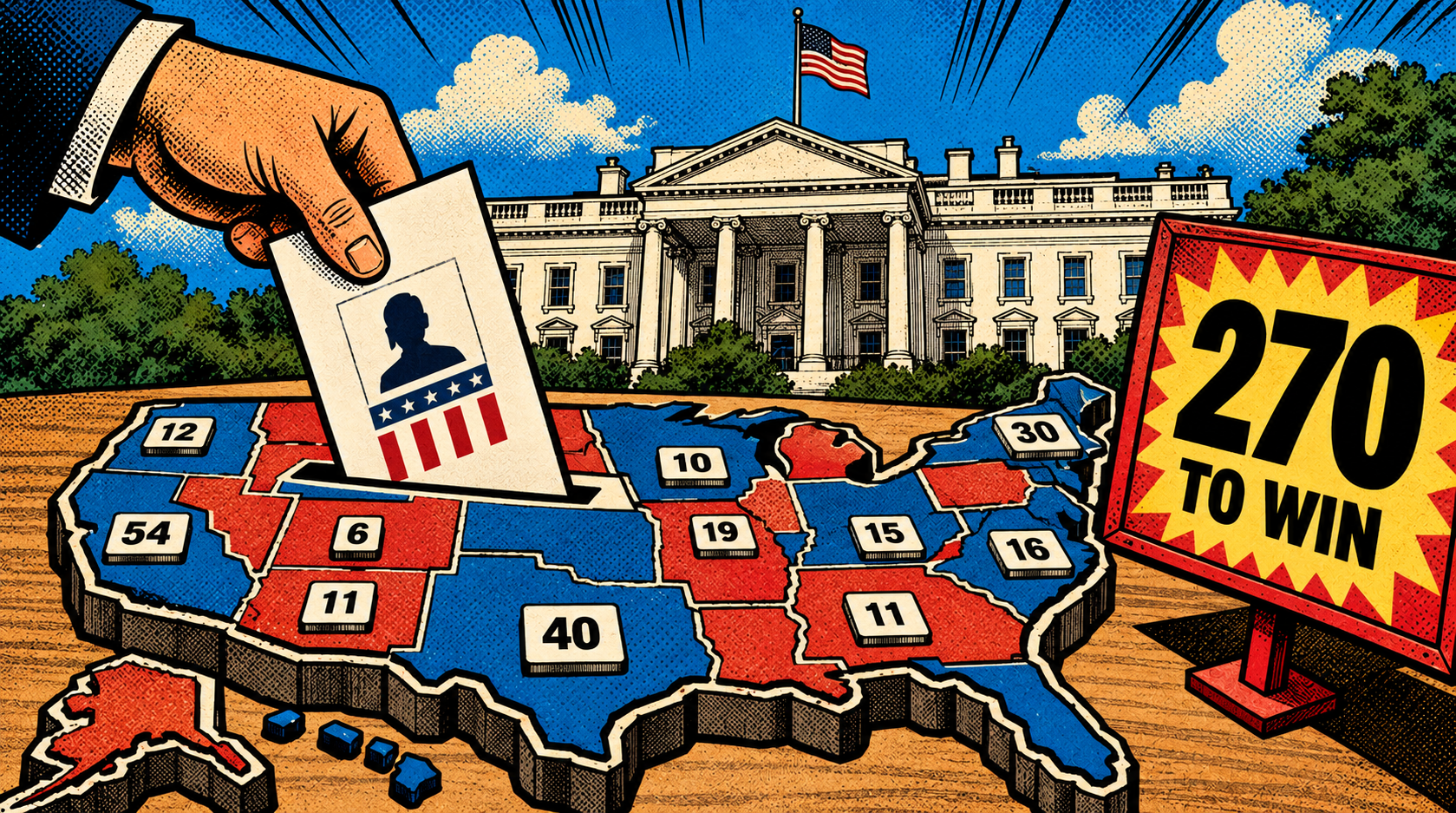
Every four years, Americans cast a presidential ballot that does not actually go straight to a candidate, and most people vote without ever fully unpacking what happens between their ballot and the outcome. The Electoral College is one of the most misunderstood parts of American government, partly because it rarely mattered much in practice until a handful of recent elections made the gap between the popular vote and the electoral outcome impossible to ignore. Here are five common myths about how it actually works.
Myth: You are voting directly for a presidential candidate
When you fill out a presidential ballot, you are technically voting for a slate of electors pledged to that candidate, not the candidate directly. There are 538 electors total, a number equal to the 435 members of the House, the 100 senators, and three electors for Washington, D.C. under the 23rd Amendment. A candidate needs 270 votes, a majority of that total, to win. Whichever party’s candidate wins a state’s popular vote typically gets that state’s slate of electors seated, and those electors meet in December to formally cast the votes that get counted by Congress in January.
Myth: Every state splits its electoral votes to match its popular vote
Only two states do that. Maine and Nebraska use what is called the congressional district method, awarding one electoral vote to whoever wins each individual congressional district and the remaining two to whoever wins the statewide vote, which occasionally produces a split result within the same state. Every other state, plus Washington, D.C., uses a winner take all system, in which the candidate who wins the statewide popular vote, even by a single ballot, receives all of that state’s electoral votes.
Myth: Electors are free agents who can vote however they personally want
For most of American history that was technically true, and it caused genuine problems. In 2016, four Washington state electors pledged to Hillary Clinton voted for other candidates instead, becoming what are known as faithless electors. The Supreme Court settled the question in 2020 in Chiafalo v. Washington, ruling unanimously that states can legally bind electors to their pledge and penalize or remove them if they vote otherwise. That decision upheld faithless elector laws already on the books in dozens of states, effectively closing off electors as a meaningful wildcard in the system going forward.
Myth: The system was created purely to check an uninformed electorate
That is part of the story, but only part of it. Delegates at the 1787 Constitutional Convention were genuinely divided between letting Congress choose the president and letting the public vote directly, and the Electoral College emerged as a compromise between those camps, partly reflecting real concerns about how a geographically spread out public with slow communication could vote knowledgeably on national candidates. But historians have also pointed to a less flattering factor: the elector allocation formula, tied to each state’s total congressional representation, meant Southern states benefited from counting enslaved people, who could not vote, toward their population totals under the three fifths compromise, which increased those states’ electoral weight beyond their actual voting population. Both threads run through the same set of debates, and historians continue to disagree about how much weight each deserves.
Myth: A president losing the popular vote is a brand new, unprecedented problem
It has happened before, just not often. Rutherford B. Hayes in 1876 and Benjamin Harrison in 1888 both won the presidency after losing the nationwide popular vote, long before the more recent examples of George W. Bush in 2000 and Donald Trump in 2016. A fifth case is sometimes debated: in 1824, Andrew Jackson won the largest share of the popular vote and the most electoral votes, but fell short of an outright majority, throwing the decision to the House of Representatives, which chose John Quincy Adams instead. So while the outcome has felt newly urgent in recent decades, the underlying mismatch between the popular vote and the electoral outcome is a recurring feature of the system, not a one time fluke.
Why this matters to voters
None of this changes how you should vote, but understanding the mechanics changes how you read election night coverage and how you evaluate arguments for or against reforming the system. Whether you think the Electoral College should stay exactly as it is or be replaced with a national popular vote, that debate goes a lot better once everyone agrees on what the system actually does, rather than what people assume it does from a ballot that looks, on its surface, like a direct vote for president.
References
Brennan Center for Justice, The Electoral College, Explained
Wikipedia, Chiafalo v. Washington
Wikipedia, List of United States presidential elections in which the winner lost the popular vote

- Five Myths About How the Electoral College Actually Works - September 29, 2026
- Why Does the President’s Party Almost Always Lose Seats in the Midterms? - September 9, 2026
- Why Is Congress Racing to Fund the Government Before the Midterms? - August 31, 2026