
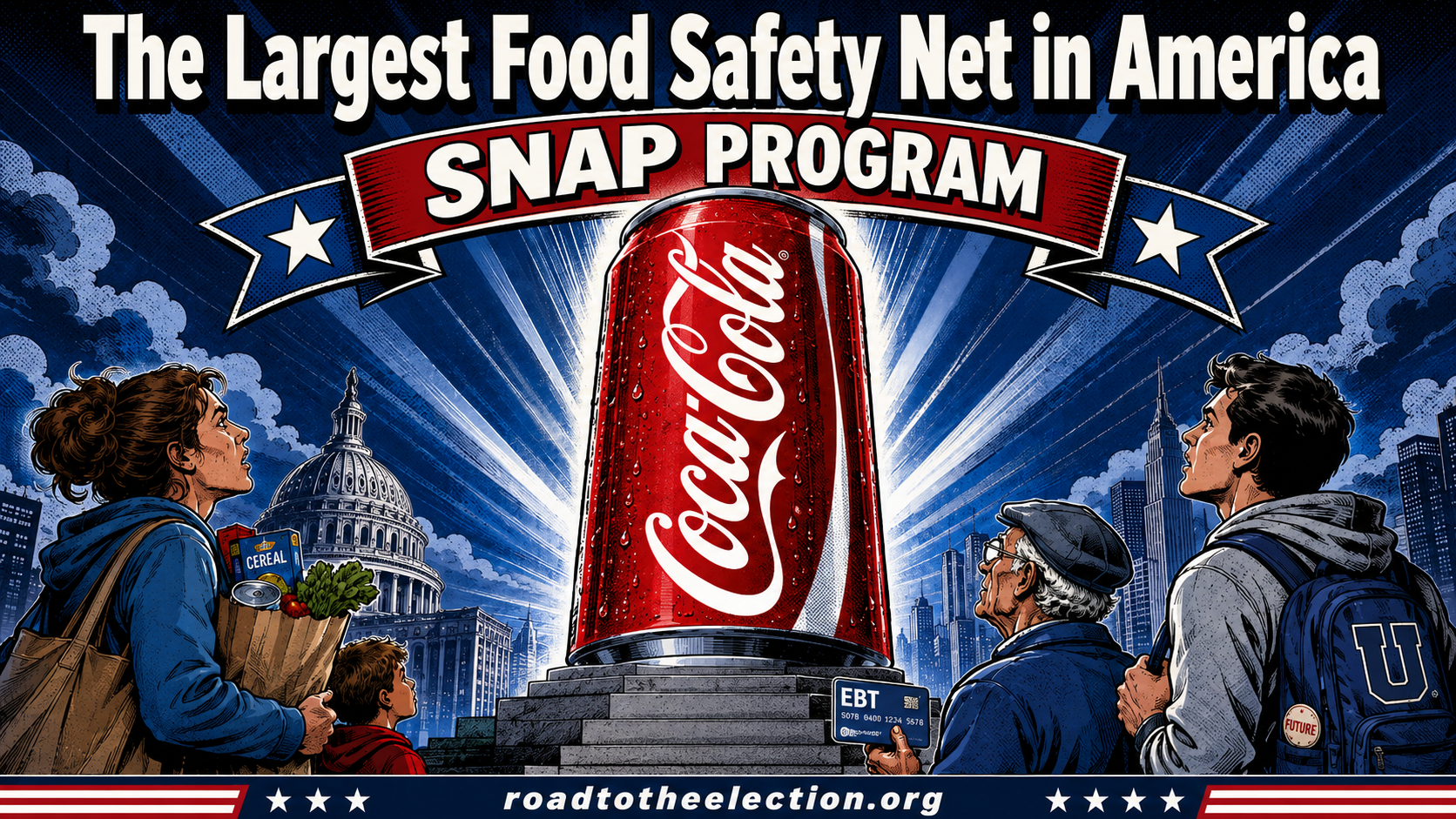
On June 22, 2026, US District Judge Amy Berman Jackson ruled that the federal government cannot block recipients of the SNAP program from using their benefits to buy soda and candy. Her ruling scuttled restrictions already in place or planned across 23 states, where the Trump administration had approved waivers allowing those states to ban sugary drinks and candy from SNAP purchases. The administration has not said whether it will appeal. The ruling landed in the middle of a much larger fight about what the SNAP program is, who it serves, what it pays for, and who profits from it. Newsweek reported that SNAP accounts for an estimated 20 to 25% of Coca-Cola’s US revenue, a figure that explains why the American Beverage Association, which lobbies on behalf of Coca-Cola and PepsiCo, more than doubled its lobbying spending to $1.7 million in the first half of 2025 to fight the proposed soda ban. This article explains what SNAP actually is, who qualifies, how much it pays, what the One Big Beautiful Bill changed, and why the soda question has become one of the most politically charged food policy debates in the country.
What the SNAP Program Is
The Supplemental Nutrition Assistance Program (SNAP), formerly known as the Food Stamp Program, is the largest federal food assistance program in the United States. It is administered by the US Department of Agriculture’s Food and Nutrition Administration (FNA), which was known as the Food and Nutrition Service until June 1, 2026, when it was officially renamed under the current administration.
SNAP is authorized by the Food and Nutrition Act of 2008, which replaced the Food Stamp Act of 1977. The program was last reauthorized by the 2018 Farm Bill, though multiple laws including the One Big Beautiful Bill of 2025 have amended it significantly since then.
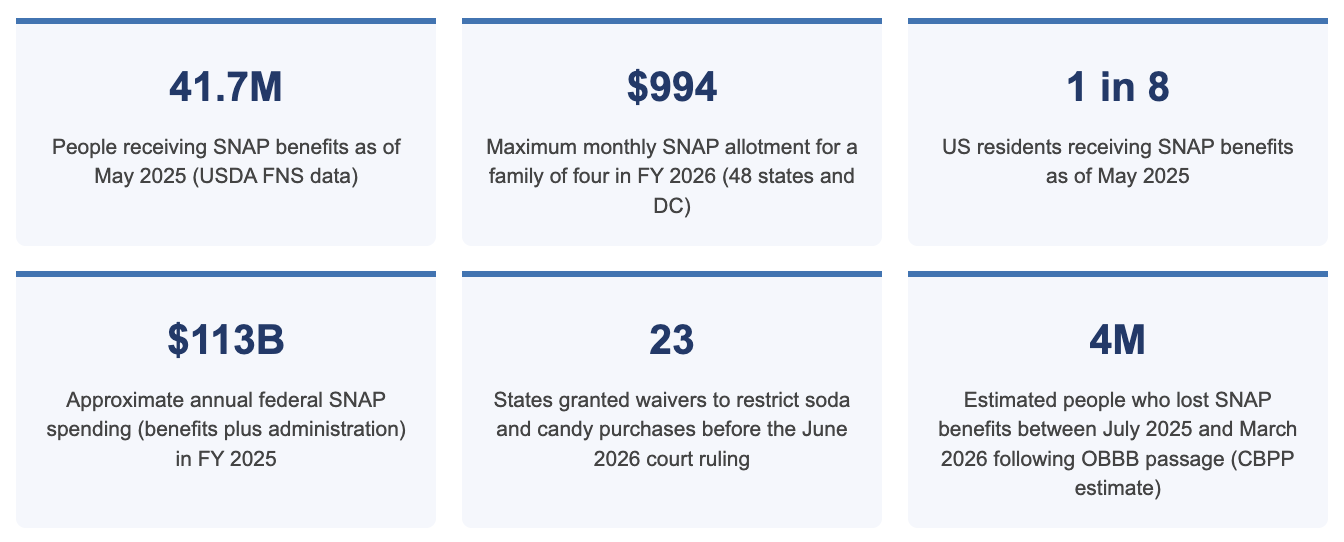
According to Feeding America, SNAP is the largest anti-hunger program in the country, helping over 41 million people in the most recently reported annual figures. The program provides monthly benefits loaded onto an Electronic Benefits Transfer (EBT) card, which works like a debit card at authorized retail locations. The amount of benefits each household receives depends on household size, income, and allowable deductions.
As USAGov confirms, SNAP benefits are added each month to an EBT card. To check the balance on an EBT card, recipients can check their receipt from a SNAP-authorized store, use a state mobile app if available, or contact their state SNAP office directly.
What You Can and Cannot Buy With SNAP Benefits
The Food and Nutrition Act of 2008 defines what SNAP benefits can purchase as “any food or food product for home consumption except alcoholic beverages, tobacco, hot foods or hot food products ready for immediate consumption.” Feeding America’s SNAP guide lists the broad categories of items that can be purchased:
Fruits and vegetables
Meat, fish, and poultry
Dairy products
Bread and cereals
Snacks and beverages, including soda and candy under federal law (prior to state waivers)
Seeds and plants to grow food at home
Items that cannot be purchased with SNAP benefits under federal law include:
Alcoholic beverages
Tobacco products
Hot foods or hot food products ready for immediate consumption
Non-food items such as pet food, cleaning supplies, paper products, and personal hygiene products
Vitamins and medicines
Soda, candy, energy drinks, and other sugary beverages are technically eligible under the federal definition of “food” and have always been purchasable with SNAP benefits. That is the legal foundation on which Judge Jackson’s June 22, 2026 ruling rests.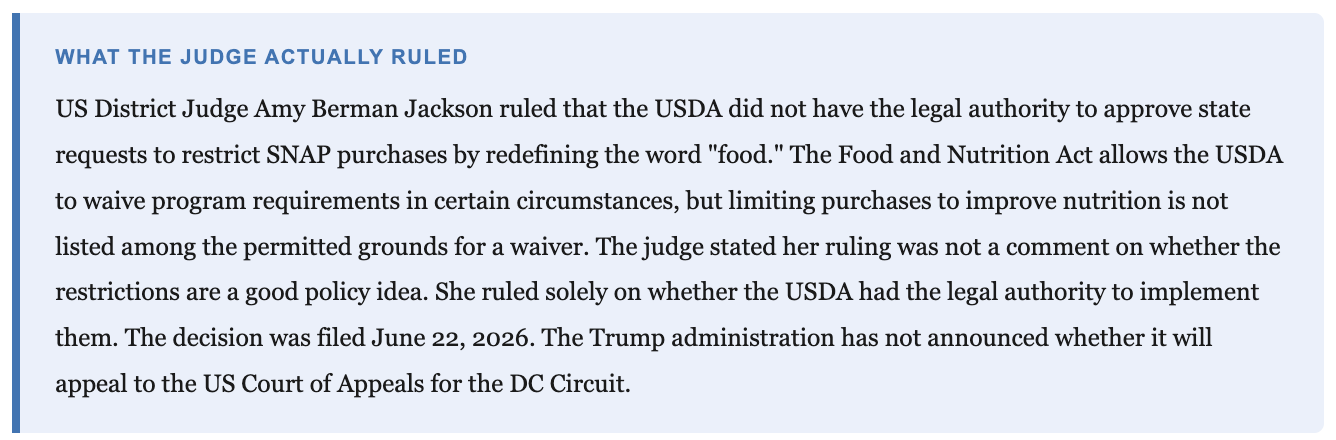
How SNAP Benefits Are Calculated in FY 2026
SNAP benefit amounts are not fixed. They are calculated based on household size, net monthly income, and inflation-adjusted maximum allotments set by the USDA each fiscal year. The fiscal year runs from October 1 to September 30. FY 2026 began on October 1, 2025.
The calculation works as follows: the USDA establishes a maximum monthly allotment for each household size based on the Thrifty Food Plan, a USDA estimate of the cost of a nutritious low-cost diet for a household of that size. From the maximum allotment, 30% of the household’s net monthly income is subtracted, because households are expected to contribute 30% of their own income toward food costs. The remainder is the household’s monthly SNAP benefit.
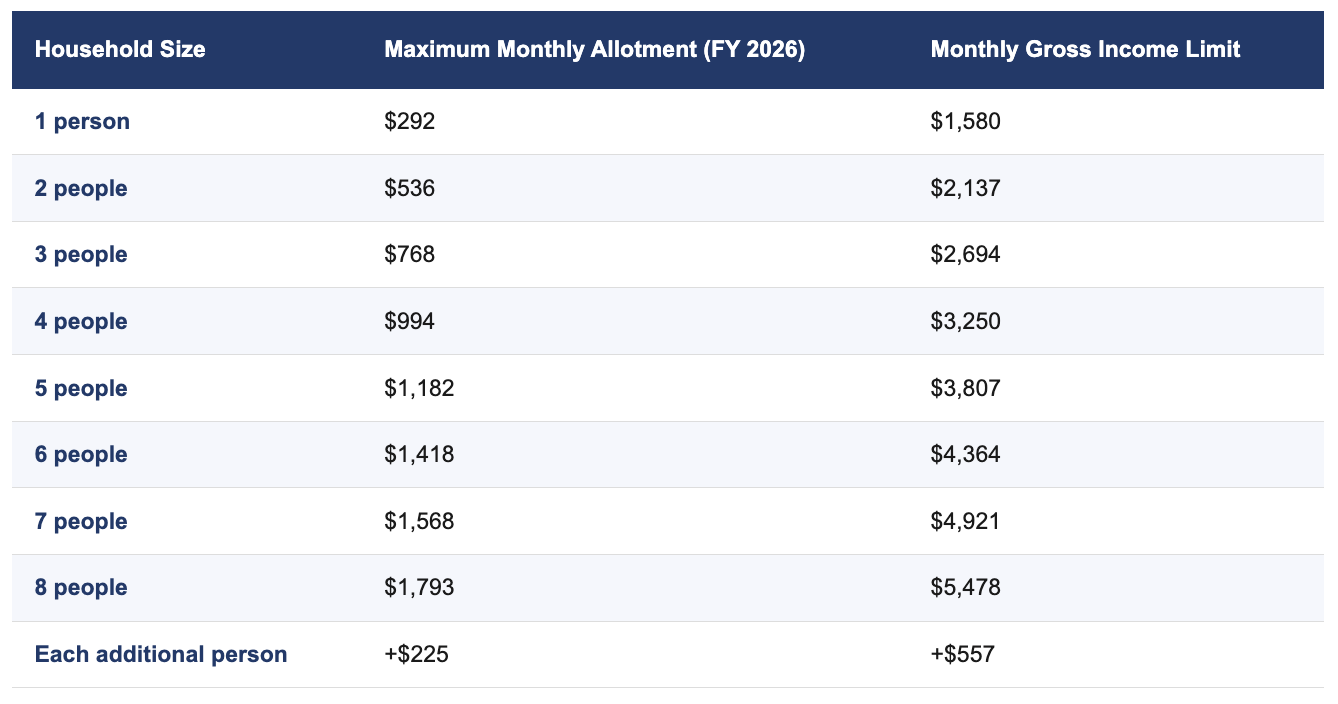
Source: USDA Food and Nutrition Administration FY 2026 Cost-of-Living Adjustment, effective October 1, 2025. Figures apply to the 48 contiguous states and the District of Columbia. Alaska, Hawaii, Guam, and the US Virgin Islands have higher maximum allotments reflecting higher local food costs.
Households with an elderly or disabled member face different asset tests. In FY 2026, households without an elderly or disabled member cannot have counted liquid assets above $3,000. Households with an elderly or disabled member cannot have counted liquid assets above $4,500. These limits are indexed annually to overall inflation.
Who Is Eligible for SNAP in 2026?
SNAP eligibility is determined by each state’s SNAP agency using federal guidelines. As USAGov explains, eligibility depends on meeting income limits and asset limits, and varies by state in certain respects. The basic federal eligibility structure for FY 2026 includes:
- Gross income test: A household’s total monthly income before deductions cannot exceed 130% of the federal poverty level. For a family of four, that is approximately $3,250 per month in the 48 states and DC.
- Net income test: After allowable deductions (including housing costs, childcare, and medical expenses for elderly or disabled members), net monthly income cannot exceed 100% of the federal poverty level.
- Asset test: Counted liquid assets cannot exceed $3,000 for most households, or $4,500 for households with an elderly or disabled member.
- Work requirements: Able-bodied adults without dependents (ABAWDs) between the ages of 18 and 49 are generally required to work, participate in job training, or volunteer for at least 20 hours per week to receive SNAP benefits for more than three months within a 36-month period.
SNAP Eligibility for College Students
A January 2025 announcement from the US Department of Education’s Federal Student Aid office confirmed that students enrolled half-time or more in an institution of higher education may be eligible for SNAP if they meet the financial eligibility requirements AND qualify for at least one SNAP student exemption. Student exemptions include:
- Working 20 or more hours per week
- Participating in a state or federal work study program
- Having a physical or mental disability that prevents working
- Caring for a dependent child under age 6, or a child aged 6 to 11 when childcare is unavailable
- Receiving Temporary Assistance for Needy Families (TANF)
- Being under age 18 or over age 49
- Participating in certain job training programs
Students must apply in the state where they currently live. There is no minimum residency period required. Students receiving a majority of their meals through a college meal plan are not eligible for SNAP.
The One Big Beautiful Bill: What It Changed for SNAP
In July 2025, Congress passed and President Trump signed the “One Big Beautiful Bill” (OBBB). According to Feeding America’s official OBBB update, the law made four significant changes to the SNAP program:
1. Expanded work requirements. The OBBB extended work and reporting requirements to new groups that were previously exempt. For the first time, people aged 55 to 64 and parents of school-aged children age 14 and older are now required to complete paperwork demonstrating work or approved job training to continue receiving SNAP benefits. These requirements also now apply to veterans, people experiencing homelessness, and former foster youth, all of whom were previously exempt from such requirements.
2. Citizenship restrictions. Some legal residents who are not US citizens and were previously eligible for SNAP are no longer eligible for benefits under the OBBB.
3. Cost shift to states beginning October 2027. Starting in October 2027, a share of SNAP food benefit costs will shift from the federal government to state governments. Historically, the federal government has covered 100% of SNAP food benefit costs. States that cannot cover their share may have insufficient funds to provide benefits to all previously eligible recipients.
4. Higher state administrative cost share beginning October 2026. States must cover a higher proportion of SNAP administrative costs starting October 2026, putting immediate fiscal pressure on state budgets for the current year.
‘Coca-Cola, Soda, and the Fight Over What SNAP Pays For
The soda ban debate brings together nutrition policy, corporate revenue, federal authority, and states’ rights in a combination that has made it one of the most contested aspects of the SNAP program in 2026.
The financial stakes for the beverage industry are significant. Newsweek reported in December 2025 that estimates suggest SNAP accounts for approximately 20 to 25% of Coca-Cola’s US revenue. That figure has not been confirmed by Coca-Cola publicly, but it reflects the outsized role that government food assistance spending plays in the revenue of the beverage sector. The American Beverage Association, which represents Coca-Cola, PepsiCo, and other non-alcoholic drink makers, spent $1.7 million on lobbying in the first half of 2025, according to Bloomberg Government analysis of Lobbying Disclosure Act filings. That figure is more than double the group’s outlay during the same period in 2024 and surpasses its annual lobbying total in all but one year since 2010. PepsiCo separately spent nearly $2.8 million on internal lobbying targeting SNAP purchasing restrictions in the same period.
The Trump administration’s push to restrict soda purchases began with Secretary of Agriculture Brooke Rollins and Health Secretary Robert F. Kennedy Jr. co-signing waivers for states beginning in spring 2025. RFK Jr. argued: “We cannot continue a system that forces taxpayers to fund programs that make people sick and then pay a second time to treat the illnesses those very programs help create.” By June 2026, the USDA had approved waivers for 23 states to restrict soda and candy purchases with SNAP benefits.
The restrictions varied by state. Iowa banned soda, candy, and a range of prepared foods. Utah and West Virginia banned soft drinks. Nebraska banned soda and energy drinks. Arkansas banned soda, low-calorie soda, fruit drinks with less than 50% natural juice, and candy, with the ban set to take effect July 1, 2026. Colorado’s human services board voted against implementing the ban after a March 2026 hearing in which SNAP recipients argued they would face stigma and confusion at checkout lines.
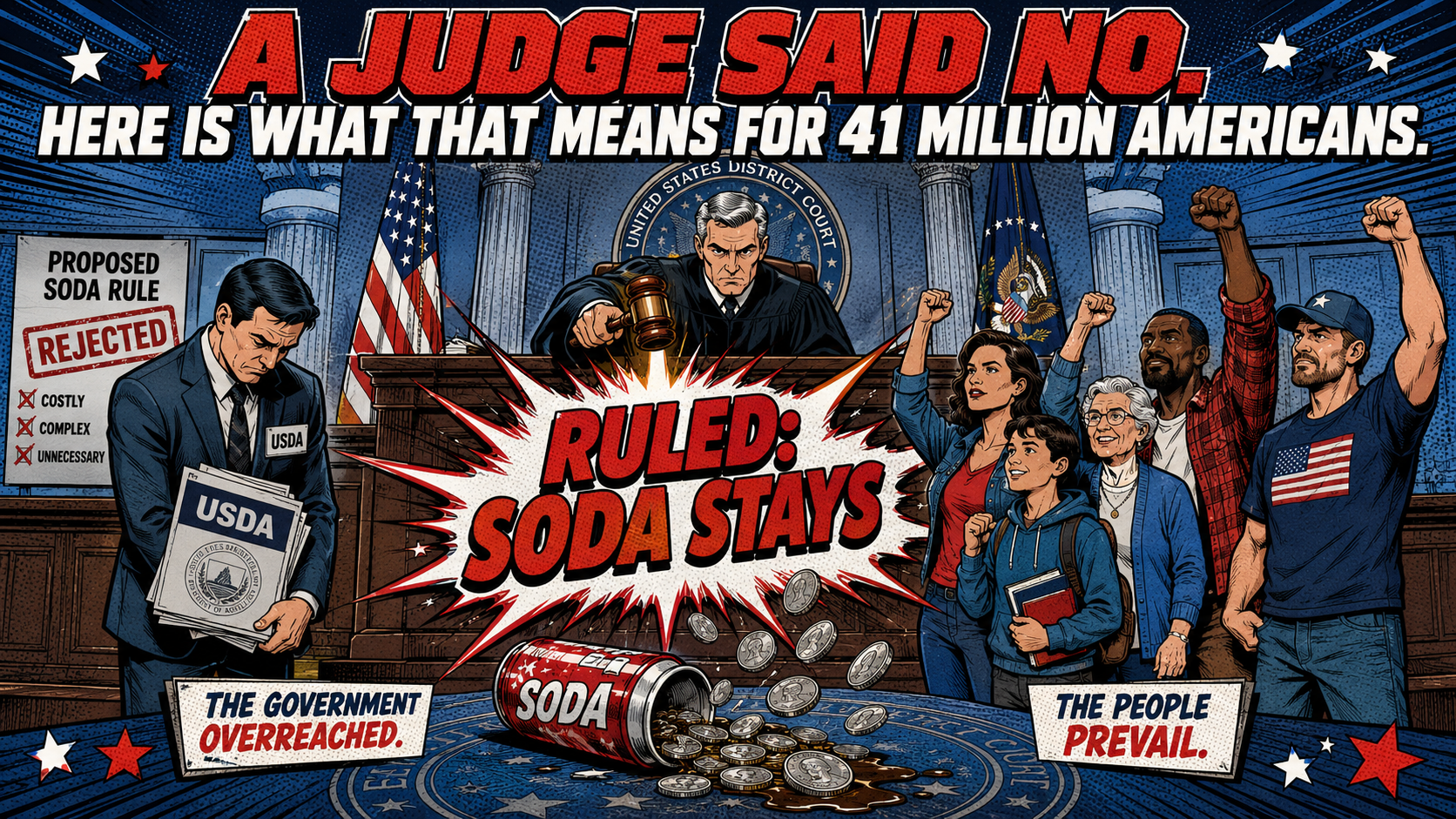
On June 22, 2026, Judge Amy Berman Jackson ruled in favor of five SNAP recipients from Iowa, Nebraska, West Virginia, Colorado, and Tennessee who had sued the USDA, represented by the National Center for Law and Economic Justice. Her ruling held that the USDA redefining “food” through administrative waiver exceeded its statutory authority. “This decision makes clear that the USDA cannot bypass the legal guardrails that establish how SNAP must operate across the country,” said Katharine Deabler Meadows, senior attorney at NCLEJ.
Despite the ruling, RFK Jr. maintained his position. “Today’s ruling does not change the facts about the health harms associated with excessive sugar consumption,” he tweeted. “Taxpayers should not be forced to pay for products that make people sick and then pay again for the medical care that follows.”
How SNAP Works in Practice: The EBT Card
SNAP benefits are delivered through the Electronic Benefits Transfer (EBT) system. Each state issues an EBT card to eligible households, and benefits are added to the card at the beginning of each month on a state-assigned date. The EBT card works at the point of sale at SNAP-authorized retailers the same way a debit card does.
Most grocery stores, supermarkets, convenience stores, and farmers markets are authorized SNAP retailers. Many states and retailers also accept SNAP for online grocery purchases through approved platforms. SNAP cannot be used for cash withdrawals. The EBT system automatically applies the SNAP definition of eligible food items at checkout, flagging ineligible items for separate payment.
The implementation challenge flagged by grocer groups during the soda ban debate is practical: adding category-level restrictions to the EBT system would require updating point-of-sale software at every authorized retailer in a state to identify and reject newly ineligible items. The Food Research and Action Center wrote in May 2025 that item-level restrictions “would drastically increase complexity for retailers” and risk “turning checkout lanes into battlegrounds, forcing grocery clerks to enforce confusing rules.”
How SNAP Connects to the 2026 Elections
For readers following election updates in the US, the SNAP program is not a background policy topic in the 2026 midterm cycle. It is a live political issue in multiple ways.
The OBBB’s cuts to SNAP, the expanded work requirements, and the cost shift to states are all scheduled to take effect at specific points between October 2026 and October 2027, putting them squarely within the political environment surrounding the November 3, 2026 general election. The 4 million people estimated to have already lost benefits are a real constituency whose economic situation will factor into how they vote.
The soda ban court ruling is now before the Trump administration as an appeal decision. If the administration appeals and pursues the case through the DC Circuit, it will remain a live issue through the election cycle. If it declines to appeal, the 23 state waivers are effectively invalidated, angering Republican governors who supported the restrictions as a MAHA priority.
And the composition of Congress after November determines the legislative environment for SNAP for the next two years, including whether any of the OBBB’s changes are modified, reversed, or further restricted.
The Bottom Line
The SNAP program feeds 41 million Americans each month, delivers up to $994 per month to a qualifying family of four, and operates through a network of more than 260,000 authorized retail locations. It is funded almost entirely by the federal government, authorized by Congress, and administered by the states. It is also the target of the most significant set of changes in its recent history: a $186 billion budget cut, expanded work requirements, a pending cost shift to states, and a soda ban that a federal judge just blocked.
Coca-Cola, which may earn an estimated 20 to 25% of its US revenue from SNAP purchases, is watching the appeal decision closely. So are 41 million Americans. And so is Congress, which will be elected or re-elected on November 3, 2026, and will ultimately determine the future of the program that is, by any measure, the largest food safety net the United States government has ever built.
References:
USA.gov. Food Assistance (SNAP/Food Stamps)
Feeding America. Supplemental Nutrition Assistance Program (SNAP)
U.S. Department of Education, Federal Student Aid. SNAP Benefits for Eligible Students
U.S. Department of Agriculture, Food and Nutrition Service. Supplemental Nutrition Assistance Program (SNAP)

- Five Myths About States Banning ICE From Polling Places - October 12, 2026
- The Secret Ballot Is Newer Than You Think, and It Took a Body Count to Get Here - October 6, 2026
- Why Is Election Day Always a Tuesday in November? - September 4, 2026