
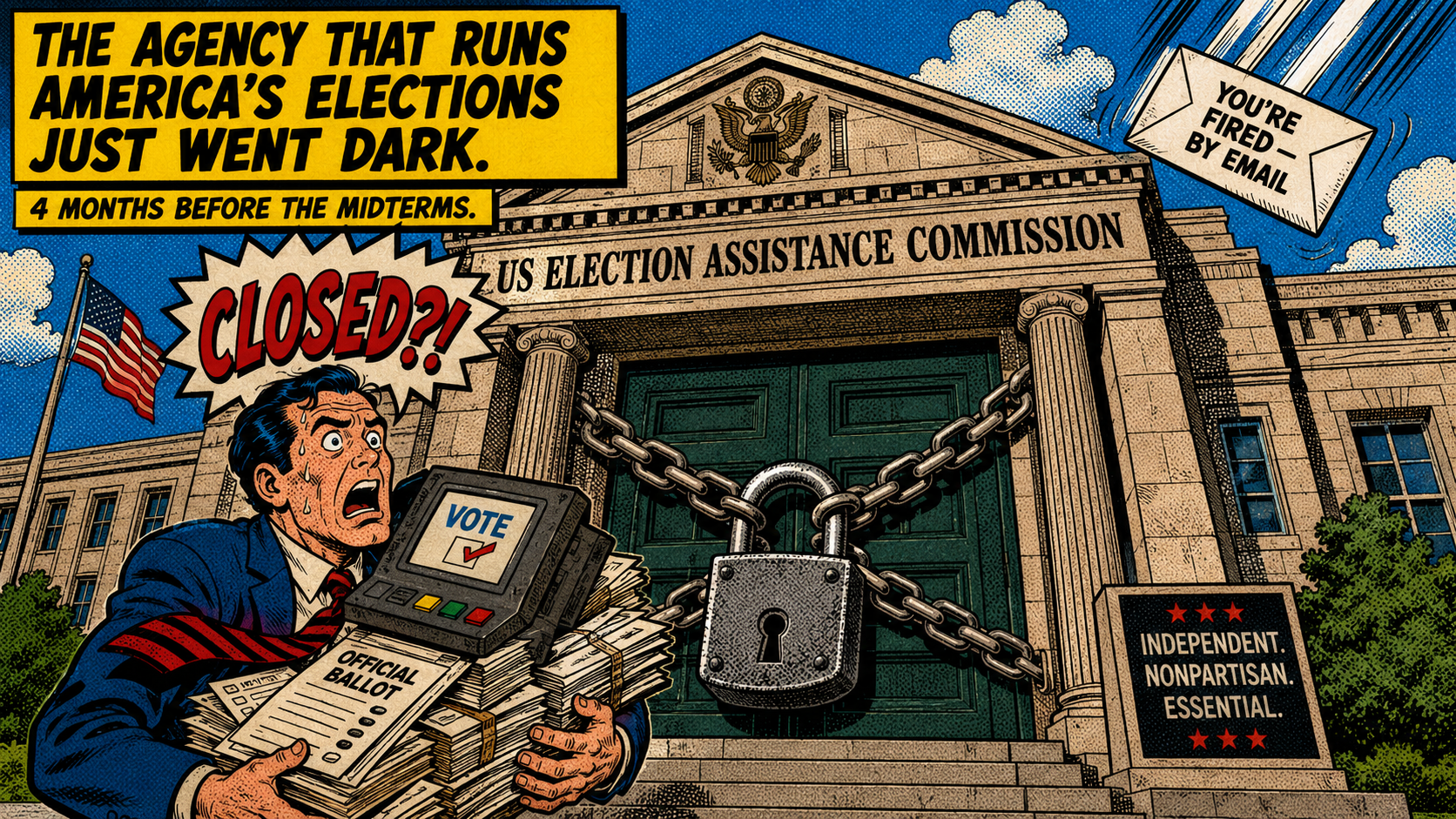
On July 9, 2026, the White House sent two short emails that left the only federal agency devoted entirely to election administration without a single commissioner four months before the 2026 midterm elections. Democratic Commissioners Thomas Hicks and Benjamin Hovland received termination notices on behalf of President Donald Trump at approximately 4 p.m. ET. Republican Commissioner Christy McCormick, who had not been fired, subsequently resigned. A fourth commissioner, Republican Donald Palmer, had already resigned in April. The US Election Assistance Commission now has no commissioners, no quorum, and no ability to take formal action. The White House cited the Supreme Court’s recent ruling in Trump v. Slaughter, which expanded presidential authority to remove members of independent federal agencies. Senate Minority Leader Chuck Schumer called it “a brazen attempt to seize control of our elections before a single vote is cast.” For anyone following election updates in the US, the question this raises is not primarily political. It is practical: what does the US Election Assistance Commission actually do, what cannot happen without it, and what does its sudden vacancy mean for November 3?
What the US Election Assistance Commission Is

The US Election Assistance Commission is an independent, bipartisan federal agency created by Congress through the Help America Vote Act of 2002 (HAVA). It is headquartered at 633 3rd Street NW, Suite 200, Washington, DC. According to the EAC’s own published description, the agency serves as a national clearinghouse and resource for information and methods to improve the administration of federal elections. It was the direct legislative response to the 2000 presidential election, in which hanging chads, inconsistent ballot designs, and chaotic manual recounts in Florida exposed serious weaknesses in how the United States ran its elections.
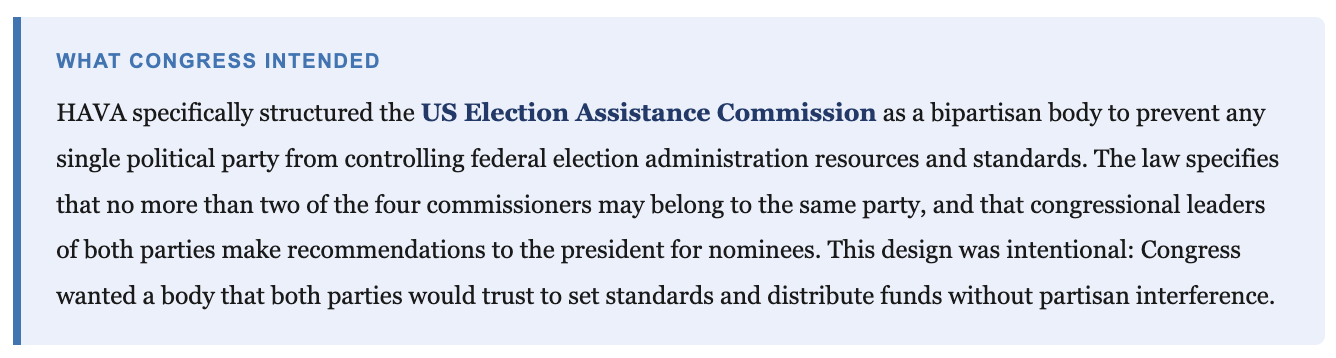
Congress deliberately structured the EAC as a bipartisan body. Federal law specifies four commissioners, no more than two of whom may belong to the same political party. Commissioners are nominated by the president based on recommendations from congressional leaders of both parties and must be confirmed by the Senate. All three commissioners fired or departed in 2026 had been confirmed unanimously by the Senate: Thomas Hicks and Christy McCormick in 2015, and Benjamin Hovland in 2019.
The agency requires an affirmative vote of at least three of its four commissioners to conduct official business or establish policy. With zero commissioners, the EAC cannot take formal action of any kind.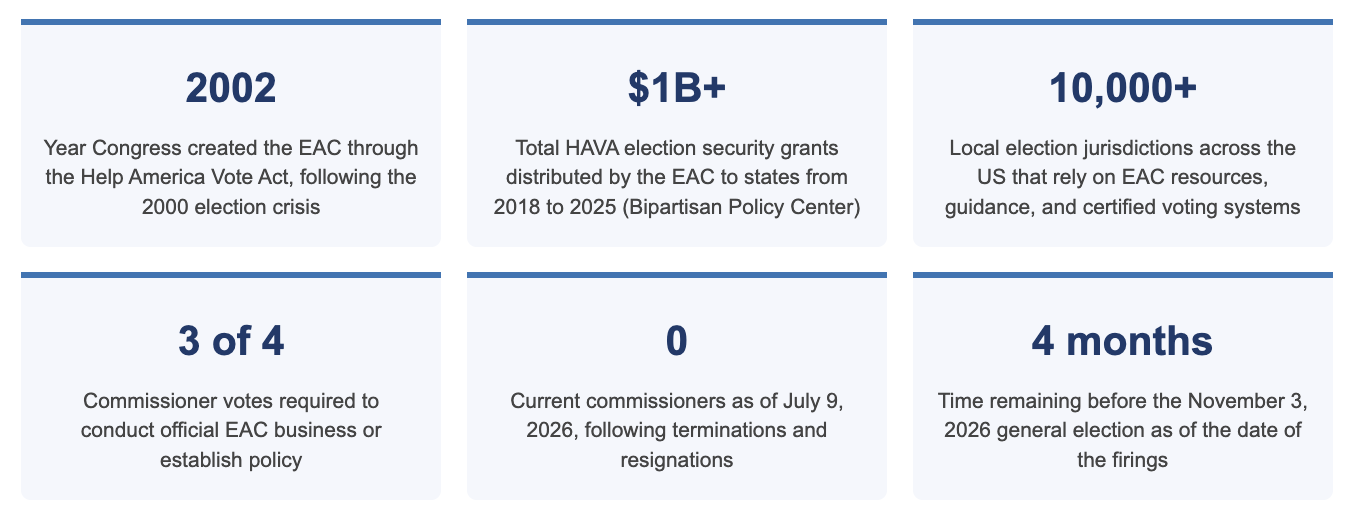
What the EAC Actually Does: Six Core Functions
The US Election Assistance Commission carries out six primary functions, each of which has a direct effect on how elections are run at the state and local level across the country.
1. Certifying Voting Systems
The EAC administers the federal testing and certification program for voting systems, accrediting independent testing laboratories and certifying whether voting machines and related equipment meet federal standards. These standards are known as the Voluntary Voting System Guidelines (VVSG). The most recent version, VVSG 2.0, covers security, accessibility, auditability, and software requirements for all types of voting equipment.
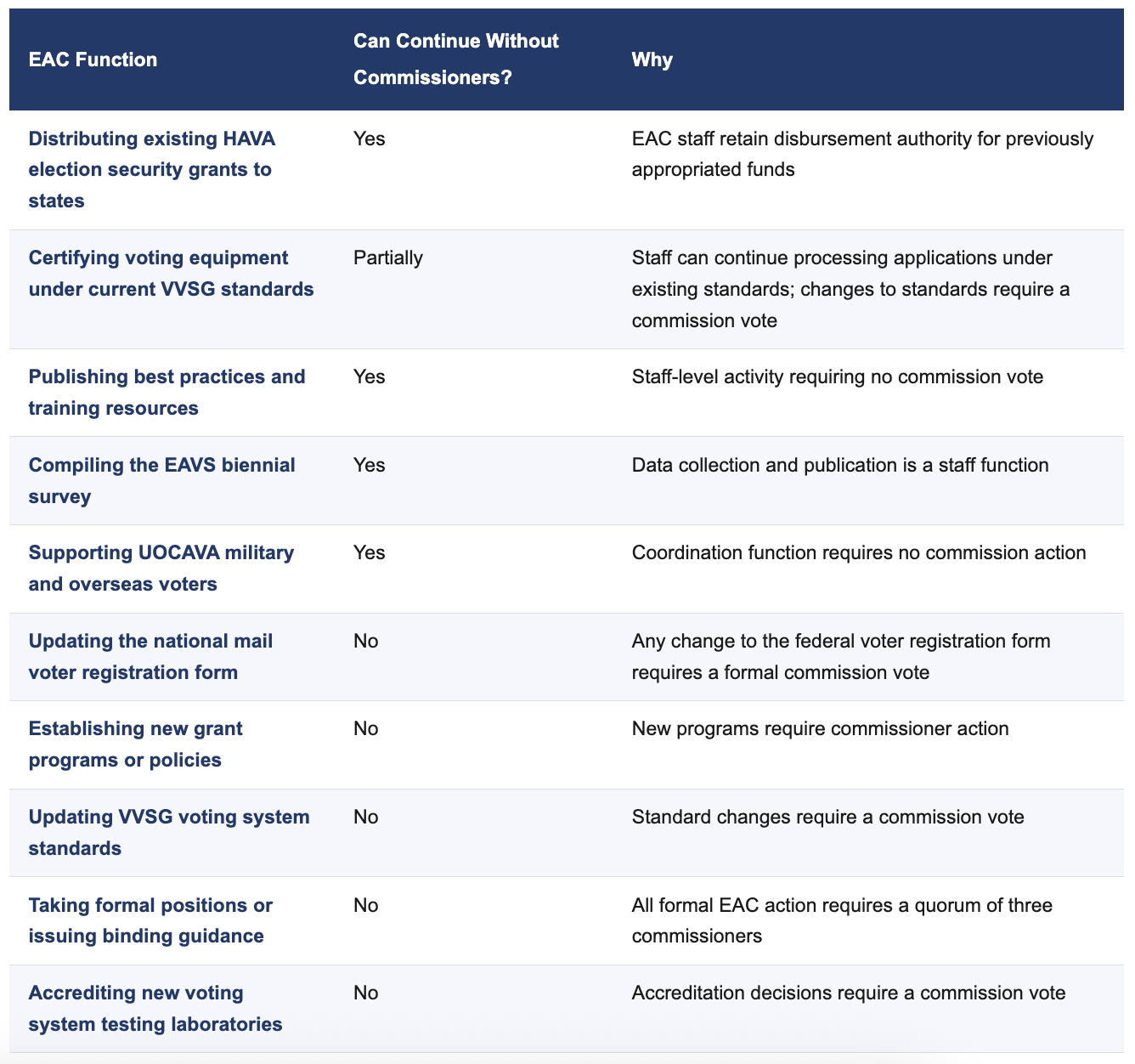
As the EAC announced on July 10, 2025, the first voting system certified to VVSG 2.0 was Hart InterCivic’s Verity Vanguard 1.0, marking a major milestone in the transition to updated security standards. Many states require EAC certification before they can purchase or deploy voting equipment. Without commissioners, updates to VVSG standards require a commission vote and cannot move forward.
2. Distributing Federal Election Security Grants
One of the EAC’s most financially significant functions is distributing HAVA election security grants to states and territories. From 2018 to 2025, the EAC distributed more than $1 billion in grants, according to the Bipartisan Policy Center. These funds are used by states to upgrade voting equipment, improve cybersecurity, train election workers, and enhance physical security at polling places and election offices.
Critically, according to Just Security’s analysis of the EAC’s authority, EAC staff retain the authority to continue disbursing previously appropriated election security grants even without commissioners. This means the grant pipeline is not immediately frozen. However, new grant programs and new funding policies require a commission vote and cannot be established without commissioners.
3. Maintaining the National Mail Voter Registration Form
The EAC maintains the national mail voter registration form, which all states are required to accept under the National Voter Registration Act of 1993. This form is the standardized document that allows Americans to register to vote by mail regardless of which state they live in. Any changes to the form — including adding new fields such as documentary proof of citizenship — require a formal vote by the EAC commissioners.
This specific function is at the center of the political dispute surrounding the commissioner firings. The Trump administration issued an executive order directing the EAC to add documentary proof-of-citizenship requirements to the national voter registration form. Multiple federal courts blocked that order, ruling the president could not unilaterally direct the commission to change the form. With the commission now empty, the legal question of what the administration can do with the form without commissioners remains unresolved.
4. Serving as a National Clearinghouse for Election Best Practices
The EAC publishes research, guidelines, training materials, and best practice resources for state and local election officials. These include toolkits for election security, disaster preparedness, accessibility for voters with disabilities, poll worker recruitment, and communications with voters. As recently as June 15, 2026, the EAC announced a new federal professional training certification program for election officials. These staff-level programs can continue without commissioners.
5. Compiling the Election Administration and Voting Survey
Every two years, the EAC publishes the Election Administration and Voting Survey (EAVS), the most comprehensive national report on election administration in the United States. The EAVS compiles data directly from election officials across all 50 states and US territories, covering voter registration, voter turnout, absentee and mail voting, provisional ballots, poll worker statistics, and voting equipment usage. The most recent EAVS, covering the 2024 general election, was published June 30, 2025.
6. Supporting Overseas and Military Voters
The EAC coordinates implementation of the Uniformed and Overseas Citizens Absentee Voting Act (UOCAVA), which guarantees the right of military personnel and US citizens living abroad to register and vote by absentee ballot in federal elections. The EAC works with the Federal Voting Assistance Program and state election officials to ensure these voters receive and can return ballots in time for their votes to be counted.
Why Congress Created the EAC: The 2000 Election and HAVA
To understand why the EAC’s sudden vacancy matters, it helps to understand why it was created. The 2000 presidential election between George W. Bush and Al Gore was decided by 537 votes in Florida, a margin so small that the method of counting ballots became a national crisis. Punch card ballots with incomplete perforations, known as hanging chads, were at the center of a manual recount process that ended when the US Supreme Court halted the recount in Bush v. Gore (2000).
The Florida recount exposed what Congress described in HAVA’s legislative findings as “a series of problems in the administration of Federal elections that have been identified following the November 2000 election.” These included the use of outdated voting equipment, inconsistent ballot designs, inadequate voter education, and the absence of any federal standard for what counted as a valid vote. Congress passed the Help America Vote Act in 2002 with bipartisan support, creating the EAC as the federal entity responsible for helping states modernize and standardize their election administration without federalizing elections.
HAVA also required states to implement specific improvements: statewide voter registration databases, provisional ballots for voters whose eligibility is questioned at the polls, identification requirements for first-time voters who register by mail, and accessibility upgrades for voters with disabilities. The EAC was given responsibility for distributing the federal funds that helped states pay for these changes and for setting the technical standards that those systems had to meet.
The Legal Basis for the Firings: Trump v. Slaughter
The White House cited the Supreme Court’s ruling in Trump v. Slaughter, decided in late June 2026, as the legal basis for removing the EAC commissioners. That ruling expanded the president’s authority to remove members of independent federal agencies, weakening a legal framework that had for decades insulated bipartisan commissions from direct White House control.
However, election law experts have noted that the Slaughter decision may not settle the question for agencies like the EAC that Congress specifically designed around bipartisan balance. Rick Hasen, an election law professor at UCLA School of Law, wrote that whether the ruling actually authorizes the removal of EAC commissioners remains legally unsettled because Congress may have structured the EAC in a way that creates a distinct exception. “Most boldly — and I would argue illegally — Trump could try to direct the commissioner-less EAC to do his bidding,” Hasen wrote, noting that such an attempt would likely face immediate legal challenge.
All three of the fired or departed commissioners were confirmed unanimously by the Senate, meaning their removal by executive email rather than through a formal process was itself unusual. New commissioners cannot be installed without Senate confirmation, and federal law requires the agency to maintain bipartisan balance, meaning the president cannot simply nominate four members of his own party to fill the vacancies.
What Can and Cannot Happen Without Commissioners
Matthew Weil, vice president of governance at the Bipartisan Policy Center and a former EAC staffer, told NBC News that the panel operated without a quorum for three years starting in December 2011 and was “pretty well hamstrung” during that period. The agency regained stability only after the Senate confirmed new commissioners in 2019. Weil called Trump’s dismissals “unprecedented” and “a significant loss for one of the federal government’s few institutions explicitly designed around bipartisan governance.”
What the EAC Has Been Doing in 2026 Before the Firings
The timing of the firings is notable given how actively the EAC was functioning in 2026 before July 9. The EAC’s official newsroom shows a fully operational agency right up to the firings:
- January 27, 2026: The EAC launched Help America Vote Day, calling on Americans to become poll workers ahead of the midterms
- February 24, 2026: Commissioner Thomas Hicks began his term as EAC Chairman, with Christy McCormick as Vice Chair
- April 28 to 29, 2026: The EAC held its 2026 annual Board of Advisors meeting in Washington DC, two weeks after gathering 150 state and local election officials in Chicago for the Standards Board and Local Leadership Council meetings
- May 12, 2026: The EAC announced the 46 winners of its 10th annual Clearinghouse Awards, recognizing best practices in election administration from the 2025 cycle
- June 15, 2026: The EAC launched a new federal professional training certification program for election officials
Less than four weeks after that last announcement, the agency went from a fully active commission to zero commissioners by email.
What This Means for the 2026 Midterms
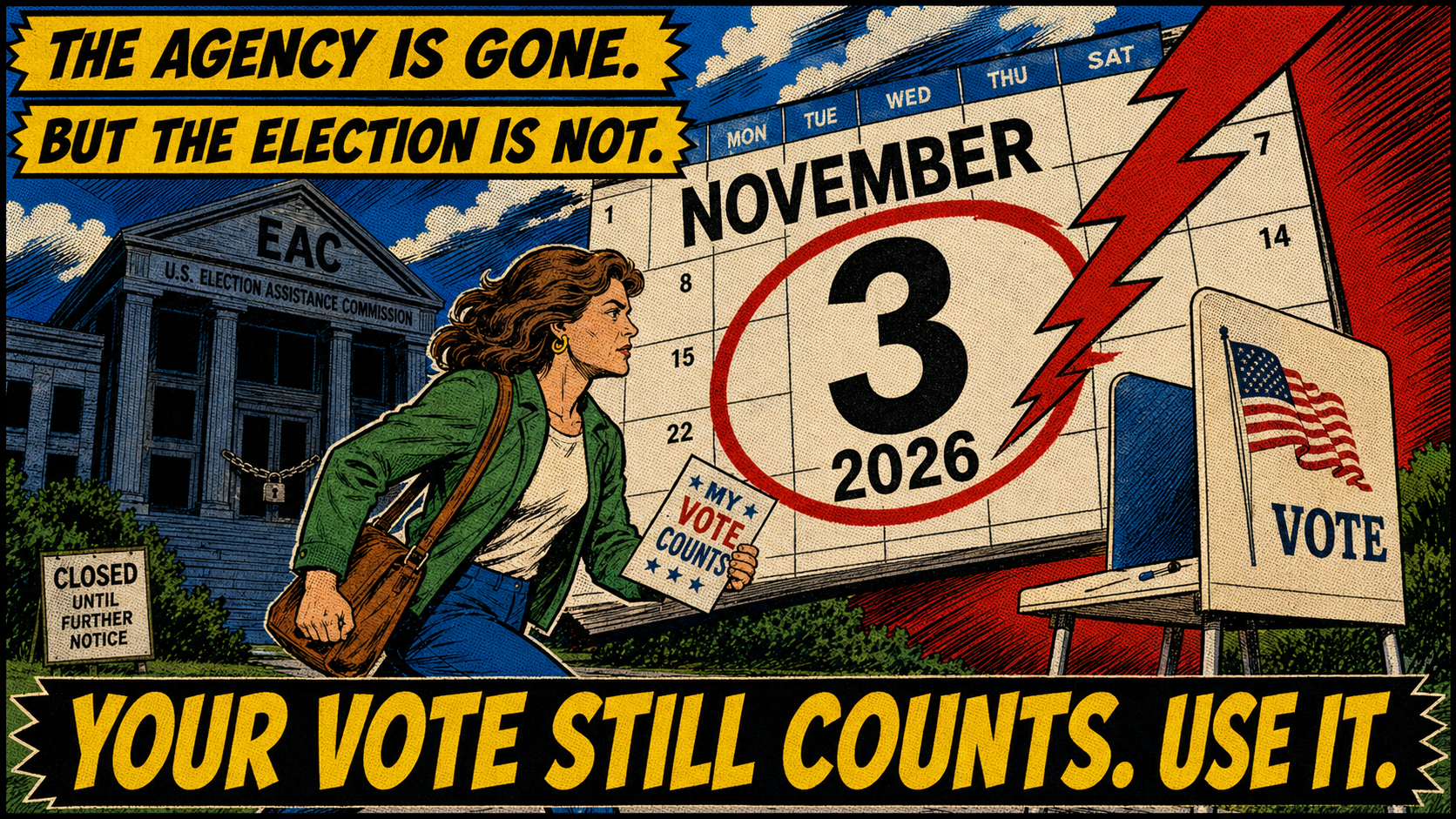
For readers following election updates in the US, the practical question is what the vacant US Election Assistance Commission means for the November 3, 2026 general election.
The most immediate operational concern flagged by election administrators is voting system certification. States that are in the process of procuring new voting equipment rely on EAC certification as a baseline standard. Jurisdictions currently in procurement processes may face delays or uncertainty if EAC staff cannot complete certification reviews without commissioner sign-off on contested questions.
The broader concern is institutional. The EAC serves approximately 10,000 local election jurisdictions across the country as a resource, a standard-setter, and a grant administrator. Its staff can continue many day-to-day functions. But its formal authority to act, to update standards, to certify new systems, and to make binding decisions is suspended until commissioners are confirmed.
The voter registration form question is the most politically charged specific issue. The Trump administration has sought to add a documentary proof-of-citizenship requirement to the national mail voter registration form since taking office. Courts blocked the executive order directing the EAC to make that change. Whether the administration will attempt to use the commission’s vacancy as an opportunity to pressure staff to act without commissioners, or whether it will pursue new legal strategies, is a live question as of this writing.
Max Flugrath of Fair Fight Action summarized the broader political concern: “Since he took office, Trump has pressured the Election Assistance Commission to change election rules to effectively implement the SAVE Act — because they can’t pass it through Congress. It’s another power grab by a desperate president who doesn’t want a fair midterm election.”
The White House frames it differently, arguing the firings are about ensuring election security and removing officials who were not aligned with the administration’s election integrity priorities.
The Bottom Line
The US Election Assistance Commission was created in 2002 because the 2000 election showed what happens when election administration is left entirely to 10,000 inconsistent local jurisdictions without federal standards, resources, or coordination. For 24 years, it has certified voting machines, distributed more than a billion dollars in security grants, maintained the national voter registration form, and served as the federal clearinghouse for election administration knowledge and best practices.
On July 9, 2026, it was left without commissioners by email. Staff will continue routine work. Grants will continue to flow. But the commission’s formal authority to act is suspended until the Senate confirms new members, a process with no guaranteed timeline. Four months before the most consequential midterm election in recent memory, the only federal agency devoted entirely to election administration is headless.
Whether that vacancy produces the “chaos” that critics predict or the “security and integrity” that the White House says it is pursuing will be determined in part by what happens in the courts, in the Senate, and ultimately on November 3 — an election that the now-vacant US Election Assistance Commission was specifically designed to help run smoothly.
References:
U.S. Election Assistance Commission. Help America Vote Act (HAVA)
U.S. Election Assistance Commission. EAC Announces First Certified Voting System to the Voluntary Voting System Guidelines (VVSG) 2.0
Just Security. What Is the Election Assistance Commission With No Commissioners?
U.S. Election Assistance Commission. EAC Announces New Federal Professional Training Certification Program for Election Officials
U.S. Election Assistance Commission. U.S. Election Assistance Commission Releases 2024 Election Administration and Voting Survey (EAVS) Report
U.S. Election Assistance Commission. Official Newsroom

- Five Myths About States Banning ICE From Polling Places - October 12, 2026
- The Secret Ballot Is Newer Than You Think, and It Took a Body Count to Get Here - October 6, 2026
- Why Is Election Day Always a Tuesday in November? - September 4, 2026