

On July 28, 2026, the Democratic Senatorial Campaign Committee announced it is spending $40 million on organizing, voter contact, and research across 10 states to try to flip the Senate. The effort is called “Win The Senate.” Republicans currently hold a 53 to 47 majority. Democrats need to flip just four seats to take control. With November 3 now 97 days away, the race for the Senate is officially on. But before we get into who is winning and who is losing, let us cover the basics. Senate elections explained simply: what the Senate is, how elections work, who can run, who gets to vote, and why any of this matters to you and your family. This is the guide to election updates in the US that nobody gave you in school.
What Is the US Senate?
According to the US Capitol Visitor Center, the Senate is one of the two chambers of Congress. The other is the House of Representatives. Together they make up the legislative branch of the federal government — the branch that writes and passes laws.
There are 100 senators. Every state gets exactly two, no matter how big or small. California has 40 million people. Wyoming has fewer than 600,000. Both get two senators. That equal representation is what makes the Senate different from the House, where bigger states have more members.
Senators serve six-year terms. That is three times longer than a House member, who serves two years. The longer term was intentional. The founders wanted the Senate to be a more deliberate, slower-moving body — a check on the faster, more reactive House
Senate Elections Explained: How the Voting Actually Works
As USAGov explains, Senate elections happen every two years alongside House elections. But here is the key thing most people do not realize: not all 100 senators are up for election at the same time.
The Senate is divided into three groups called classes. Each class is up for election in a different election cycle. That means roughly one-third of the Senate — about 33 or 34 seats — is on the ballot every two years. The other two-thirds keep their seats and are not up for election.
Why? Stability. The Capitol Visitor Center notes that staggered terms give Congress continuity and reduce the immediate pressure of public opinion on senators. Even after a wave election, two-thirds of the Senate stays in place.
In 2026, 35 Senate seats are on the ballot. Those 35 seats decide whether Republicans keep their majority or Democrats take it back.
Who Can Run for US Senate?

The rules come straight from the Constitution and they are simple. To run for Senate you must:
Be at least 30 years old
Have been a US citizen for at least 9 years
Live in the state you want to represent at the time of the election
That is it. No degree required. No political experience required. No wealth requirement. The Senate has higher age and citizenship thresholds than the House because the founders saw it as the more senior chamber. To get on the ballot, candidates go through their state’s primary election process — usually winning their party’s primary before advancing to the November general election.
Why Did the Way We Elect Senators Change in 1913?
Here is a piece of history most people never learn. Senators were not always chosen by voters.
For the first 124 years of the republic, US senators were chosen by state legislatures — the politicians in each state’s own government, not regular voters. The idea was that senators would represent the interests of the states as institutions, not the people directly.
The system became deeply corrupt. Wealthy business interests bribed state legislators to elect senators who would protect them. Senate seats were effectively bought and sold. By the early 1900s, public anger was so intense that Congress passed the 17th Amendment. As the US Senate’s own historical records show, the 17th Amendment was ratified in 1913 and required senators to be directly elected by the voters of their state. That is the system we use today.

What Does Controlling the Senate Actually Mean?
When one party controls the Senate, it controls a lot. Here is what majority control means in practice.
The Majority Leader Sets the Agenda
The Senate majority leader decides which bills come to the floor for a vote. The majority controls what senators even get to debate. Bills the majority leader does not bring to the floor simply do not get voted on, no matter how popular they are with the public.
Committee Chairs Belong to the Majority
Every Senate committee — Judiciary, Finance, Armed Services, Foreign Relations — is chaired by a member of the majority party. Committee chairs control which hearings are held, which nominees advance, and which bills move forward. Losing the majority means losing every committee chair.
The Filibuster and the 60-Vote Rule
Here is where Senate math gets complicated. Most major legislation does not just need 51 votes to pass. It needs 60. That is because of the filibuster — a procedure that allows the minority party to extend debate indefinitely on a bill, blocking a vote, unless 60 senators vote to cut off debate. That 60-vote threshold is called cloture.
With 53 Republicans right now, Democrats need 7 Republicans to join them to break a filibuster. That almost never happens on major legislation. This is why controlling the Senate does not automatically mean you can pass anything you want. You can set the agenda and confirm judges, but passing big laws still usually requires bipartisan support.
Supreme Court and Federal Judges
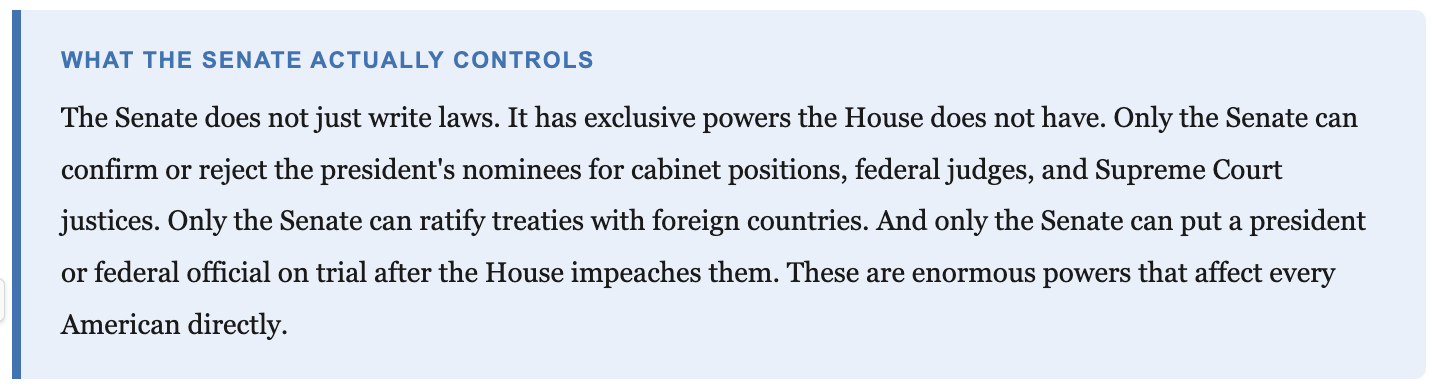
This is the most lasting impact of Senate elections. Federal judges serve for life. Supreme Court justices serve for life. Every single one requires Senate confirmation. The party that controls the Senate when a vacancy opens controls who sits on the federal bench for decades. Judicial confirmations only require a simple majority — not 60 votes — because Senate rules changed in 2013 for lower court nominees and in 2017 for Supreme Court nominees.
The Current Senate: Who Has Control and By How Much?
According to the US Senate’s official party division records, the 119th Congress (2025 to 2027) began with Republicans holding 53 seats and Democrats holding 45 seats, with 2 Independents who caucus with Democrats. That gives Republicans an effective 53 to 47 majority.
That is not a huge margin. A swing of just a few seats can flip control. Here is the simple math for November:
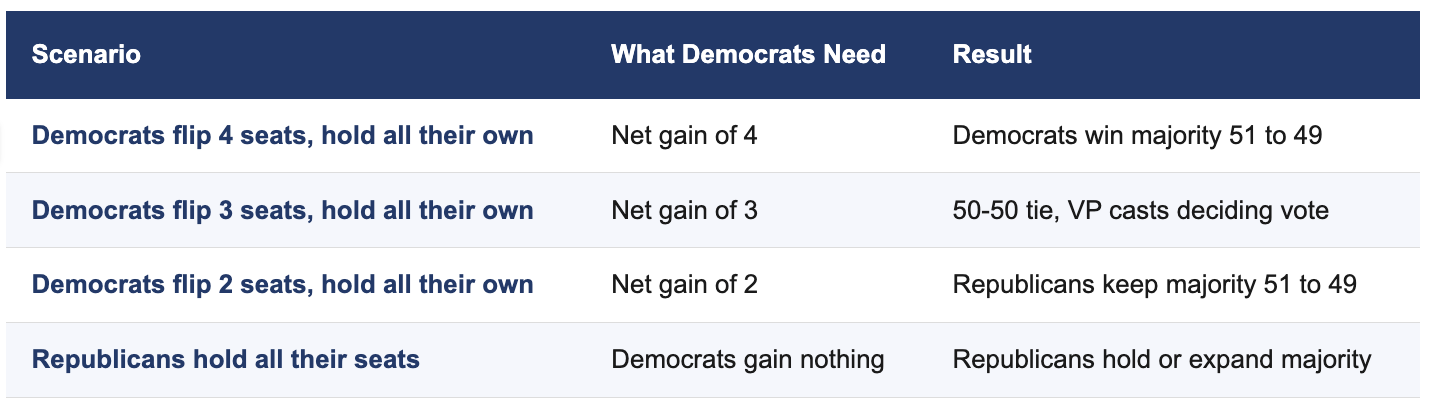
In 2026, Republicans are defending 22 of the 35 seats up for election. Democrats are defending 13. More Republican seats on the ballot means more opportunities for Democrats to go on offense.
The 2026 Senate Battleground: Where the Race Will Be Won or Lost

The DSCC’s $40 million “Win The Senate” ground game targets 10 specific states — 7 where Democrats are on offense and 3 where they are playing defense. That list tells you exactly where the battle is being fought.
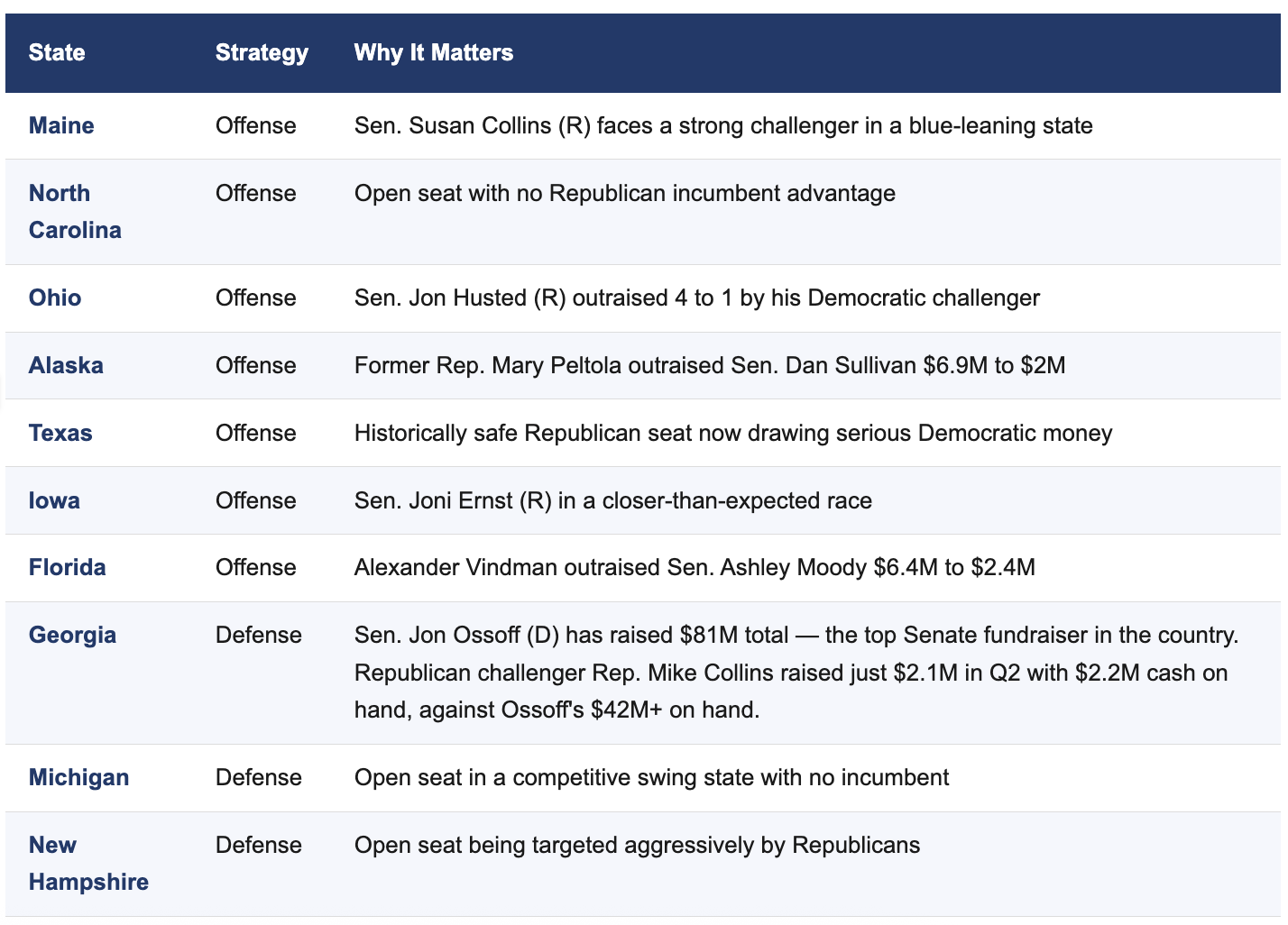
Democratic Senate candidates have raised a combined $574 million this cycle compared to $336 million for Republicans — a gap of $238 million — according to FEC filings through June 30, 2026. That fundraising advantage does not guarantee a win. But it does mean Democrats can run ads, knock on doors, and contact voters at a scale Republicans cannot match in most of these states.
What Happens When a Senate Seat Goes Empty Between Elections?
Sometimes a senator dies, resigns, or takes another job before their term ends. What happens to their seat?
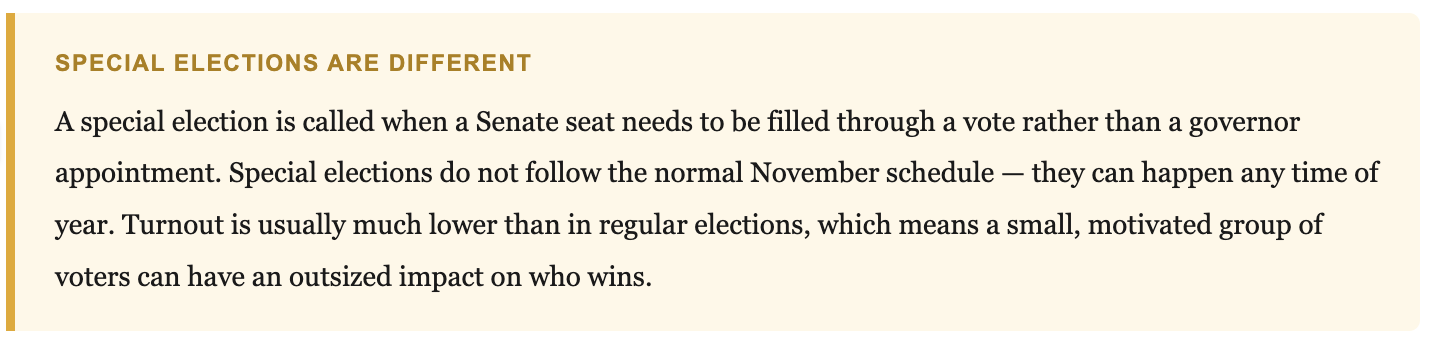
Most states allow the governor to appoint a replacement senator to serve until a special election can be held. The appointed senator does not have to belong to the same party. Some states require the governor to pick someone from the same party as the departing senator. Others give the governor complete freedom.
Recent examples: when JD Vance became Vice President in January 2025, Ohio’s Senate seat was temporarily vacant. When Marco Rubio became Secretary of State, Florida’s governor appointed a replacement. These appointments can shift the Senate’s balance of power overnight without any election.
Why Your Senate Vote Affects Your Everyday Life
A lot of people feel like Washington politics is far away from daily life. But the Senate makes decisions you feel every single day.
Your healthcare costs. The Senate votes on Medicare, Medicaid, the Affordable Care Act, and prescription drug pricing. Every major healthcare law in the past 60 years needed Senate approval.
Your taxes. Tax cuts and tax increases both go through the Senate. The 2017 tax cuts and the 2021 and 2022 spending bills all required Senate passage.
Federal judges in your state. Every federal district court judge — the judges who decide cases in your state — was confirmed by the Senate. The Senate chose those judges.
Military spending. The Senate must approve the military budget every year. Where your tax dollars go in defense spending goes through the Senate.
Immigration policy. Any changes to immigration law — visa categories, border funding, pathways to citizenship — require Senate action.
The Short Version
Senate elections explained as simply as possible: 100 senators, two per state, six-year terms, one-third up for election every two years. Republicans hold a 53 to 47 majority right now. Democrats need 4 seats to flip control. 35 seats are on the ballot November 3, 2026. Democrats just committed $40 million to a ground game across 10 competitive states.
The Senate confirms Supreme Court justices, approves treaties, tries impeachments, and shapes every major law that touches your healthcare, your taxes, and your daily life. Whoever wins the Senate majority in November controls all of that for the next two years.
That is why this is one of the most important votes you will cast this year. Keep following election updates in the US right here as the race develops over the next 97 days.
References:
U.S. Capitol Visitor Center. The U.S. Senate
USA.gov. Congressional Elections and Midterm Elections
United States Senate. Party Division Historical Records
Political Wire. Senate Democrats Spend $40 Million in Battlegrounds
Slay News. Democrats Build $238 Million Fundraising Advantage in Fight for Senate Control
Democratic Senatorial Campaign Committee. Win the Senate

- Dark Money Is Pouring Into the 2026 Midterms. Here Are Five Myths About How It Actually Works - September 21, 2026
- The Supreme Court Just Blocked Trump’s Mail Ballot Restrictions. Here’s What That Means - September 17, 2026
- What Happens If No Presidential Candidate Wins 270 Electoral Votes? - September 2, 2026