
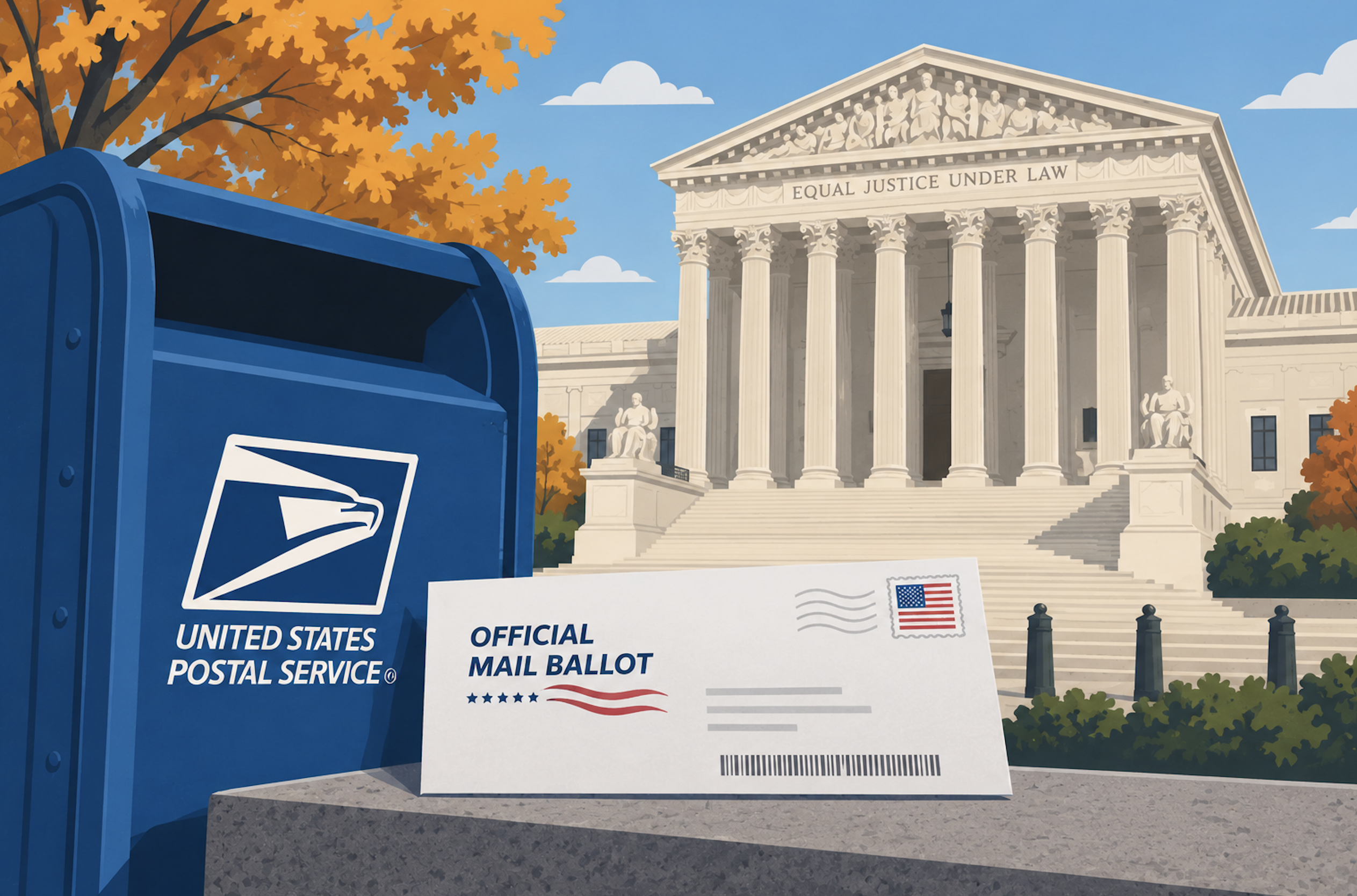
If you are planning to vote by mail this November, the ballot heading to your mailbox almost got caught in a legal fight that reached the Supreme Court with weeks to spare. On September 14, 2026, the justices declined to let the Trump administration enforce a set of new mail ballot rules for this year’s midterms, closing out a monthslong court battle that touched the Postal Service, two dozen state attorneys general, and a federal judge in Boston.
Short answer: The Supreme Court left in place a lower court order blocking the administration’s mail ballot restrictions, meaning the Postal Service will keep delivering ballots the way it always has for this year’s midterms. The ruling was about timing and process as much as the underlying policy, and the fight over the rules themselves is not over.
What did the executive order try to do?
In March 2026, President Trump signed an executive order directing the U.S. Postal Service to build a system that would only deliver mail ballots to voters whose names and addresses appeared on lists submitted in advance by state election officials, verified through a barcode printed on the ballot envelope. The administration framed it as a safeguard against noncitizens voting, though courts noted no evidence of meaningful mail ballot fraud was ever presented in the case, and independent research has consistently found that kind of fraud to be extremely rare.
What did the lower courts say?
Twenty three Democratic led states, along with voting rights groups, sued almost immediately, arguing the order exceeded the Postal Service’s authority and would create chaos this close to an election. In June 2026, U.S. District Judge Indira Talwani in Boston blocked key parts of the order, finding it likely unconstitutional. The Supreme Court briefly lifted that injunction in August on narrow procedural grounds, since the Postal Service had not yet finalized its plan. Once the agency released a detailed rulebook running nearly a hundred pages, Judge Talwani blocked it again, writing that she was unaware of any authority Congress had given the Postal Service to regulate how election mail gets handled.
What did the Supreme Court actually decide?
Ruling on its emergency docket, the Court kept Judge Talwani’s injunction in place, finding the government was unlikely to succeed on the merits of its case. The order itself was unsigned, but Justice Brett Kavanaugh wrote separately to say the Postal Service might well have the legal authority to do something like this eventually, just not with so little runway before an active election. He called rushing the plan into effect now “arbitrary and capricious.” Justices Samuel Alito and Clarence Thomas dissented. Practically, that means the Postal Service keeps delivering mail ballots as usual in states running mail elections this fall, including Alabama, North Carolina, Wisconsin, Hawaii, Oregon, and Washington.
Why did the timing matter so much?
Kavanaugh’s concurrence leaned on an idea the Supreme Court has invoked for years, often called the Purcell principle, after the 2006 case Purcell v. Gonzalez. In that case, the Court held that judges should be cautious about changing election procedures once voting is close at hand, because last minute shifts can confuse voters and undermine confidence in the results, even when the underlying legal question has merit. Purcell has usually been invoked to stop courts from altering state voting rules right before an election, and legal scholars have debated for years how far the principle should stretch. Here, the logic ran the other direction: the justices used that same wariness about late changes to block the executive branch itself from rewriting how millions of mail ballots get delivered, just weeks before voters started receiving them.
What happens next?
The legal fight over the substance of the order is still working its way through the courts, and the administration could try again after this year’s midterms with more lead time. The Council on Foreign Relations has noted that mail voting disputes like this one have become a recurring feature of recent election cycles rather than a one time event. Election officials in several Republican led states, including Utah, had also warned the plan would likely cause delays and confusion regardless of the underlying legal questions, since Postal Service systems are not built to cross reference barcodes against state voter lists on this kind of timeline.
Why this matters to voters
For anyone who requested a mail ballot this year, the ruling means nothing changes about how that ballot gets to you or how you return it. But the case is a reminder of how fragile election administration can look when major rules get contested in real time, sometimes with only weeks between a policy announcement and the ballots actually going out. Whatever you think of the underlying restrictions, the fact that the country’s mail voting system almost changed mid cycle, and then almost changed back, is exactly the kind of scenario the Purcell principle was built to prevent.
References
NPR, The Supreme Court rejects Trump’s mail voting restrictions for this year’s midterms
Votebeat, Supreme Court blocks Trump’s proposed mail ballot restrictions for 2026 election
Council on Foreign Relations, The Battle Over Mail in Voting May Disrupt the 2026 Midterm Elections
Ballotpedia, The Purcell Principle

- Dark Money Is Pouring Into the 2026 Midterms. Here Are Five Myths About How It Actually Works - September 21, 2026
- The Supreme Court Just Blocked Trump’s Mail Ballot Restrictions. Here’s What That Means - September 17, 2026
- What Happens If No Presidential Candidate Wins 270 Electoral Votes? - September 2, 2026