
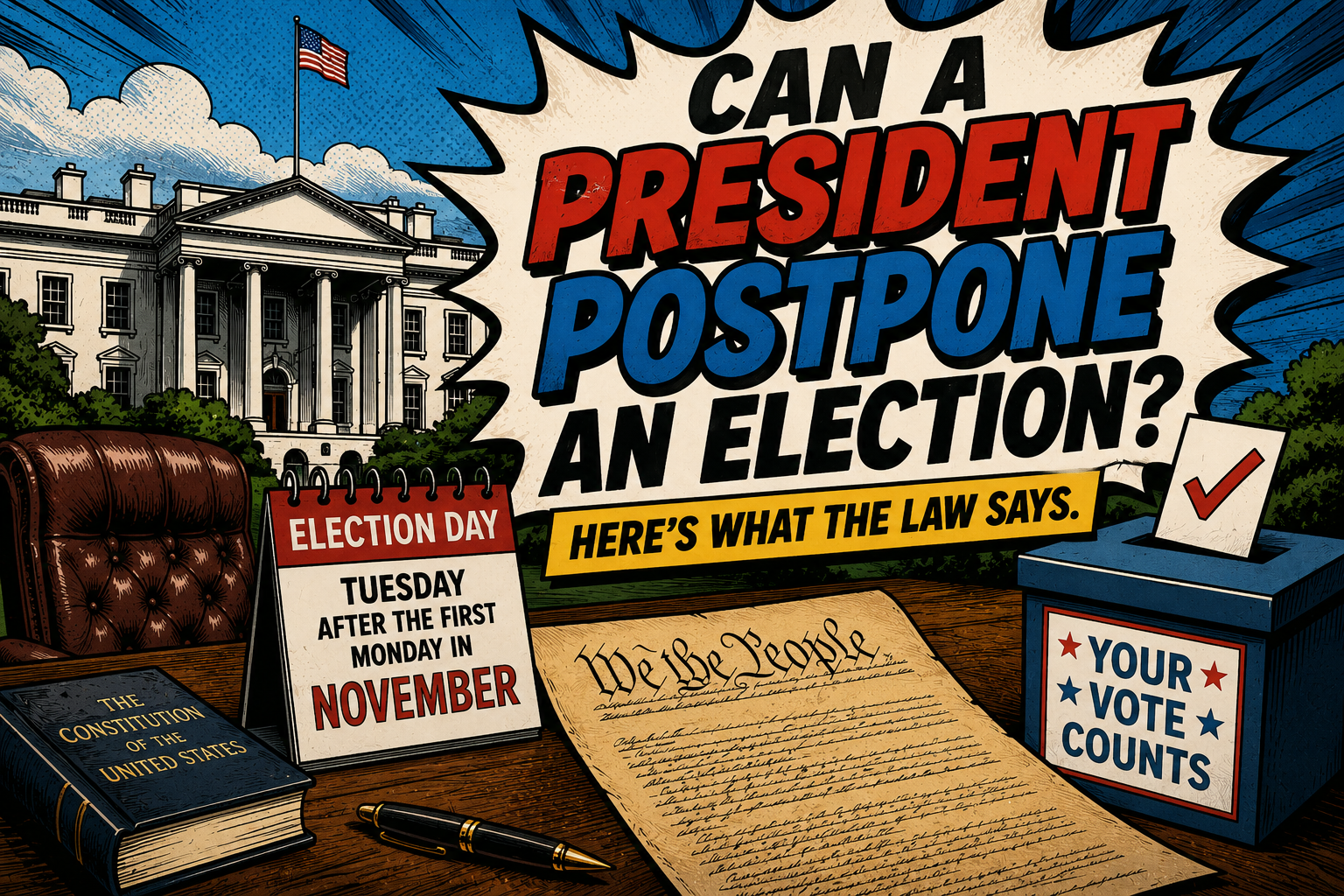
Every four years, Americans know when to expect a presidential election. Campaigns spend months preparing for it, states print millions of ballots, and voters across the country head to the polls on Election Day.
But what happens if the country is facing a major crisis?
Could a president postpone the election because of a war, terrorist attack, natural disaster, or another national emergency? Could the White House decide that conditions are simply too dangerous for Americans to vote?
The short answer is no.
A president does not have the power to cancel or postpone a presidential election on their own. The reason comes down to how federal elections are established under the Constitution and federal law.
Who actually decides when Election Day happens?
The date of a presidential election is not chosen by the sitting president. Congress established the timing of presidential elections under federal law. Election Day occurs on the Tuesday after the first Monday in November every four years.
That means Election Day can fall anywhere from November 2 through November 8. The Constitution gives Congress authority over the timing of choosing presidential electors, while states handle much of the actual process of conducting elections. You can read the federal law establishing the timing of presidential elections through Cornell Law School’s Legal Information Institute. Because the date is established by federal law, a president cannot simply sign an executive order announcing that Election Day has been moved. Congress would have to become involved.
Could Congress postpone Election Day?
Congress has significantly more authority over the timing of a federal election than the president does.
In theory, Congress could pass legislation changing Election Day. That legislation would have to make it through both the House and Senate and then be signed into law, or Congress would have to override a presidential veto. But even Congress faces an important constitutional deadline. The 20th Amendment states that the terms of the president and vice president end at noon on January 20. Moving Election Day would not automatically move that date. That creates a very limited window between the November election and the constitutionally required beginning of the next presidential term. The text of the 20th Amendment is available through the National Archives.
What if there is a national emergency?
This is where the question gets more interesting.
Presidents have broad emergency powers in certain circumstances, but declaring a national emergency does not automatically give a president the authority to postpone a federal election.
Even during an extraordinary crisis, the laws governing Election Day and the constitutional timeline for presidential terms would still matter. That does not mean an emergency couldn’t disrupt voting. A hurricane, wildfire, terrorist attack, power outage, or another emergency could make voting difficult in a particular area. States and local governments may have procedures for dealing with those situations, and courts can also become involved. But there is a major difference between responding to a local disruption and postponing a presidential election across the entire country.
CAN A NATIONAL EMERGENCY CANCEL AN ELECTION?
Not automatically. Declaring a national emergency does not give the president the power to cancel Election Day. Federal law establishes when presidential elections occur, and the Constitution establishes when presidential terms end.
Has America ever postponed a presidential election?
The United States has held presidential elections through some of the most serious crises in its history. Perhaps the most striking example came in 1864. The country was in the middle of the Civil War. Union and Confederate armies were still fighting, hundreds of thousands of Americans had already died, and the future of the country itself remained uncertain. The presidential election still happened. Abraham Lincoln defeated George B. McClellan and won a second term. Presidential elections were also held during World War I in 1916, World War II in 1944, and the COVID 19 pandemic in 2020. The circumstances surrounding each election were very different, but the country continued holding federal elections rather than allowing the sitting president to postpone them.
What about September 11?
The September 11, 2001 terrorist attacks provide an interesting example of how emergencies can affect elections at the local level. New York City was holding a mayoral primary on the morning of the attacks. Voting was already underway when the attacks occurred. New York officials postponed the primary, and voters returned to the polls later that month. But that was a state and local election being handled under state law. It did not establish a presidential power to postpone a nationwide federal election. The distinction matters because elections in the United States are not administered entirely by Washington.
What role do states play?
Although federal law establishes the date of federal elections, the actual voting process is largely administered by states and local governments. States determine many of the rules surrounding voter registration, early voting, absentee ballots, polling locations, ballot processing and election administration. That is why voting can look different depending on where you live. One state might offer weeks of early voting. Another might have different rules for requesting an absentee ballot. Even polling hours can vary. The U.S. Election Assistance Commission provides information about how elections are administered across the country. This decentralized system also means an emergency affecting one part of the country does not necessarily stop voting everywhere else.
Could an executive order change Election Day?
Executive orders can be powerful, but they have limits.
A president can use executive orders to direct agencies within the executive branch, provided the president is acting within authority granted by the Constitution or federal law. An executive order cannot simply override a federal statute passed by Congress. Because Congress established the date of presidential elections, changing that date would require more than a presidential announcement. If a president attempted to unilaterally postpone an election, the move would almost certainly face immediate legal challenges. Federal courts would then have an important role in determining whether the president had exceeded their constitutional authority.
What if the election simply couldn’t happen?
This is where things become much less straightforward. Imagine an extreme national catastrophe that prevented large portions of the country from conducting an election normally. There could be emergency legislation, state action and extensive litigation over how voting should proceed. Congress might consider changing certain deadlines. States might modify election procedures. Courts could be asked to settle disputes over ballots or voting access. But one deadline would still be approaching. January 20. The sitting president’s term does not simply continue indefinitely because an election has been disrupted. Under the Constitution, the presidential and vice presidential terms end at noon that day. If no president elect had qualified by then, federal succession laws and constitutional provisions could become extremely important.
The Presidential Succession Act establishes who may temporarily exercise presidential powers if neither a president nor vice president is able to serve. You can read more about presidential succession through the Congressional Research Service.
Could a president stay in office by canceling the election?
This is probably the biggest misconception surrounding the issue. Canceling or delaying an election would not automatically extend a president’s term. The Constitution sets the end of the presidential term independently of Election Day. At noon on January 20 following a presidential election year, the existing presidential term ends. A president cannot simply declare that because an election was delayed, they will remain president until another one can be held. Any unprecedented situation in which no successor had been selected would instead raise questions about presidential succession, Congress, the courts and the Constitution.
Why does this matter to voters?
Questions about postponing elections tend to appear during periods of national uncertainty. A war begins. A major disaster strikes. A pandemic spreads. Political tensions rise. It is understandable that voters might wonder whether the president has the authority to change the election calendar. But America’s election system intentionally divides that power. Congress establishes federal election dates. States administer elections. Courts resolve legal disputes. The Constitution establishes when presidential terms begin and end. The president plays an enormously powerful role in American government, but deciding whether the country holds a presidential election is not a decision one person gets to make. That separation of power becomes especially important during a crisis, when the rules governing elections may matter more than ever.
References:
U.S. Code, Title 3, Section 1: Presidential Election Day
National Archives: 20th Amendment to the U.S. Constitution
U.S. Election Assistance Commission: Voting and Elections
Congressional Research Service: Presidential Succession
Congress.gov: Constitution Annotated, Presidential Elections
National Archives: Electoral College
Global News: Can a President Delay a U.S. Election?

- Five Myths About How the Electoral College Actually Works - September 29, 2026
- Why Does the President’s Party Almost Always Lose Seats in the Midterms? - September 9, 2026
- Why Is Congress Racing to Fund the Government Before the Midterms? - August 31, 2026