
Sometime in the last year, you may have noticed a strange thing happening in state capitols: legislatures redrawing congressional district lines in years that don’t end in a “2.” Texas did it. California answered. Then a Supreme Court ruling set off a chain reaction across the South. If you’ve been trying to follow the redistricting fights ahead of the 2026 midterms and found yourself lost somewhere between “gerrymandering” and “Voting Rights Act,” this one’s for you.
The short answer: yes, mostly. There’s no federal law that says a state can only redraw its congressional map once per decade. That’s just been the tradition. What’s actually limiting states isn’t a calendar — it’s the Constitution, the Voting Rights Act, and a patchwork of state rules that vary wildly depending on where you live. 2025 and 2026 turned into a real-time stress test of exactly how far those limits stretch.
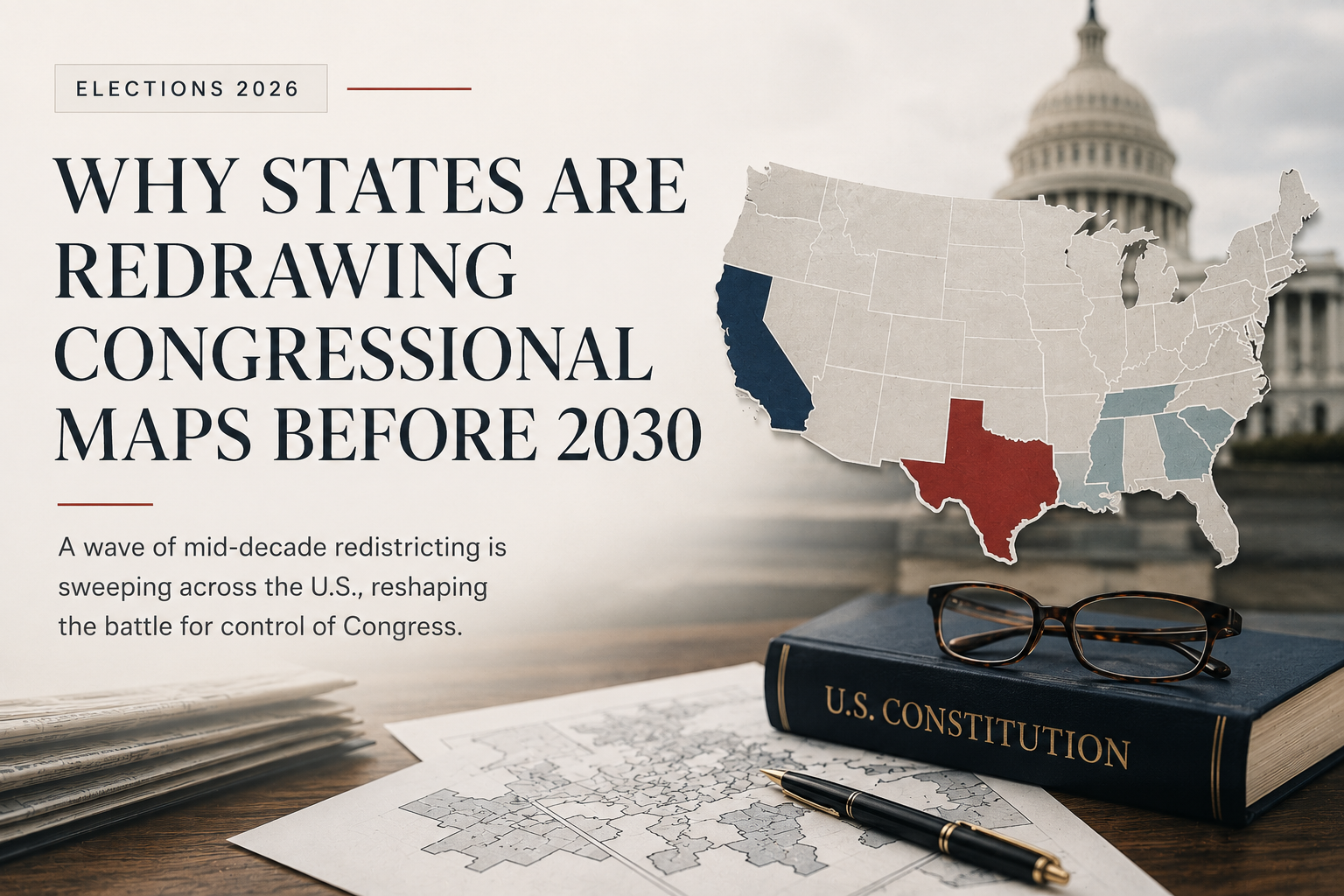
How redistricting is supposed to work
The Constitution requires a census every ten years, and states use that fresh population count to redraw congressional districts so each one has roughly the same number of people. That’s the whole reason redistricting is a “once a decade” habit — not a rule, a rhythm. Article I, Section 4 hands the actual mechanics to state legislatures, subject to Congress’s power to override them, and courts have long held that a state can redraw its map more than once in a decade if it wants to. It just almost never wants to, because doing so is expensive, politically risky, and invites lawsuits.
What kicked off the 2026 fight: Texas
In the summer of 2025, the Justice Department sent Texas a letter arguing that four of its congressional districts — drawn back in 2021 and home to large Latino populations represented by Democrats — were unconstitutional “racial gerrymanders.” Governor Greg Abbott called a special legislative session to redraw the map. Texas Democrats, lacking the votes to stop it, left the state to deny the legislature a quorum, a tactic Texas Democrats have used before. It didn’t work for long: Republican lawmakers eventually passed a new map (88–52 in the House, 18–11 in the Senate), and Abbott signed it on August 29, 2025. The new lines were designed to hand Republicans up to five additional U.S. House seats.
The court battle: struck down, then revived
Texas’s new map didn’t survive its first legal test. On November 18, 2025, a federal judge, Jeffrey Brown, ruled that the map was in fact an illegal racial gerrymander under Section 2 of the Voting Rights Act, writing that “substantial evidence shows that Texas racially gerrymandered the 2025 map.” He ordered the state to use its older 2021 map for 2026 instead.
That victory for Texas Democrats was short-lived. The Supreme Court’s conservative majority stepped in and allowed the new, Republican-favorable map to be used for the 2026 elections anyway — even while acknowledging the lower court’s finding that it was “likely” a racial gerrymander. The move highlighted something important about how these fights actually get resolved in an election year: courts are often less concerned with settling the underlying legal question than with avoiding last-minute changes to election rules, a concept known as the Purcell principle (more on that below).
California’s answer: Proposition 50
Texas’s move didn’t stay a one-state story for long. California Democrats, led by Governor Gavin Newsom, put a countermeasure directly to voters: Proposition 50, a ballot measure letting the legislature temporarily bypass the state’s independent redistricting commission and adopt a new map designed to net Democrats up to five additional seats. Voters approved it in a special election on November 4, 2025.
Notably, an earlier draft of Prop. 50 included “trigger” language that would have undone the measure if Texas or Florida backed off their own redistricting — a kind of mutually-assured-restraint clause. Lawmakers stripped that language once it became clear Texas was moving forward regardless. California Republicans and the Trump administration’s Justice Department have since challenged Prop. 50 in court on similar racial-gerrymandering grounds; as of this writing, that case remains unresolved.
The bigger shockwave: the Supreme Court and the Voting Rights Act
While the Texas–California fight played out, a separate and much larger case was moving through the courts: Louisiana v. Callais, argued before the Supreme Court in October 2025. At issue was whether Louisiana’s congressional map — which included a second majority-Black district — relied too heavily on race to satisfy the Voting Rights Act.
The Court’s eventual ruling weakened the legal protections that had, for decades, encouraged states to draw “majority-minority” districts to comply with the VRA. Practically, that gave states far more room to redraw maps without those protections standing in the way — and several did, almost immediately.
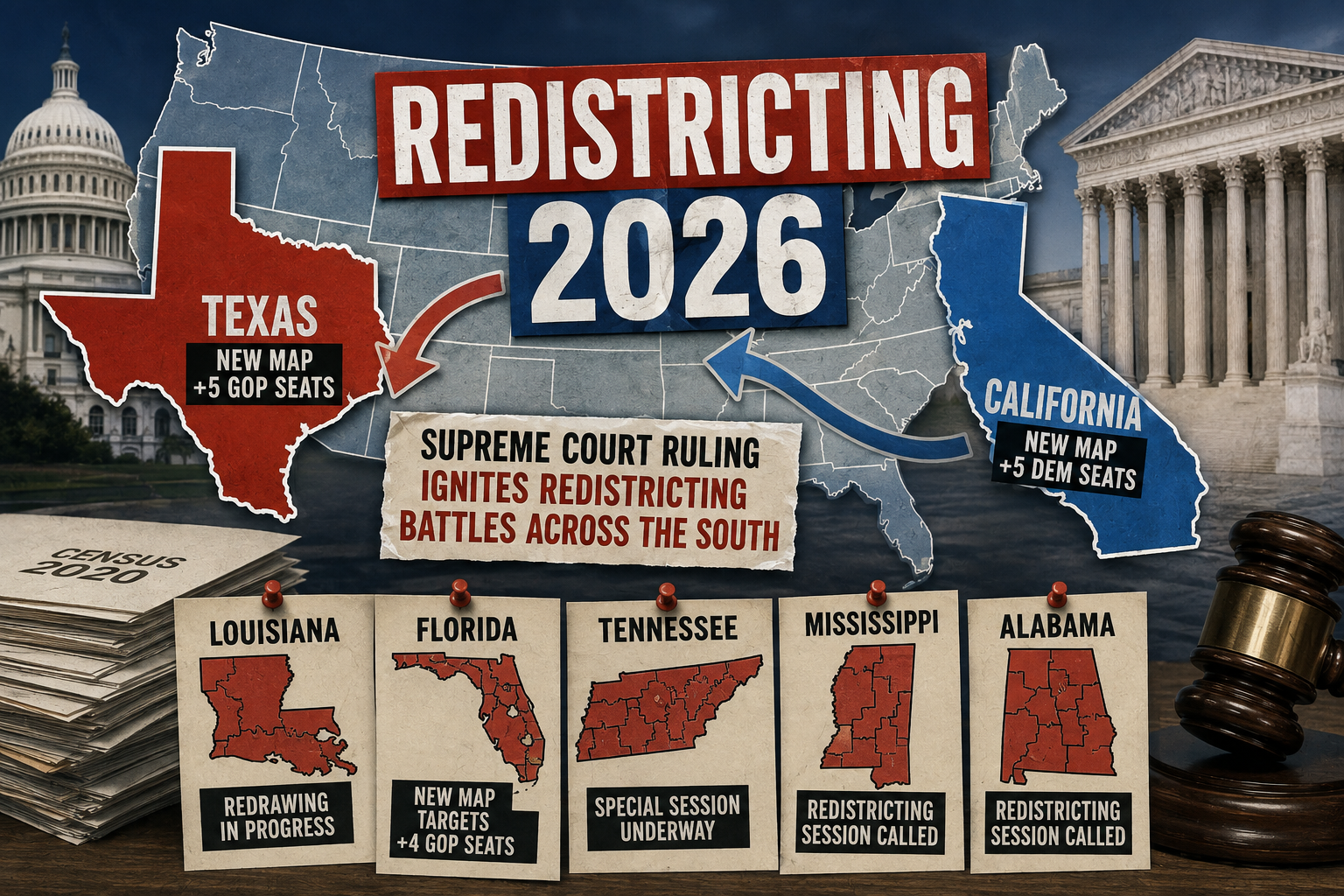
The Southern redistricting cascade
Within days of the ruling, a handful of states announced their own mid-decade redraws:
Louisiana suspended its scheduled primaries and moved to redraw its map, with analysts projecting the state could pick up one to two additional Republican-leaning seats.
Florida‘s legislature passed a new map championed by Governor Ron DeSantis, targeting four additional Republican seats.
Tennessee called a special session, with one proposal going as far as eliminating the state’s only Democratic-held seat.
Mississippi and Alabama each called their own sessions to consider similar changes.
Taken together, analysts estimate Republicans could net somewhere in the range of a dozen additional seats nationally from this whole cycle of redraws, with Democratic-leaning states like California clawing back a smaller number in response. Nothing about that math is final — several of these maps are still tied up in litigation, and courts could yet order changes before ballots are printed.
Is any of this actually legal? A quick history lesson
It’s worth remembering this isn’t entirely new. Texas itself pulled off a mid-decade redistricting once before, in 2003, under then-House Majority Leader Tom DeLay — a move that also drew a legislative walkout by Democrats and years of litigation in a case that reached the Supreme Court as League of United Latin American Citizens v. Perry. The Court left most of that map intact. In other words, the tools being used in 2025 and 2026 aren’t new inventions; they’re a rerun of a two-decade-old playbook, now spreading to more states at once and colliding with a Supreme Court that has been steadily narrowing the Voting Rights Act’s reach.
The main legal guardrails that still apply: maps can’t intentionally dilute a racial group’s voting power in violation of the Fifteenth Amendment, and courts are generally reluctant to let any election rule change — map, deadline, or procedure — take effect too close to an election under the Purcell principle. That second guardrail is precisely why the Supreme Court let Texas’s map stand for 2026 even amid unresolved legal questions: with primaries approaching, justices were wary of ordering a switch back to old lines at the last minute.
What this means heading into November
If you live in Texas, Louisiana, Florida, Tennessee, Mississippi, Alabama, or California, there’s a real chance your congressional district looks different in 2026 than it did in 2024 — not because your address changed, but because the lines around it did. Some of these maps could still be redrawn again if pending lawsuits succeed, so it’s worth double-checking your district and polling place closer to Election Day rather than assuming last cycle’s map still applies.
Why this matters to voters
It’s tempting to read all of this as an inside-baseball story about state legislatures and court dockets, but the stakes are direct: district lines determine which communities get grouped together, which votes carry more or less weight in deciding a seat, and ultimately which party holds the U.S. House majority in January 2027. The redistricting wars of 2025 and 2026 are, in a real sense, part of the election itself — decided months before a single vote is cast.
None of this means elections are being “rigged” in the sense of votes not counting; every one of these maps has gone through some combination of a legislature, a governor’s signature, a ballot measure, or a court, and most remain open to further legal challenge. But it’s a useful reminder that the shape of American elections isn’t fixed for a decade at a time — it’s negotiated, litigated, and occasionally rewritten in real time, right up until the votes are cast.
Watch: Why Mid Decade Redistricting Exploded
YouTube video link
References:
Mid-Decade Congressional Redistricting: Key Issues — Congressional Research Service, Congress.gov
Redistricting ahead of the 2026 elections — Ballotpedia
2025 California Proposition 50 — Ballotpedia
Court Rejects Texas’ Mid-Decade Map, California’s Redraw Unaffected — Governing
After Texas Ruling, Trump and Republicans Head to 2026 With a Redistricting Edge — NPR
Gerrymandering, the Supreme Court, and the 2026 Midterm Elections — Council on Foreign Relations

- A Supreme Court Case You Probably Missed Could Open the Door to a Lot More Election Lawsuits - October 9, 2026
- Dark Money Is Pouring Into the 2026 Midterms. Here Are Five Myths About How It Actually Works - September 21, 2026
- The Supreme Court Just Blocked Trump’s Mail Ballot Restrictions. Here’s What That Means - September 17, 2026