
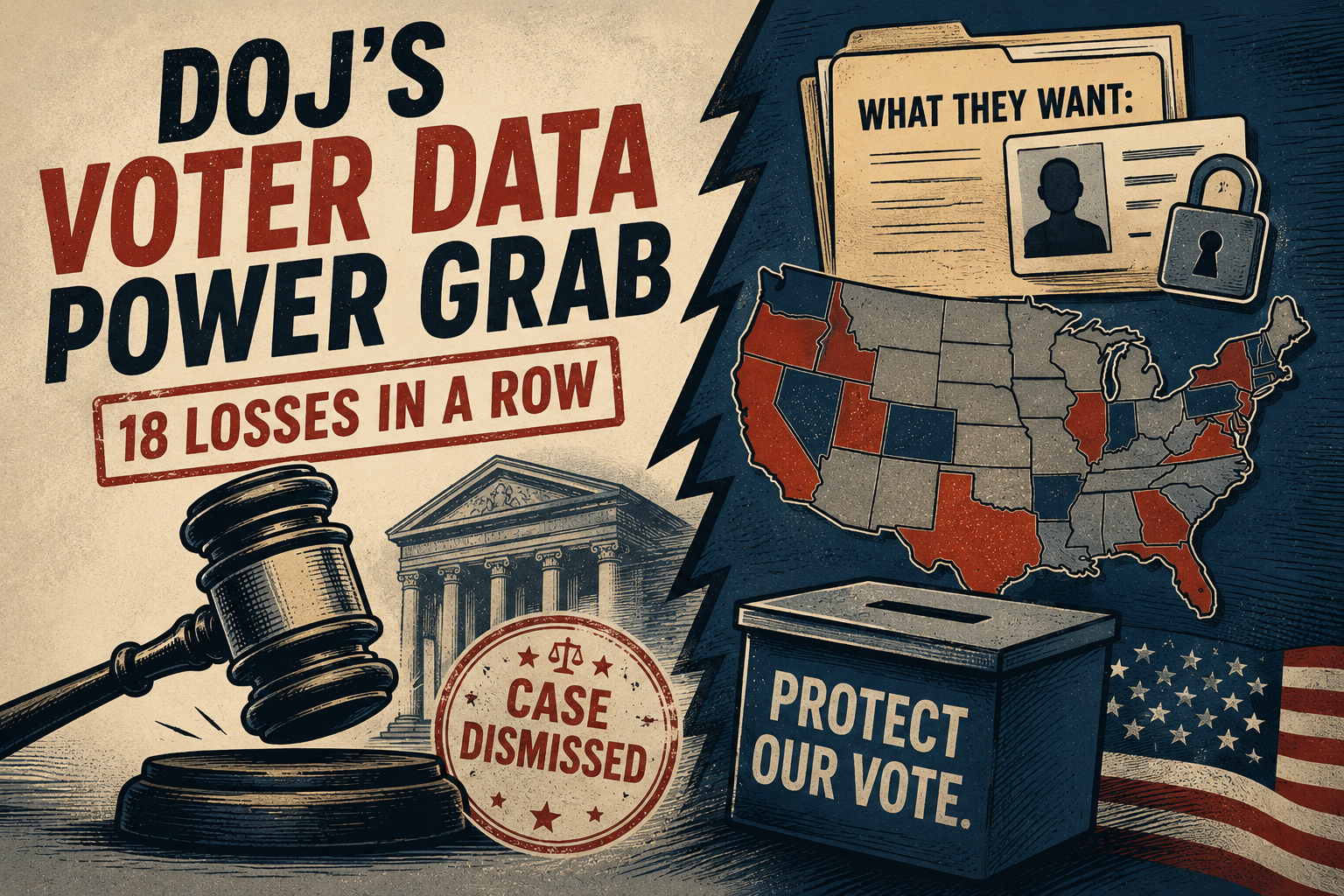
In July 2026, New Jersey Governor Mikie Sherrill refused a Justice Department demand for personal data on roughly 6,600 people who had been mistakenly added to the state’s voter rolls through a software glitch, people the state itself had already caught and was working to remove. The Justice Department sued anyway. On July 23, a federal judge threw the case out. That single dismissal was not an isolated event. It was the eighteenth loss in a row for the Justice Department in a sprawling, nationwide legal campaign to obtain state voter data, a campaign that by August had grown to lawsuits against 30 states and Washington DC, with 23 of those cases already dismissed.
The short answer: the Justice Department is trying to obtain full, unredacted state voter registration data, most states are refusing or offering only limited public information, and federal judges have sided against the Justice Department in almost every ruling so far.
What the Justice Department is actually asking for
Since May 2025, the Trump administration’s Justice Department has contacted nearly every state in the country, at least 48 plus Washington DC, requesting complete statewide voter registration lists. These are not the ordinary public voter files that campaigns and researchers already have access to. The requests include sensitive identifiers like driver’s license numbers and partial Social Security numbers, and in some cases have extended to full copies of ballots from past elections, records tied to the 2020 election, and even direct access to voting equipment.
The department’s stated legal basis is Title III of the Civil Rights Act of 1960, which Attorney General Pamela Bondi’s office has argued grants the Attorney General broad authority to demand the production and inspection of state election records. Assistant Attorney General Harmeet Dhillon has framed the effort as fulfilling the department’s duty to protect election integrity, with officials describing the goal as identifying improper registrations by cross checking voter rolls against other databases.
Why courts keep ruling against the DOJ
The pattern in these rulings has been remarkably consistent. In the New Jersey case, Judge Zahid Quraishi found that Title III’s language covers records that already came into an election official’s possession, not the live, continuously updated computerized databases that states maintain today, an interpretation the Justice Department’s demand did not fit. He also found the department’s reading conflicted with existing federal election laws that actually require states to keep updating their voter lists rather than freezing them for federal inspection.
Beyond that specific statutory question, judges in multiple jurisdictions, including a Sixth Circuit Court of Appeals panel reviewing a Michigan case, have pointed to a broader constitutional principle: the Constitution’s Elections Clause gives states the primary authority to run their own elections, with the federal executive branch limited to specific, narrow roles rather than open ended oversight of state voter files.
Not every state has said no
The response has not been uniform. Roughly 16 states, including Alabama, Florida, and Texas, have provided or agreed to provide complete voter files with sensitive identifiers included. Most others have handed over only the publicly available version of their voter rolls, the kind already open to campaigns and the press, or refused the request outright. A smaller group of states occupies an odd middle ground: Mississippi, South Dakota, and Tennessee reportedly provided data but declined to sign the confidentiality agreement the Justice Department wanted attached to it, leaving the legal status of how that data can be used somewhat unsettled.
A law with an ironic history
There is a notable historical wrinkle in all of this. Title III of the Civil Rights Act of 1960, the statute the Justice Department is now citing to demand state voter data, was originally written to help federal investigators uncover racial discrimination in voter registration across the Jim Crow South, giving the department tools to expose states that were illegally blocking Black citizens from registering to vote. Six decades later, the same statute is now the legal basis for a federal effort that a number of states argue amounts to federal overreach into their own voter files, a genuine role reversal in how the law is being used, whatever one makes of the current dispute on its merits.
Why this matters to voters
If your state is one of the roughly 30 currently being sued, or one of the 16 that already agreed to hand over sensitive data, this fight is not abstract. Voter registration files that include driver’s license numbers and Social Security information are exactly the kind of records identity thieves want, and every additional copy sitting with a new federal agency, especially one whose confidentiality terms some states have declined to sign, is another place that data could eventually leak from. Whatever you think about the Justice Department’s stated goal of catching improper registrations, the practical question hanging over this fight is a simple one: once your personal data leaves your state’s hands, who is actually responsible for keeping it safe.
Watch:
References
Trump DOJ loses bid for New Jersey voter rolls, now 0 for 18 (Democracy Docket)
Tracker of Justice Department Requests for Voter Information (Brennan Center for Justice)
DOJ’s Voter Roll Lawsuits: A Primer (Holtzman Vogel)

- The Supreme Court Is About to Decide a Major Voter Roll Case. Here Is the Timeline That Got Us Here - September 24, 2026
- Why Poll Workers Are Disappearing, And What It Means for Election Day - September 14, 2026
- Why Is the Justice Department Suing States Over Voter Rolls, and Why Does It Keep Losing? - August 28, 2026