
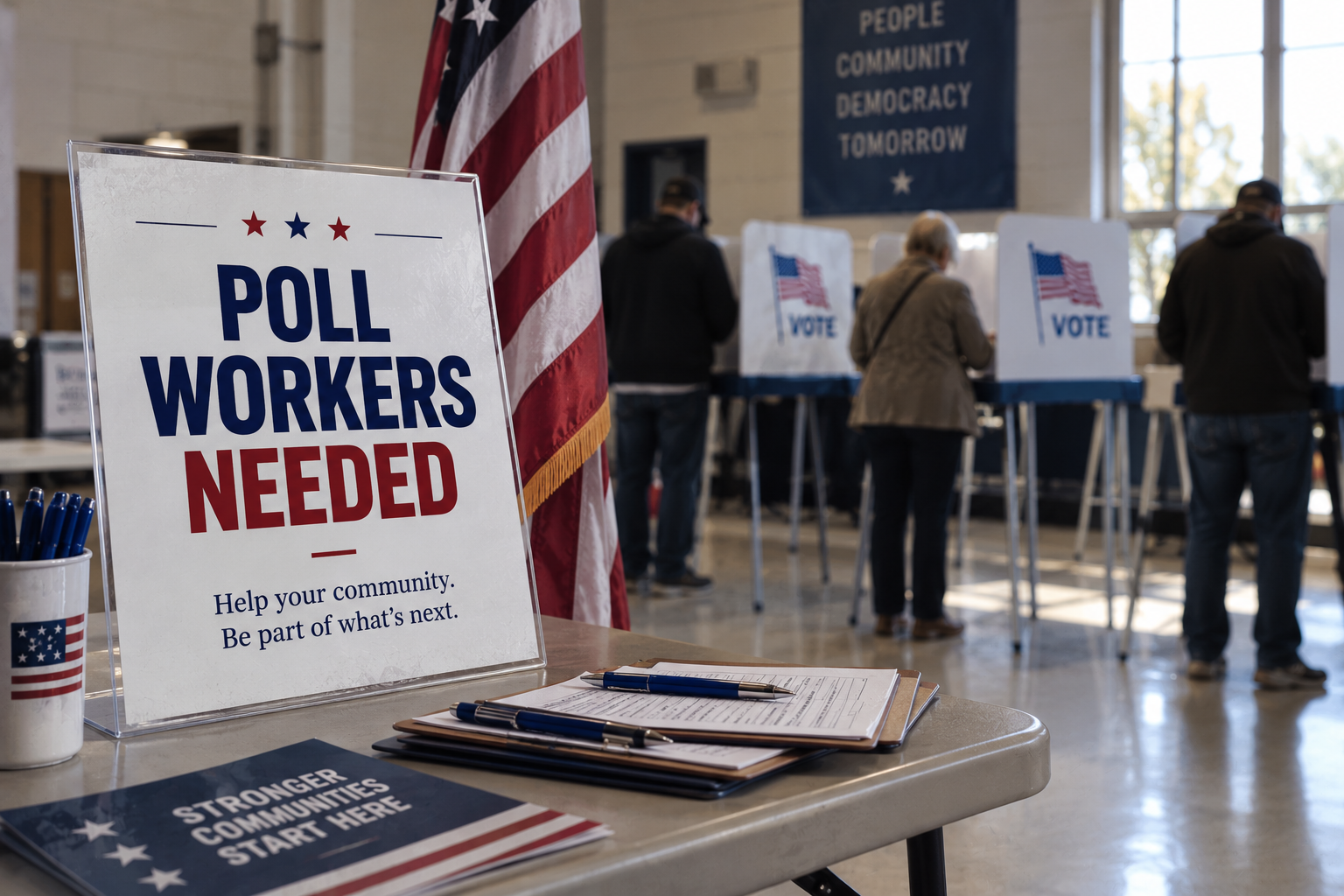
The person who checks you in at your polling place, hands you a ballot, and helps you troubleshoot the scanner when it jams is almost never a career bureaucrat. Most poll workers are your neighbors: retirees, teachers on a day off, college students earning a stipend. It is one of the few civic jobs an ordinary citizen can just sign up for. But in county election offices across the country, the people who used to fill those seats are quietly disappearing, and that has real consequences for how smoothly your polling place runs this November.
Short answer: Yes, many election offices are dealing with a genuine poll worker shortage, driven less by apathy than by burnout, threats, and harassment aimed at election staff since 2020. Recruitment campaigns are underway nationwide ahead of the 2026 midterms, but officials say the underlying safety concerns have not gone away.
What does a poll worker actually do?
Poll workers are the temporary, hourly staff who run individual polling locations on Election Day: checking in voters, issuing ballots, operating voting machines, and closing out the site at night. They are distinct from full time election administrators, like county clerks or election directors, who manage the process year round. According to the U.S. Election Assistance Commission, roughly 900,000 poll workers are needed nationwide in a typical general election, and counties have to recruit and train nearly all of them fresh for every cycle.
How bad is the shortage, really?
It depends on the county, but the data on the people above poll workers, the full time local election officials who recruit and train them, points to a serious retention problem. A Brennan Center for Justice analysis found that roughly one in eight local election officials nationwide had started their job only after the November 2020 election, and researchers estimated the country was losing experienced election officials at a rate of about one and a half people per day in the years that followed. When the people running the show turn over that quickly, the volunteers and part time staff underneath them lose institutional knowledge and mentorship too.
A more recent Brennan Center survey of election officials, conducted between late January and late February 2026, found that 32 percent had personally experienced threats, harassment, or abuse related to their job, and more than half worried that ongoing intimidation would make it harder to recruit or retain workers going forward. Three quarters said their state or local government had not stepped in to replace federal security funding that had been cut.
Why are people actually leaving?
Ask election officials directly and the answer usually is not pay, though the hourly wages for poll workers are modest almost everywhere. It is the atmosphere around the job. Since the contested 2020 election, local election workers have reported being followed home, having their addresses posted online, and receiving threatening calls and messages, often rooted in false claims about voting machines or ballot counting. The Brennan Center survey found half of respondents worried about political leaders interfering with their work, and nearly as many feared politically motivated investigations into how they did their jobs. For a role that used to attract retirees looking for a low stress way to serve their community, that kind of exposure is a hard sell.
What is being done about the shortage?
Recruitment has become its own seasonal campaign. The EAC urged Americans to sign up as poll workers as part of its Help America Vote Day push in January 2026, and county associations across the country marked National Poll Worker Recruitment Day in mid August to get ahead of the November midterms. Both major parties have also built out their own volunteer and poll watching operations this cycle, though those efforts are aimed at partisan election observation rather than the nonpartisan staffing counties need.
On the protection side, Congress has repeatedly tried and failed to pass dedicated safeguards. The Election Worker Protection Act, reintroduced in the current Congress after earlier versions stalled in 2022 and 2023, would fund grants for recruiting and training poll workers, shield their personal information from public records requests, and create federal penalties for threatening or intimidating election staff. It has not advanced to a floor vote in any of its previous forms.
Has the federal government ever stepped in like this before?
There is a real historical precedent for Washington intervening to protect the people who run elections, and it goes back to Reconstruction. After the Civil War, white supremacist groups like the Ku Klux Klan used violence and intimidation to keep Black voters and the officials overseeing their registration away from the polls across the South. In response, Congress passed the Enforcement Acts of 1870 and 1871, the second of which is often called the Ku Klux Klan Act, making it a federal crime to interfere with someone’s right to vote or to conspire against election officials carrying out their duties. Those laws gave federal prosecutors and, at times, federal troops the authority to intervene when local authorities would not or could not protect voters and poll workers themselves. It was an extreme response to an extreme threat, but it established a durable legal principle: that protecting the people who administer elections is itself a matter of national interest, not just a local staffing problem.
Why this matters to voters
A poll worker shortage does not just affect the people behind the check in table. Understaffed polling places mean longer lines, later opening times, and newer workers who are less familiar with troubleshooting equipment or handling provisional ballots correctly. In the tightest races this fall, that kind of friction can shape how confident voters feel about the process, even when nothing has actually gone wrong. If you have ever wondered whether you are qualified to help, the honest answer is probably yes: most counties will train you, pay you for the day, and count you as one more experienced pair of hands for the next election after this one.
References
U.S. Election Assistance Commission, Poll Worker Resources for Election Officials
GovTrack, Text of S. 2124: Election Worker Protection Act of 2025

- What Is Actually Happening in France Right Now, and Why It Matters for the Race to Replace Macron - October 19, 2026
- How a 1971 Supreme Court Case Still Decides Who Makes Your Local Ballot - October 14, 2026
- The Supreme Court Is About to Decide a Major Voter Roll Case. Here Is the Timeline That Got Us Here - September 24, 2026