
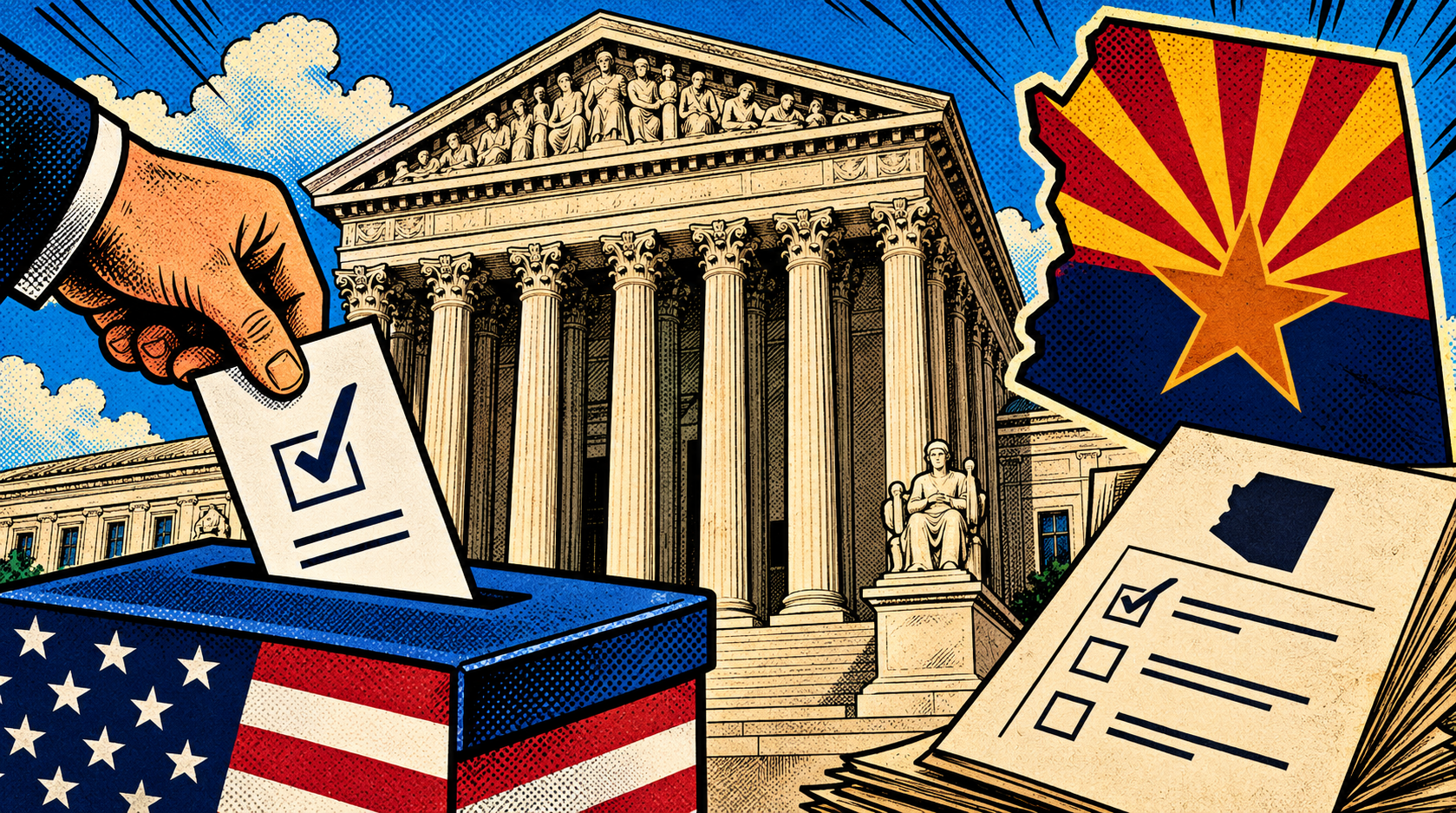
A Supreme Court case with a name most voters have never heard, Republican National Committee v. Mi Familia Vota, is on track to decide how aggressively states can verify citizenship and purge voter rolls nationwide. It did not arrive at the Court overnight. The path runs through a decades old federal law, two Arizona statutes, eight consolidated lawsuits, and a 26 state legal brief filed just this week. Here is how it unfolded.
1. 1993: Congress passes the law at the center of the fight
The National Voter Registration Act, often called the Motor Voter Act, required states to offer voter registration at motor vehicle offices and set rules for how states maintain their voter rolls. One provision at the heart of today’s case says states must finish any systematic removal program at least 90 days before a federal election, a deadline meant to prevent last minute purges from sweeping up eligible voters by mistake.
2. 2018: Arizona agrees to a consent decree
Years before the current fight, Arizona settled an earlier legal dispute over its voter registration practices through a consent decree, a court approved agreement limiting how the state could verify citizenship on registration forms. That agreement becomes important later, since it is one of the things a federal judge would eventually say Arizona’s new laws violated.
3. 2022: Arizona passes two new laws
Governor Doug Ducey signed HB 2492 and HB 2243. The first requires election officials to reject state voter registration forms that lack documentary proof of citizenship, such as a passport, birth certificate, or driver’s license number tied to citizenship status. The second requires monthly checks against noncitizen databases and allows the state to cancel a registration on suspicion of noncitizenship, with 35 days notice before the cancellation takes effect.
4. 2022 to 2023: Eight lawsuits and counting
Voting rights groups including Mi Familia Vota and Voto Latino, along with the Democratic National Committee and the Department of Justice, filed a wave of lawsuits arguing the new laws violated federal law and the state’s own prior settlement. The cases were consolidated in front of a single federal judge in Arizona.
5. 2023: A federal judge strikes down both laws
U.S. District Judge Susan Bolton ruled that both HB 2492 and HB 2243 violated the National Voter Registration Act as well as the 2018 consent decree, blocking the state from enforcing either law as written.
6. February 2025: The Ninth Circuit agrees
A panel of the U.S. Court of Appeals for the Ninth Circuit upheld Judge Bolton’s ruling, finding that Arizona’s citizenship paperwork requirement made its state registration form legally unequal to the standard federal form, and that the state’s monthly purge checks ran headlong into the NVRA’s 90 day quiet period.
7. June 29, 2026: The Supreme Court steps in
The justices agreed to hear the case, setting up a ruling that could either affirm the lower courts’ reading of the NVRA or open the door for Arizona, and potentially other states, to enforce stricter citizenship verification and more frequent voter roll purges.
8. September 2026: Twenty six states weigh in
Just this week, Alabama Attorney General Steve Marshall led a brief signed by 26 states urging the Court to side with Arizona and the Republican National Committee, arguing the NVRA actually permits states to verify citizenship and remove ineligible voters at any point, including close to an election. The brief argues that allowing noncitizens to remain on the rolls, even briefly, dilutes the votes of eligible citizens.
9. What happens next
No oral argument date or ruling has been announced yet, but the timing puts this case on a path to be decided sometime after the 2026 midterms are already underway or complete, meaning this year’s elections in Arizona and elsewhere will likely proceed under the current, lower court rulings regardless of how the Supreme Court eventually rules.
Why this matters to voters
Whichever way the Supreme Court rules, the decision will not stay confined to Arizona. More than a dozen states have floated or passed similar documentary proof of citizenship requirements in recent years, and the outcome here will settle whether the 90 day quiet period in a 1993 law still means what courts have said it means for the past three decades. For any voter who has ever wondered why a registration got flagged or a name got dropped from the rolls without explanation, this is the case quietly deciding the rules behind that process.
References
U.S. Department of Justice, Civil Rights Division, The National Voter Registration Act of 1993
SCOTUSblog, Republican National Committee v. Mi Familia Vota

- The Supreme Court Is About to Decide a Major Voter Roll Case. Here Is the Timeline That Got Us Here - September 24, 2026
- Why Poll Workers Are Disappearing, And What It Means for Election Day - September 14, 2026
- Why Is the Justice Department Suing States Over Voter Rolls, and Why Does It Keep Losing? - August 28, 2026