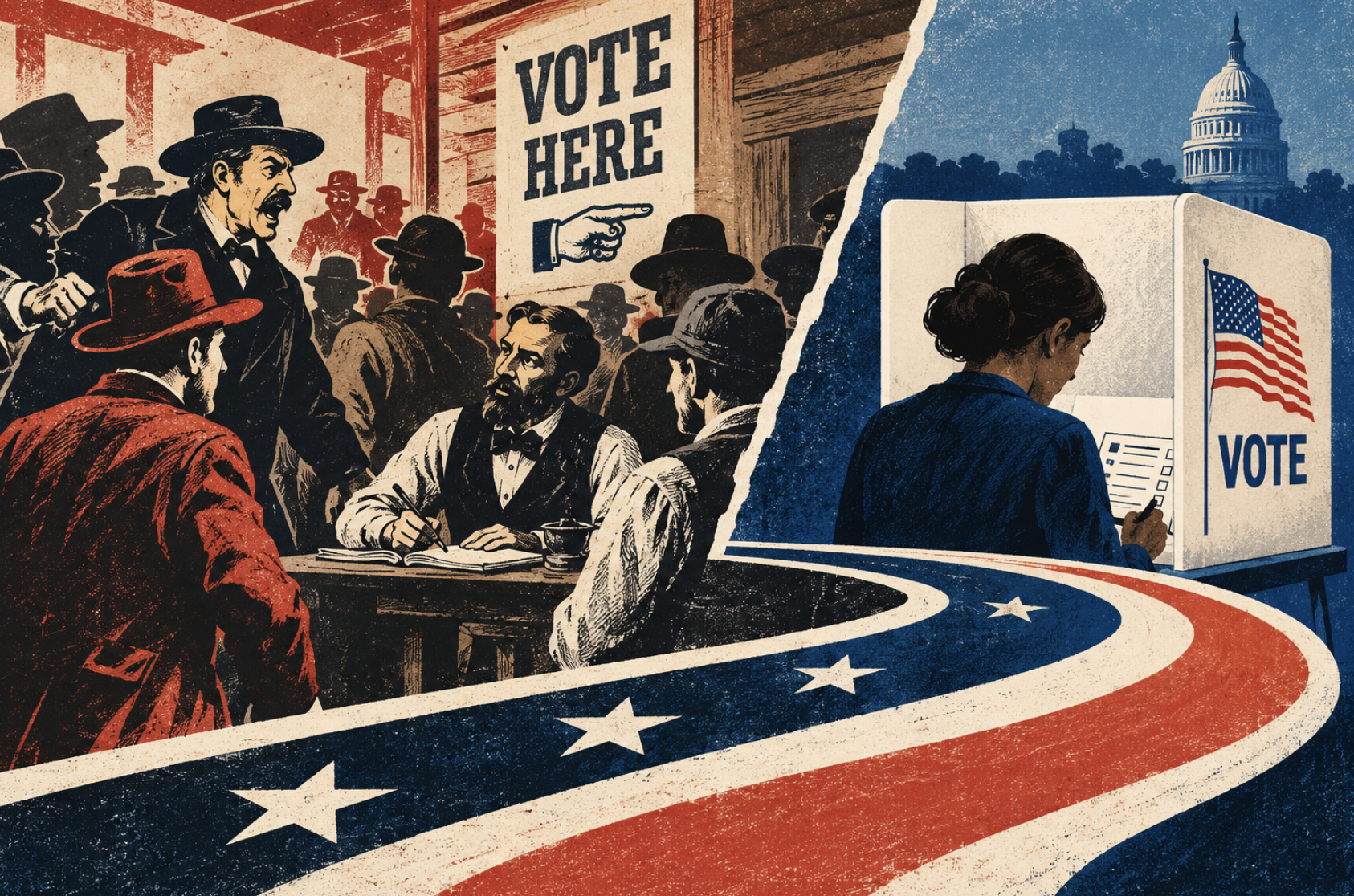
Walk into any polling place today and you will find a small curtained booth, or at least a quiet corner, where no one can see how you mark your ballot. That privacy feels like a basic, permanent feature of voting in America. It is not. For most of the nineteenth century, American elections were conducted almost entirely in public, and the fight to change that cost real money, real elections, and in some documented cases, real lives.
Before the 1880s, there was no such thing as an official, government printed ballot in most of the country. Political parties printed their own tickets, already filled in with their slate of candidates, often in a distinct color so everyone around you could see at a glance which party’s ticket you were carrying to the polls. In Kentucky and a handful of other places, voters did not even need paper. They simply announced their choice out loud to an election clerk, a method called viva voce voting, with their vote recorded publicly for anyone in earshot. Polling places themselves were often just a table in a saloon or a private home, with little separation between the officials, the party agents working the crowd, and the voters trying to get through.
That openness was not a quirky inconvenience. It was a business model for corruption. Since everyone could see which ticket you carried or hear which name you called out, parties could verify exactly how you voted, which made buying votes straightforward and effective. It also made intimidation easy. Party operatives would crowd polling places to steer voters toward their ticket and block rivals from reaching the ballot box at all, sometimes with fists, knives, or guns. Historians who have tallied election day violence in this era have documented dozens of deaths nationwide tied directly to polling place conflicts in the decades before reform took hold.
The model for a fix came from, of all places, Australia, where the colonies of Tasmania, Victoria, and South Australia had already adopted government printed, privately marked ballots in 1856. American reformers imported the idea decades later, and Louisville, Kentucky became the first American city to try it, with the new ballot system drafted by local reformer Lewis Naphtali Dembitz. Massachusetts went further in 1888, becoming the first state to fully adopt what came to be called the Australian ballot, printed by the government rather than the parties, listing every candidate on one shared form, and marked privately in a dedicated space. A contested, uncomfortably close 1884 presidential election had already put the issue on the national agenda, and once Massachusetts proved the system worked, states adopted it in a rush. Within a few years most of the country had followed, and Kentucky itself finally abandoned oral voting in 1891.
Not every state moved at the same pace, and the reform did not always arrive clean. South Carolina held out until 1950 before fully adopting government printed ballots, decades behind the rest of the country. In parts of the South, the shift toward marking a ballot privately also arrived alongside literacy tests, which required voters to read and complete election materials entirely on their own, without assistance. For voters who had been denied an education, often former slaves and their descendants who had been barred by law from learning to read before the Civil War, that combination of secrecy and a literacy requirement became another tool of disenfranchisement rather than a straightforward privacy protection. Congress eventually outlawed literacy tests nationwide through the Voting Rights Act of 1965.
Why this matters to voters
The booth you step into today exists because an earlier generation decided that watching people vote, and punishing or rewarding them for it, was incompatible with a functioning democracy. That principle is now so built into how Americans think about elections that most voters never have to consider the alternative. But the uneven, sometimes exploited rollout of ballot secrecy is also a reminder that a reform meant to protect voters can be applied unevenly, or even turned against the people it was supposed to help, depending on what rules get attached to it along the way.
References
Atlas Obscura, Voting Booths Were a Radical 19th Century Reform to Stop Election Fraud
Literacy Mid South, The Ballot or the Book: Literacy Tests as a Tool of Voter Disenfranchisement