
In June 2026, Washington, D.C. held its first-ever ranked-choice primary, and local reporters noted something unusual: candidates were complimenting each other on the debate stage instead of tearing each other down. That’s not an accident, it’s how the voting method is designed to work. But zoom out to the national picture and the story gets messier: while D.C. and a possible Michigan ballot measure are expanding ranked-choice voting, five states have banned it outright since 2024. This is a live fight, not a settled question, and it’s worth understanding both the mechanics and the politics behind it.
The short answer: it’s genuinely both.
Ranked-choice voting is growing in some places and getting outlawed in others, often for the same underlying reason, it changes who wins, and that makes it politically inconvenient for whoever it would have hurt.
How ranked-choice voting actually works
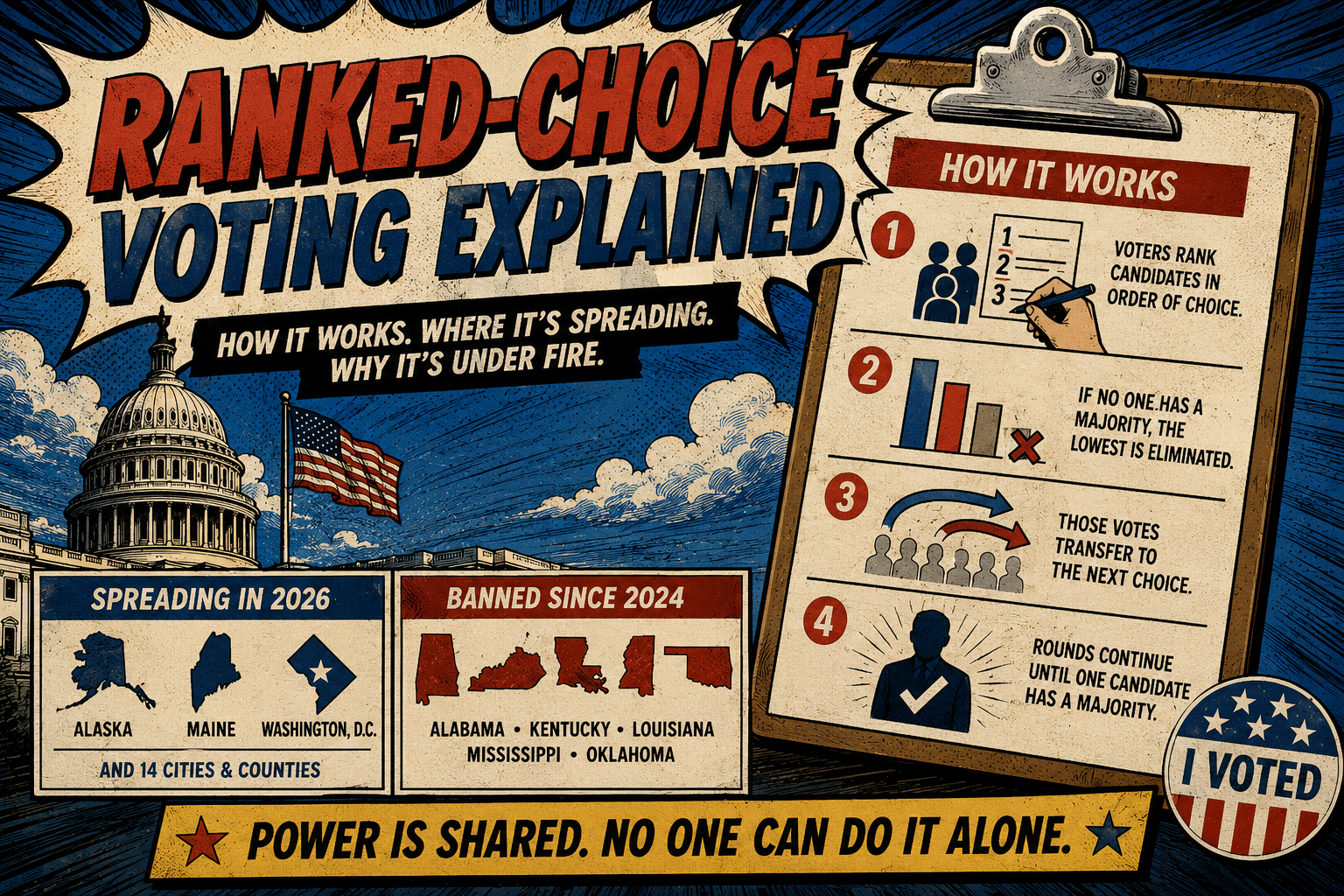
Instead of picking just one candidate, voters rank candidates in order of preference, first choice, second choice, and so on. If one candidate wins a majority of first-choice votes outright, the election ends there, same as always. If nobody clears 50%, the candidate with the fewest first-choice votes is eliminated, and everyone who ranked that candidate first has their vote automatically shift to their next choice. That process repeats, round by round, until one candidate has a majority.
The pitch is straightforward: voters can support a longshot or third-party candidate as their first choice without “wasting” their vote or accidentally helping the candidate they like least, the so-called spoiler effect. Winners, in theory, need broader support across the electorate rather than just a plurality within their own base.
Where it’s actually used in 2026
According to FairVote’s tracking, 17 cities, counties, and states are using ranked-choice voting in 2026. Two states use it for major federal and state races: Alaska (U.S. Senate, House, governor, and legislature) and Maine (U.S. Senate and House). Washington, D.C. joined this year after voters approved it with more than 72% support in 2024, also opening primaries to unaffiliated voters for the first time. A dozen cities and three counties round out the list, including Oakland, San Francisco, and Berkeley in California, Portland in both Maine and Oregon, and Arlington County in Virginia.
The 2024 backlash — and why it happened
Ranked-choice voting had a rough November in 2024. Voters rejected new RCV measures in Colorado, Idaho, Nevada, and Oregon. Missouri went further and approved a statewide ban on the system (with a carve-out for St. Louis’s existing municipal use). In Alaska, a measure to repeal the state’s ranked-choice system, adopted just a few years earlier, came within 664 votes of succeeding, one of the closest statewide results in the country that year.
Partly in response to those close calls and to a couple of high-profile Republican losses in Alaska and Maine races decided by ranked-choice tabulation, five states – Alabama, Kentucky, Louisiana, Mississippi, and Oklahoma – preemptively banned ranked-choice voting in 2024, even though none of them were using it. Political scientist Chandler James, quoted by Governing, summed up the mood: “voters this year were reluctant to make dramatic changes to the way they vote,” though he cautioned that doesn’t necessarily mean the method is fading, its use had majority support in the counties already using it, including the Portland, Oregon area.
Michigan’s 2026 push — and the countermove
The next big test may be Michigan. A grassroots group called Rank MI Vote is trying to put a statewide ranked-choice voting amendment on the 2026 ballot, covering most federal and statewide races. The state’s Board of Canvassers approved the proposal’s language on June 27, 2026, but the group still needs to collect at least 446,198 valid signatures within six months to qualify.
Opponents, organized under the banner “Stop RCV,” argue the system is confusing for voters and slower and costlier for election administrators to tabulate. Michigan’s Republican-controlled state House has moved in the opposite direction, introducing legislation in July 2026 to ban ranked-choice voting statewide before the ballot measure can even reach voters, a preemptive strike similar to what happened in the five states that banned it in 2024 without ever using it.
This isn’t actually new
If any of this feels like déjà vu, it should. The United States tried a close cousin of ranked-choice voting — proportional representation using a single transferable vote, in more than 20 cities in the first half of the 20th century, starting with Ashtabula, Ohio in 1915. New York City used it for City Council elections from 1937 to 1947, a period historians point to as the system’s high-water mark nationally. Nearly all of those cities eventually repealed it, and the pattern of repeal is familiar: the method tended to help minor parties and independent candidates win seats they otherwise couldn’t, which mobilized the entrenched party machines it displaced to organize against it — often successfully, sometimes within just a few election cycles. The current wave of adoption and backlash is, in that sense, a rerun of a century-old argument about who wins when the counting method changes.
The actual case for and against
Supporters argue ranked-choice voting produces majority winners, reduces negative campaigning (candidates need second- and third-choice votes from their rivals’ supporters, so attacking those rivals too harshly can backfire), and lets voters express real preferences without strategic voting. Maine and D.C.’s 2026 primaries, where candidates reportedly complimented each other on stage, are often cited as evidence this dynamic is real, not just theoretical.
Critics counter that the system is harder to explain to voters, can produce “exhausted ballots” (when a voter’s ranked choices are all eliminated before a winner is determined, effectively removing their vote from the final count), and takes longer to tabulate, a real logistical cost for election offices, especially in close races where every round of elimination needs to be verified. Whether those trade-offs are worth it is, at bottom, a values question rather than a factual one, which is part of why the fight keeps recurring rather than settling.
Why this matters to voters
If you live in Alaska, Maine, D.C., or one of the cities and counties using ranked-choice voting, your ballot this year may look different from what you’re used to, and it’s worth learning how to fill it out correctly, an improperly ranked ballot is usually still counted, but skipping the mechanics can mean your later choices don’t get used the way you intended. If you live in Michigan, whether or not you’ll be asked to rank your ballot in future elections could be decided by whichever side, the ballot initiative or the legislature’s ban, moves first. And wherever you live, this fight is a useful reminder that voting rules aren’t neutral background facts: how votes get counted shapes who wins, which is exactly why both sides care so much about it.
How does ranked choice voting work? DC’s new 2026 election ballot explained | 4 More Context
Local news explainer specifically about D.C.’s 2026 rollout — the same first-RCV-primary moment the article opens with.
References:
The 2026 Elections and Ranked Choice Voting — FairVote
What’s the Future of Ranked Choice Voting After Tough Election Setbacks? — Governing
Alaska’s ranked choice repeal measure fails by 664 votes — Alaska Public Media
2024 Alaska Ballot Measure 2 — Ballotpedia
2026 Ballot Measures — Ballotpedia

- Five Myths About States Banning ICE From Polling Places - October 12, 2026
- The Secret Ballot Is Newer Than You Think, and It Took a Body Count to Get Here - October 6, 2026
- Why Is Election Day Always a Tuesday in November? - September 4, 2026