
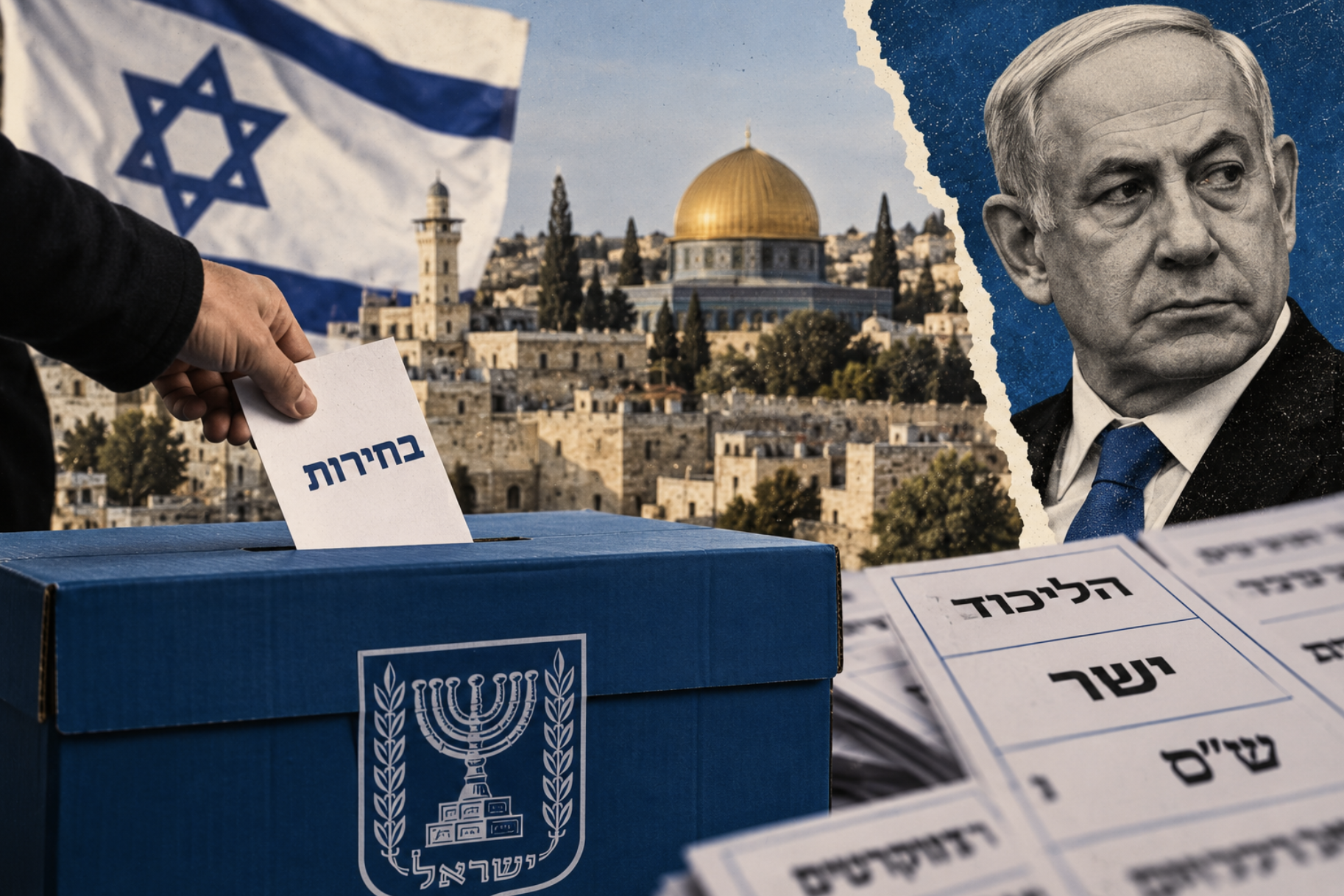
On October 27, roughly 7.3 million eligible Israeli citizens will vote in the country’s sixth national election since 2019, and its first in nearly four decades to arrive at the natural end of a full parliamentary term rather than an early collapse. It is also the first general election since the Hamas led attacks of October 7, 2023, and the wars in Gaza and against Hezbollah in Lebanon that followed, which makes this vote, more than most, a referendum on the leadership that steered the country through that period.
If you are used to American ballots, the mechanics of this election will look almost nothing like what you are familiar with. Israelis do not vote for individual candidates or for representatives of a specific district, because Israel has no electoral districts at all. Voters choose a single party, and the country’s 120 seat parliament, the Knesset, gets divided up in direct proportion to each party’s share of the national vote. A party needs at least 3.25 percent of the vote just to win any seats, which is why smaller parties frequently merge into joint lists before an election rather than risk falling short and losing their votes entirely. No single party has ever won a majority on its own, so after the votes are counted, the real contest begins: parties get 28 days, extendable by two more weeks, to negotiate a coalition controlling at least 61 seats. If nobody can build one, the country votes again.
That coalition math is unusually uncertain this year. Prime Minister Benjamin Netanyahu, Israel’s longest serving leader, is running for another term while standing trial on corruption charges he denies. His Likud party is polling roughly even with a new centrist nationalist party called Yashar, led by former military chief of staff Gadi Eisenkot, which several recent polls have put narrowly ahead. Neither Netanyahu’s bloc of right wing and religious parties nor the loose opposition coalition built around Yashar and other centrist and left leaning parties currently appears positioned to reach 61 seats outright, meaning smaller parties, including Arab led parties that most mainstream politicians on both sides have ruled out governing with, could end up holding outsized leverage over who actually forms the next government.
Several issues are driving the vote beyond the basic question of who leads the country next. There has still been no independent government inquiry into the security failures that preceded the October 7 attacks, something most opposition parties are campaigning on and Netanyahu has resisted. A long running fight over military draft exemptions for ultra Orthodox men remains unresolved after Israel’s Supreme Court struck down the exemptions. Netanyahu’s earlier push to limit the Supreme Court’s own power, shelved for now, remains a live and divisive issue. And the economic strain of a defense budget that has roughly doubled since 2023 is weighing on a public also dealing with a high cost of living. Netanyahu separately faces an arrest warrant from the International Criminal Court over the conduct of the Gaza war, which he has rejected as illegitimate.
Why this matters to voters
You do not need any particular view on Israeli politics to find the mechanics of this election genuinely instructive. A system built entirely around proportional representation, with no districts, a party only vote, and a mandatory multi party coalition negotiation after every election, produces a fundamentally different kind of government than the American system does, one where minor parties can win real influence and governments routinely include four, five, or more parties stitched together after the fact. Watching how Israel’s results translate into an actual governing coalition over the coming weeks is a useful real time comparison for anyone curious what elections look like in a democracy built on different assumptions than ours about what a vote is actually supposed to produce.
References
Al Jazeera, Israel’s elections 2026 explained in maps and charts
ABC News Australia, Israelis are heading to the polls in their most seismic election in decades

- Israel Votes This Week in an Election Unlike Anything on a U.S. Ballot - October 23, 2026
- Minimum Wage in the US: Which States Pay More in 2026? - May 12, 2026