
Minimum Wage in the US: Which States Pay More in 2026?
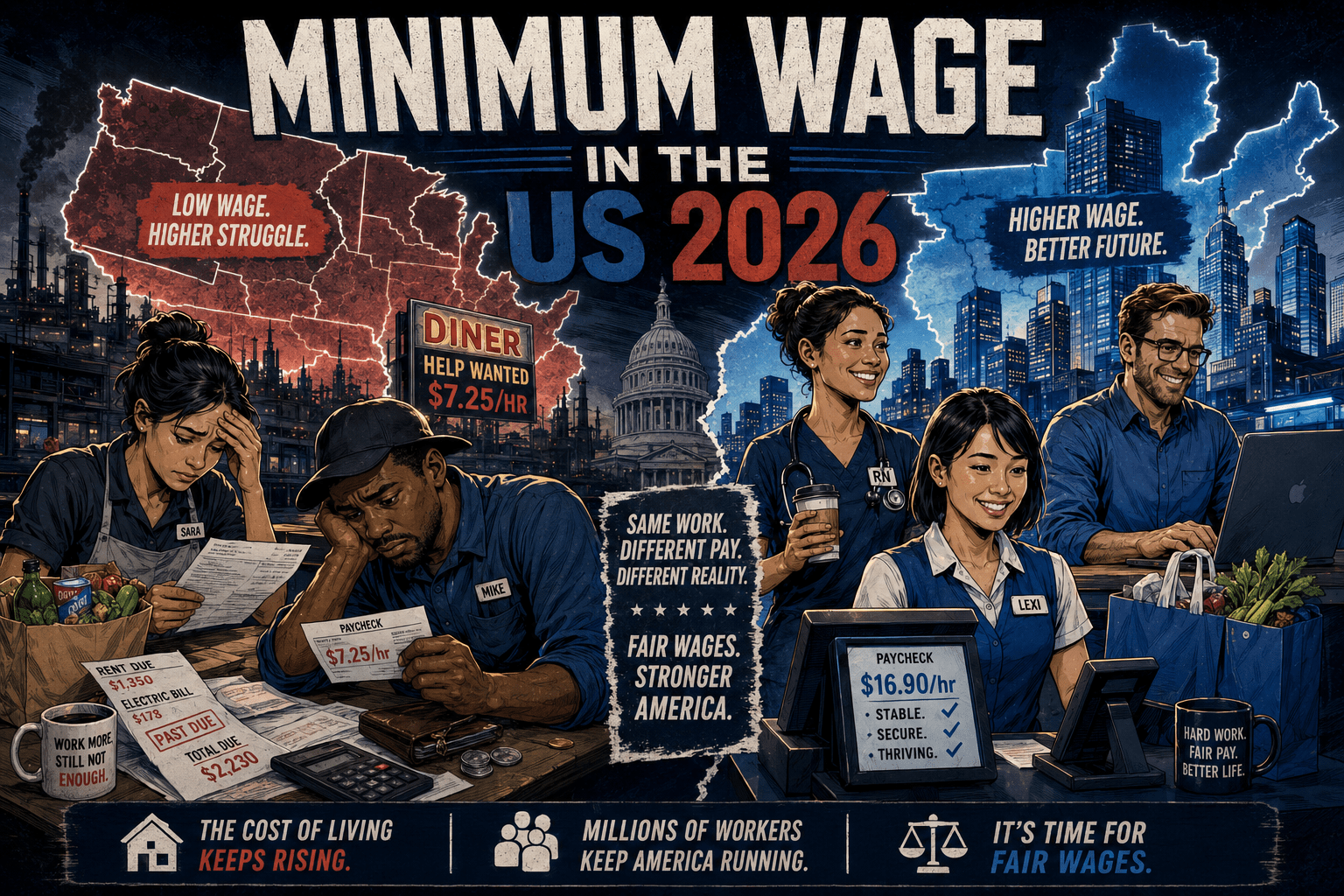
The minimum wage in the US has been a flashpoint in American policy debates for decades — but in 2026, it has become something more: a direct issue on the ballot. Across the country, several states have minimum wage measures tied to their 2026 election cycles, and the gap between the federal floor and what states actually pay has widened to a level that’s hard to ignore. From Washington D.C.’s $17.95 per hour down to the federal floor of $7.25 per hour still applied in more than a dozen states, the divide tells a story about economics, politics, and what it means to work a full-time job in America today.
This article explains the federal law behind minimum wage, how states have responded, which jobs are most affected, what the real earnings look like for workers at the bottom of the wage scale, and why — heading into the 2026 midterms — this remains one of the most politically consequential economic issues in the country.
The Law Behind the Minimum Wage: The Fair Labor Standards Act
The legal foundation of the minimum wage in the US is the Fair Labor Standards Act (FLSA), signed into law by President Franklin D. Roosevelt on June 25, 1938. According to the U.S. Department of Labor, the FLSA established three core worker protections that remain in effect today: a federal minimum wage, overtime pay requirements, and a ban on oppressive child labor.
When the FLSA was enacted, Congress set the minimum wage at $0.25 per hour, with a gradual increase to $0.40 per hour by 1945. The law was created in response to conditions the Roosevelt administration described plainly: one-third of the American population was “ill-nourished, ill-clad, and ill-housed.” Congress found that a small number of employers paying substandard wages were pulling wages down across entire industries by producing goods at lower costs — creating a race to the bottom that federal law was designed to stop.
Since 1938, Congress has raised the federal minimum wage 22 times through 10 separate amendments to the FLSA. The most recent increase was enacted through legislation signed in 2007 and took effect in three steps, reaching $7.25 per hour on July 24, 2009. That rate has not changed since.
The FLSA sets a wage floor for covered, nonexempt employees. As USAGov explains, when both a state and federal minimum wage apply to a worker, the higher of the two rates governs. States may set their own minimum wages above the federal rate — and many have — but no covered employer may legally pay less than the federal minimum. The Department of Labor’s Wage and Hour Division enforces FLSA compliance. Tipped employees may be paid as little as $2.13 per hour in federal law, but the combined total of tips and base pay must reach at least $7.25 per hour — or the employer must make up the difference.
Why the Federal Minimum Wage Has Been $7.25 Since 2009
The federal minimum wage increase by state trend masks a fundamental fact: the federal baseline hasn’t moved in over 16 years. Research from Virginia Commonwealth University’s Research Institute for Social Equity (RISE) found that if the federal minimum wage had kept pace with productivity growth, it would have reached approximately $25.52 per hour by 2024 — more than three times the current rate.
The freeze is not accidental. The FLSA does not include automatic inflation or cost-of-living adjustments. The federal minimum wage changes only when Congress passes and the president signs legislation amending the FLSA. Since 2009, multiple bills have proposed increases — including the Raise the Wage Act, which proposed a $17 per hour federal floor — but none have cleared both chambers of Congress and been enacted into law.
The result: according to the VCU RISE report, the real purchasing power of the federal minimum wage has steadily eroded. In inflation-adjusted terms, $7.25 today buys significantly less than it did in 2009 — let alone in 1968, when the minimum wage reached its historical purchasing-power peak.
More than one-third of U.S. states still apply the federal minimum wage of $7.25 per hour as their effective floor in 2026. Five states — Alabama, Louisiana, Mississippi, South Carolina, and Tennessee — have no state minimum wage law at all, which means the federal rate applies by default to covered workers.
State Minimum Wage Laws in 2026: A Full Comparison
Because Congress has not raised the federal minimum wage, states have increasingly passed their own state minimum wage laws. The Department of Labor’s Wage and Hour Division publishes the official state-by-state breakdown, updated as of January 1, 2026. Below is a comprehensive overview of where every state stands.
Highest State Minimum Wages in 2026
| State / Jurisdiction | Minimum Wage (Jan 2026) | Notable Detail |
|---|---|---|
| District of Columbia | $17.95/hr | Adjusted annually on July 1 based on a set formula |
| Connecticut | $16.94/hr | Overtime premium applies on 7th consecutive workday |
| California | $16.90/hr | Adjusted annually; double time applies over 12hrs/day or 8hrs on 7th day |
| Washington State | $16.66/hr | Indexed annually to inflation |
| Massachusetts | $15.00/hr+ | Among states with $15/hr or above |
| New Jersey | $15.49/hr | Scheduled annual increases in effect |
| New York | $16.50/hr | Varies by region; NYC rate is higher |
| Hawaii | $16.00/hr | Domestic service workers covered; exemption for employees earning $4,000+/month |
| Maryland | $15.00/hr | Part of the $15+ tier |
| Rhode Island | $15.00/hr | Part of the $15+ tier |
Mid-Range States: Above Federal, Below $15
| State | Minimum Wage (Jan 2026) | Notable Detail |
|---|---|---|
| Colorado | $15.16/hr | Indexed annually; applies to select industries |
| Arizona | $15.15/hr | Annual indexed increases |
| Michigan | $10.56/hr | Scheduled increases underway |
| Florida | $14.00/hr | Voters approved $15 floor via 2020 ballot measure; phased in annually |
| Delaware | $15.00/hr | Adopts federal rate if it exceeds state rate |
| Illinois | $15.00/hr | Applies to employers of 4+ employees; excludes family members |
| Missouri | $13.75/hr | Voter-approved increases via 2018 ballot initiative |
| Alaska | $13.00/hr | Scheduled to increase to $14.00 on July 1, 2026 |
| Nevada | $12.00/hr | Annual adjustments in effect |
| Arkansas | $11.00/hr | Applies to employers of 4+ employees |
| Virginia | $12.00/hr | Phased increases legislated through 2026 |
| Montana | $10.55/hr | Indexed to CPI annually |
| Ohio | $10.45/hr | Indexed; small employers may apply lower rate |
States at or Near the Federal Floor ($7.25)
| State | Rate | Status |
|---|---|---|
| Alabama | $7.25 (federal) | No state minimum wage law |
| Louisiana | $7.25 (federal) | No state minimum wage law |
| Mississippi | $7.25 (federal) | No state minimum wage law |
| South Carolina | $7.25 (federal) | No state minimum wage law |
| Tennessee | $7.25 (federal) | No state minimum wage law |
| Idaho | $7.25 | State law matches federal rate |
| Indiana | $7.25 | Applies to employers of 2+ employees |
| Iowa | $7.25 | Equals federal rate; state law sets it at the federal level |
| Kansas | $7.25 | State law excludes FLSA-covered workers when federal rate applies |
| Kentucky | $7.25 | Premium required on 7th consecutive workday |
| North Carolina | $7.25 | State rate matches federal |
| Texas | $7.25 | State rate matches federal |
| Wisconsin | $7.25 | State rate matches federal |
| Georgia | $5.15 (state); $7.25 (federal applies) | State rate is below federal; FLSA governs for covered workers |
| Wyoming | $5.15 (state); $7.25 (federal applies) | Same as Georgia — federal rate applies to covered workers |
In states where the state minimum wage is lower than the federal rate — or where no state law exists — the federal minimum wage of $7.25 per hour applies to all covered, nonexempt workers under the FLSA. Workers cannot be paid less than the federal floor regardless of state law. The higher of the two rates always applies.
What Does a Full-Time Minimum Wage Worker Actually Earn?
Understanding what minimum wage means in annual income terms helps put the numbers in context. The UC Davis Center for Poverty and Inequality Research provides the standard calculation: a full-time worker is defined as working 40 hours per week for 52 weeks per year — a total of 2,080 hours annually.
| Hourly Rate | Annual Earnings (Full-Time) | Example State(s) |
|---|---|---|
| $7.25/hr | $15,080/year | Texas, Iowa, Indiana, and 10+ others |
| $11.00/hr | $22,880/year | Arkansas |
| $13.00/hr | $27,040/year | Alaska |
| $15.00/hr | $31,200/year | Illinois, Delaware, Maryland, Rhode Island |
| $16.90/hr | $35,152/year | California |
| $17.95/hr | $37,336/year | District of Columbia |
For context, the federal poverty guideline for a single-person household in 2025 was approximately $15,060. A full-time worker at the federal minimum wage of $7.25 earns just $20 above that threshold annually — before taxes, and without accounting for housing, healthcare, transportation, or childcare costs.
The VCU RISE research illustrates the gap clearly: in Virginia, a single working adult needs approximately $53,353 per year to cover essential living costs. A full-time minimum wage worker in that state earns $25,813 — less than half. For a two-adult family with one child where only one adult works, the gap is even larger.
This is the distinction between minimum wage and living wage — a concept that has moved from academic research into mainstream policy debate, particularly in the context of the 2026 election cycle.
What Jobs Pay Minimum Wage in the US?
Minimum wage jobs in America are concentrated in specific industries where labor costs are central to the business model. The Bureau of Labor Statistics identifies the following sectors as the primary employers of minimum wage and near-minimum wage workers:
- Food service and restaurants — cashiers, cooks, food preparers, dishwashers, and counter service workers. This is the largest category of minimum wage employment in the US.
- Retail trade — sales associates, stock clerks, cashiers, and customer service workers at grocery stores, big-box retailers, and convenience stores.
- Personal care and home health aides — workers who assist elderly or disabled individuals with daily living activities. Many home health aide positions are at or near the minimum wage floor.
- Agricultural workers — farmworkers harvesting crops, working in processing facilities, or in agricultural support roles. Exemptions in the FLSA mean some agricultural workers are covered by different standards.
- Janitorial and cleaning services — commercial cleaners, building maintenance workers, and laundry services staff.
- Child care workers — despite the skilled nature of the work, child care workers remain among the lowest-paid categories in the US labor market.
- Hospitality and hotel services — housekeeping staff, front desk workers, and hotel service employees frequently earn at or near the minimum.
Minimum wage workers are not a monolithic group. According to VCU RISE research, minimum wage workers are disproportionately women, people of color, young workers, and workers with less formal education. These groups bear the greatest economic impact of a federal rate that has not increased since 2009.
Pros and Cons of the Minimum Wage: What Research Shows
The debate over the minimum wage in the US is one of the most extensively researched topics in labor economics. Below is a factual summary of the main arguments on both sides, drawn from peer-reviewed research and government data — not advocacy positions.
Arguments for Higher Minimum Wages
- Reduces poverty by raising the earnings floor for the lowest-paid workers
- Narrows income inequality, particularly for women and workers of color
- Increases consumer spending by putting more money in the hands of workers who tend to spend a high share of their income locally
- Reduces reliance on public assistance programs by raising incomes above the poverty threshold
- Encourages worker retention and reduces turnover costs for employers
- Multiple states that raised minimum wages saw no significant employment loss, based on state-level data after increases
Arguments Against Higher Minimum Wages
- May reduce hours or employment opportunities for low-wage workers, particularly in lower-cost labor markets
- A single national rate does not account for regional differences in the cost of living — $15/hr has different purchasing power in San Francisco vs. rural Mississippi
- May accelerate automation in industries like fast food and retail, displacing workers at the low end of the wage scale
- Small businesses with thin margins may absorb wage increases differently than large corporations, creating competitive disadvantages
- Some economists argue that targeted wage subsidies (like the Earned Income Tax Credit) are a more efficient tool for reducing poverty than wage floors
It is worth noting that the economic research on minimum wage is genuinely mixed — and often depends heavily on the size of the increase, the local labor market, and the time period studied. There is no single consensus finding that higher minimum wages either universally harm or universally help employment. The evidence, as economists regularly note, is context-dependent.
How Minimum Wage Became a 2026 Election Issue
For anyone following election updates in the US, minimum wage is not a background policy detail in 2026 — it is an active ballot and campaign issue in multiple states.
Several states have minimum wage ballot measures on or adjacent to their 2026 primary and general election cycles. This is consistent with a broader trend: since 2014, minimum wage ballot measures have passed in nearly every state where they’ve appeared, cutting across typical partisan lines. Voters in red and purple states including Florida, Missouri, and Alaska have all approved minimum wage increases in recent election cycles — even while voting for Republican candidates at the top of the ticket.
At the federal level, the minimum wage is a dividing line between the two parties. Democrats have consistently proposed increases to the federal floor — the Raise the Wage Act being the most recent significant legislative effort. Republicans have generally opposed federal increases, arguing that wage floors should be set at the state level to reflect local economic conditions.
In the context of the 2026 midterm elections, this divide matters for a specific reason: the composition of Congress after November will determine whether any federal minimum wage legislation can advance. A Democratic House or Senate majority would likely accelerate legislative action on wages; a continued Republican majority would likely preserve the current federal rate.
For the roughly 1.1 million workers earning at or below the federal minimum wage — and the tens of millions earning near it — the outcome of November’s congressional elections is not an abstract political question. It is a paycheck question.
Minimum wage ballot measures function independently of candidate elections — voters approve them directly through the initiative process. But the federal rate requires an act of Congress. Which party controls the House and Senate after the 2026 midterms will determine the realistic legislative pathway for any federal minimum wage increase in the next two years.
How States Are Adjusting Wages Automatically
One structural solution to wage stagnation that several states have adopted is automatic indexation — linking the state minimum wage to the Consumer Price Index (CPI) or another measure of inflation so that wages adjust annually without requiring legislative action.
States that currently use automatic indexation include Washington, Colorado, Arizona, Ohio, Montana, and the District of Columbia. These states’ wages increase each year in line with inflation, preventing the real-value erosion that has occurred with the federal rate since 2009.
By contrast, the federal minimum wage has no automatic adjustment mechanism. It changes only when Congress passes and the president signs a new law — a process that has produced 16 consecutive years of stagnation at the federal level while states have diverged significantly.
The result, as the Congressional Research Service’s overview of state minimum wage laws documents, is a growing patchwork: in 2026, the gap between the highest and lowest effective minimum wages in the US spans more than $10 per hour. That gap represents not just a policy difference but a meaningful divide in the standard of living for full-time workers in different parts of the country.
The Bottom Line
The minimum wage in the US in 2026 is not one rate — it is dozens of rates, ranging from the frozen federal floor of $7.25 to the District of Columbia’s $17.95. The Fair Labor Standards Act sets the legal baseline, but states have used their authority to go significantly higher, with more than half the country now above the federal minimum and a growing number using automatic adjustments to keep wages in step with inflation.
For full-time minimum wage workers, the difference between states is not marginal. At $7.25 per hour, a full-time worker earns $15,080 per year. At $17.95, that same schedule produces $37,336. That gap shapes housing decisions, family stability, access to healthcare, and the ability to save.
And heading into November 2026, it shapes votes. As election updates in the US continue to track the issues driving voter behavior this cycle, minimum wage — as both a ballot measure and a congressional priority — remains one of the clearest examples of how economic policy and electoral outcomes are directly connected. What Congress looks like after November 3 will determine whether the federal floor stays where it has been since 2009, or whether it moves for the first time in a generation.
- U.S. Department of Labor — Minimum Wage
- U.S. Department of Labor, Wage and Hour Division — State Minimum Wage Laws (Updated January 1, 2026)
- USAGov — Minimum Wage
- VCU Research Institute for Social Equity (RISE) — Equity Implications of the Unchanged Federal Minimum Wage Since 2009 (February 2025)
- Congressional Research Service — State Minimum Wages: An Overview (CRS Report R43792)
- UC Davis Center for Poverty and Inequality Research — What Are the Annual Earnings for a Full-Time Minimum Wage Worker?

- Israel Votes This Week in an Election Unlike Anything on a U.S. Ballot - October 23, 2026
- Minimum Wage in the US: Which States Pay More in 2026? - May 12, 2026