
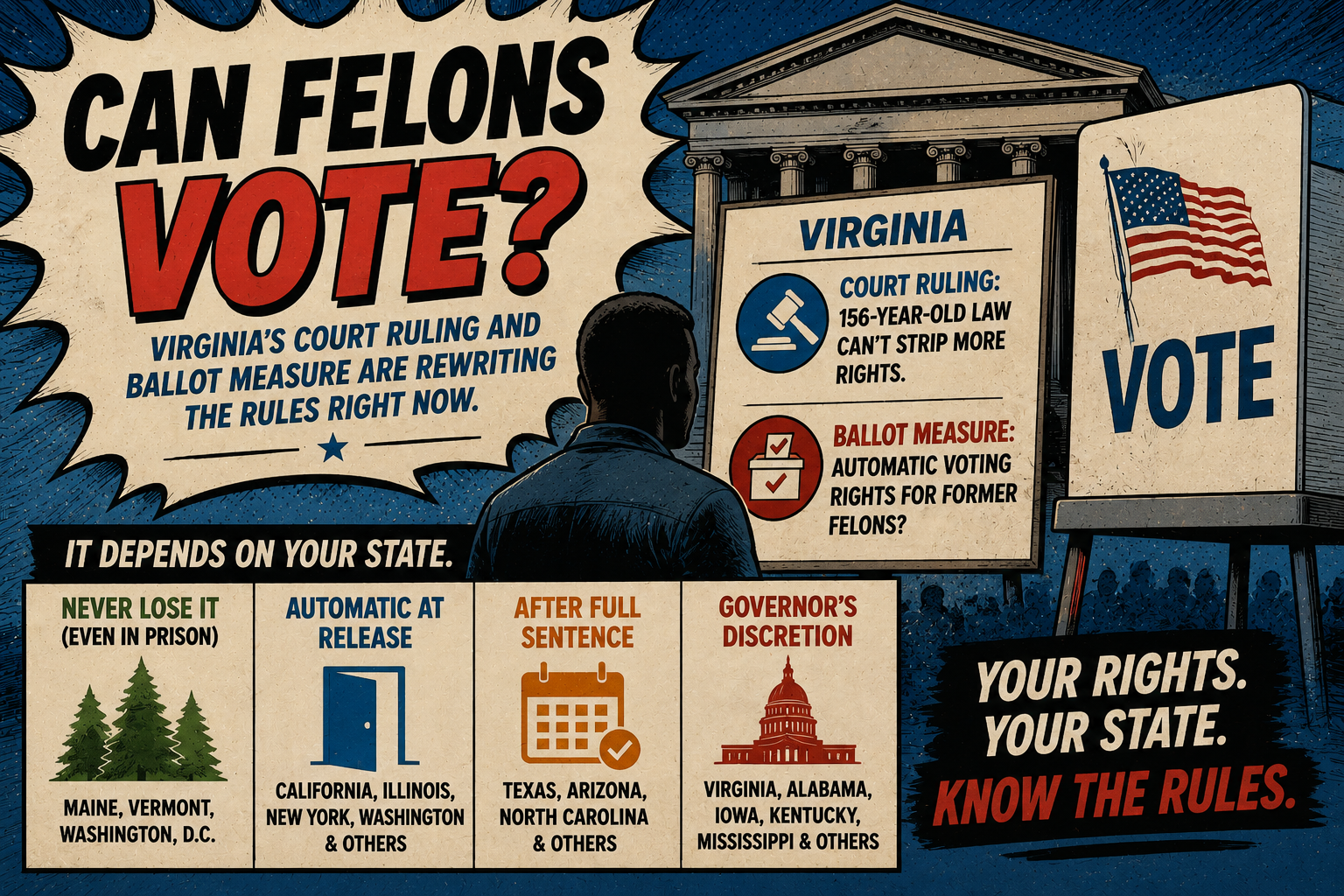
On August 20, 2026, a federal judge affirmed something that sounds almost too specific to be true: Virginia has been permanently stripping voting rights from people convicted of crimes that a 156-year-old federal law never actually authorized the state to punish that way. The ruling didn’t come out of nowhere, it’s the latest chapter in a fight over exactly how much power a state has to decide, on its own, who gets to vote again after a felony conviction. And Virginia isn’t the only place this question is live right now: a separate constitutional amendment on this November’s ballot could change the rules again before the ink on the court ruling is even dry.
The short answer: it depends entirely on your state, and the range is enormous. In Maine, Vermont, and Washington, D.C., you never lose your right to vote, even while incarcerated. In Virginia and roughly a dozen other states, a felony conviction can mean permanently losing the right to vote unless the governor personally decides to give it back.
The national patchwork, in four buckets
Felon voting rights fall into roughly four categories depending on where you live. A handful of states, Maine, Vermont, and D.C. never take away the right to vote at all, including for people currently incarcerated. A larger group of states, including California, Illinois, New York, and Washington, restore voting rights automatically the moment someone is released from prison, regardless of whether they’re still on parole or probation. A third group, including Texas, Arizona, and North Carolina, waits until a person has fully completed their sentence, parole and probation included, before rights come back automatically. And a final group of states, Virginia among them, uses a discretionary process: voting rights stay revoked unless the person successfully petitions the governor for restoration or receives a pardon, with no guaranteed timeline or outcome.
That last category is where most of the current legal and political fighting is happening, and Virginia is currently its most active battleground.
What the Virginia court ruling actually changed
The lawsuit, brought by the ACLU of Virginia, argued that the state’s felony disenfranchisement rule violated the 1870 Virginia Readmission Act, one of the federal laws that let former Confederate states rejoin the Union after the Civil War, on the condition that they not use their new state constitutions to permanently bar voting except for a specific, limited list of “common law” felonies. U.S. District Judge John Gibney had already ruled in the plaintiffs’ favor in January 2026, and his August 20 order affirmed that decision: only 11 specific offenses, arson, burglary, jail escape, larceny, manslaughter, mayhem, murder, rape, robbery, sodomy, and suicide, can trigger permanent disenfranchisement under that 1870 law. Modern felony convictions that don’t map onto that 19th-century list can no longer be used to permanently bar someone from voting in Virginia.
Practically, that means people whose felony convictions fall outside that specific list can now register to vote in time for November’s general election, including the vote on the constitutional amendment described below. The ruling arrived close enough to the calendar that some newly eligible voters missed August’s primary while the state worked out how to implement it, and it’s not yet clear whether the state will appeal.
Virginia’s separate fix: a constitutional amendment on the ballot
Running alongside the court fight is a different effort entirely: a constitutional amendment on Virginia’s November 2026 ballot that would automatically restore voting rights to anyone upon release from incarceration, replacing the current governor’s-discretion system altogether. The Virginia General Assembly passed the measure in two consecutive legislative sessions, as Virginia’s constitution requires, the Senate voted 21–18 in January 2025 and the House 55–42 the following month, clearing the way for voters to decide it directly this fall. A January 2025 poll found 63% of likely voters supported it, with 32% opposed.
It’s worth being clear that the court ruling and the ballot amendment are doing two different jobs. The court case narrows who Virginia can permanently disenfranchise at all, based on a 19th-century federal law. The ballot amendment, if approved, would go further and automate restoration for everyone once they’re released, replacing the discretionary petition process entirely rather than just shrinking the list of crimes it applies to.
Why the discretionary system exists in the first place
Virginia’s current governor’s-petition system, along with similar discretionary processes in states like Alabama, Iowa, Kentucky, and Mississippi, traces back to the same Reconstruction-era period at the center of the court case. Voting rights advocates, including Progress Virginia’s LaTwyla Mathias, have argued in this debate that permanent, discretionary disenfranchisement rules were written and expanded during the Jim Crow era specifically to suppress Black voter turnout, a characterization with real historical documentation behind it, even as reasonable people can still disagree about whether or how quickly today’s discretionary systems should change as a result.
Why this matters to voters
If you or someone you know has a felony conviction, the honest answer to “can they vote?” is that it depends on exactly where they live and, in places like Virginia right now, on developments that are still actively moving. Virginians with certain convictions may be newly eligible to register ahead of November, and the ballot amendment could reshape the rules again regardless of how you vote on it. Outside Virginia, it’s worth checking your own state’s specific category, automatic-at-release, automatic-after-full-sentence, or discretionary-petition, since assuming the wrong one, in either direction, could mean missing a registration window you’re actually eligible for, or wrongly believing you’re eligible when you’re not.
References
Judge affirms ruling in favor of former felons in voting rights lawsuit — Virginia Mercury
Virginia Voting Rights Restoration for Felons Upon Release Amendment (2026) — Ballotpedia
Felon Voting Laws by State: A Rights Restoration Guide — FindLaw
2026 Virginia Voting Rights Restoration Amendment — Wikipedia

- The Supreme Court Is About to Decide a Major Voter Roll Case. Here Is the Timeline That Got Us Here - September 24, 2026
- Why Poll Workers Are Disappearing, And What It Means for Election Day - September 14, 2026
- Why Is the Justice Department Suing States Over Voter Rolls, and Why Does It Keep Losing? - August 28, 2026