
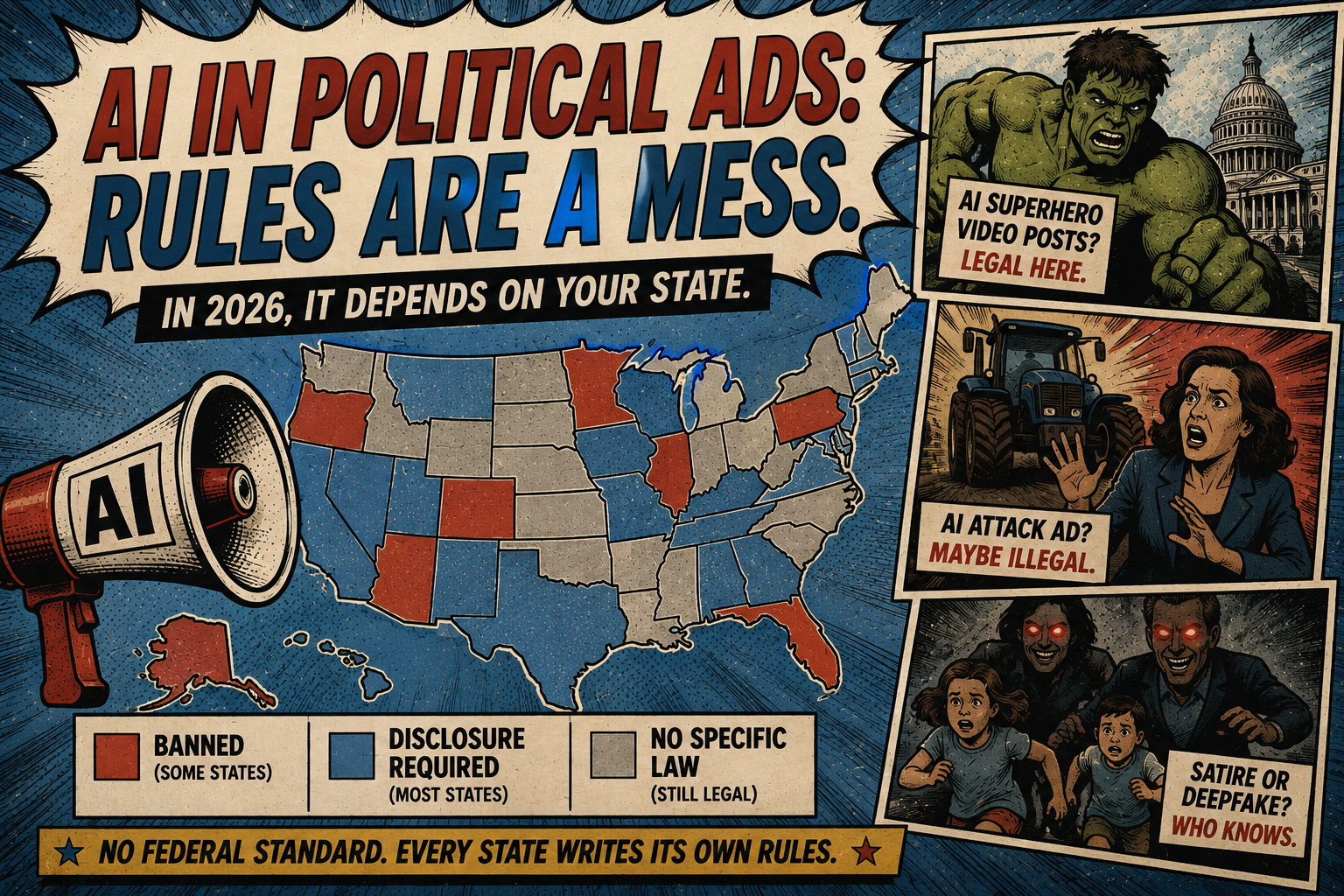
This summer, a former Michigan congressman posted an AI-generated video of himself as a Hulk-like superhero fighting crime. A state senator running against him circulated an AI clip showing Governor Gretchen Whitmer about to be struck by a tractor. In Oregon, a losing primary candidate ran ads depicting his opponent and the governor with glowing red eyes, chasing a group of scared children. None of these ads has been definitively ruled illegal — and that’s not an oversight. It’s because the rules for AI in political advertising are a genuine patchwork, and whether any of the above breaks the law depends almost entirely on which state it ran in.
The short answer: it depends on your state, and even the states with rules disagree on what “using AI” actually requires. There’s no federal law setting a baseline standard for AI-generated content in political ads. Instead, roughly 29 to 31 states have passed their own rules since 2023, and two of the toughest ones have already been thrown out by courts.
What the state laws actually require
State approaches to AI in campaign ads generally split into two camps. Some states impose outright temporal bans: Minnesota and Texas prohibit certain political deepfakes within a set window before an election, while Maryland bans them year-round. Most other states instead require disclosure, a label telling viewers that AI was used to generate or alter the content. A handful, including Colorado and Utah, go further and require the disclosure to specify who created the AI content and how it was made or edited.
That’s a meaningful gap: in a disclosure-only state, an AI attack ad can run right up to Election Day as long as it’s labeled. In a ban state, the same ad might be prohibited outright during the final stretch of a campaign, labeled or not. And in states with no law at all, there’s effectively no state-level rule governing either scenario.
The Oregon test case
Oregon’s 2024 disclosure law is facing its first real test this cycle. Jonathan Lockwood, who ran unsuccessfully against Rep. Janelle Bynum in Oregon’s 5th Congressional District primary, posted AI-generated ads depicting Bynum and Governor Tina Kotek with glowing red eyes chasing frightened children, along with a separate ad falsely placing Bynum in a McDonald’s uniform. The Oregon Secretary of State’s office opened an investigation in July 2026 after receiving a complaint, and Lockwood could face prosecution and a fine of up to $10,000 if found in violation.
His defense leans entirely on the First Amendment and the absurdity of the content itself: he’s argued the imagery is so over-the-top that no reasonable viewer could mistake it for real footage, and separately has called Oregon’s law an “unconstitutional synthetic media law” designed to suppress protected political speech. As of this writing, the investigation remains open with no resolution announced.
Michigan and Kentucky show how murky “satire” gets
Oregon isn’t the only state grappling with this. In Michigan, former Rep. Mike Rogers posted an unlabeled AI video of himself as a superhero, while State Senate Minority Leader Aric Nesbitt released a labeled AI video showing Governor Whitmer nearly hit by a tractor, both men have pointed to satire exemptions built into Michigan’s law as their defense. In Kentucky, a PAC ran a labeled, clearly satirical AI ad involving Rep. Thomas Massie, while a separate unlabeled AI ad depicting Rep. Ed Gallrein retreating from battle drew more scrutiny.
The common thread is that nearly every state law with a disclosure requirement also carries a satire or parody exemption, and nobody has clearly defined where ordinary political mockery ends and a disclosure violation begins. That ambiguity is arguably the point of contention in every one of these live cases, it’s not that the law doesn’t exist, it’s that nobody yet knows exactly what it covers.
When the FCC got involved: New Hampshire’s Biden robocall
The starkest cautionary tale predates this cycle but still shapes how regulators think about the problem. Ahead of New Hampshire’s 2024 primary, a political consultant used AI voice-cloning to blast out a robocall impersonating President Biden, urging Democrats to skip the primary and “save” their votes for November. The FCC hit the consultant with a $6 million fine, but he was acquitted of the associated criminal charges. The split outcome, a serious civil penalty paired with a criminal acquittal, is a reminder that even the most attention-grabbing deepfake enforcement action to date didn’t produce a clean, universally applicable legal precedent.
Why the toughest laws keep getting struck down
Here’s the deeper problem for any state hoping to write an airtight rule: the toughest versions of these laws keep losing in court. California’s law targeting “materially deceptive” election-related deepfakes was blocked by a federal judge on First Amendment grounds, as was a similar law in Hawaii. Montana’s law is currently facing its own constitutional challenge. Courts applying strict scrutiny to these statutes have generally found that broad, content-based restrictions on political speech, even deceptive political speech, run into the same free-speech protections that cover ordinary political satire, parody, and hyperbole, all of which have a long history of First Amendment protection in American elections.
That leaves lawmakers walking a narrow line: a disclosure requirement is more likely to survive a court challenge than an outright ban, but disclosure alone does little to stop a deceptive ad from spreading before anyone notices the fine print, or before a viewer ever sees the label at all if the video is re-shared without it.
The federal vacuum
Congress hasn’t stepped in with a nationwide standard. The one federal law addressing AI-generated content, the Take It Down Act, passed in May 2026, targets nonconsensual intimate imagery, a real and serious problem, but an entirely different one from election ads. There’s no federal equivalent requiring disclosure or restricting AI use in campaign advertising specifically, which means the 2026 midterms are running under whatever patchwork of state rules happens to apply wherever a given ad airs, or none at all.
Why this matters to voters
If you see a strange, over-the-top, or shocking video of a candidate this fall, don’t assume a law required someone to tell you it was AI-generated, whether it did depends on your state, and even where a disclosure law exists, the “satire” exemption may cover exactly the kind of content that grabbed your attention in the first place. The practical takeaway isn’t that AI in political ads is unregulated everywhere; it’s that the regulation is inconsistent enough that viewers are still the last line of defense. Treat anything that looks manufactured to provoke outrage with the same skepticism you’d apply to an anonymous chain email, and don’t count on a label to tell you what’s real.
References
Voters face uneven AI deepfake protections — Axios
AI campaign ads put Oregon’s deepfake law to the test — Axios
State AI deepfake laws face first big test in 2026 midterm elections — Arizona Capitol Times
Judge Blocks California Law Restricting “Materially Deceptive” Election-Related Deepfakes — Reason
AI deepfake policy in California — Ballotpedia
State Deepfake Laws in 2026: What’s Changed and What’s Next — MultiState

- A Supreme Court Case You Probably Missed Could Open the Door to a Lot More Election Lawsuits - October 9, 2026
- Dark Money Is Pouring Into the 2026 Midterms. Here Are Five Myths About How It Actually Works - September 21, 2026
- The Supreme Court Just Blocked Trump’s Mail Ballot Restrictions. Here’s What That Means - September 17, 2026