
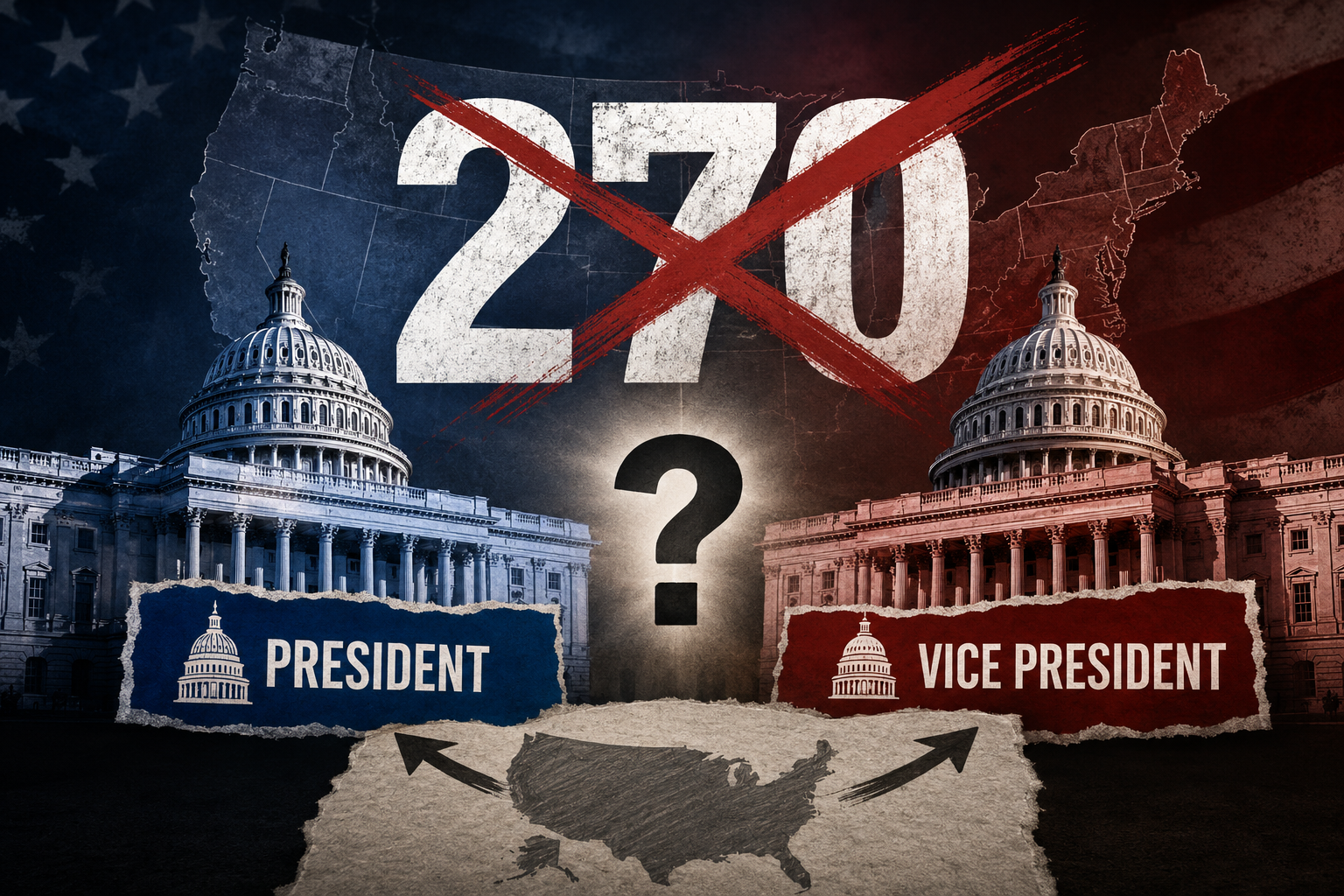
Every four years, election coverage repeats the same number so often it starts to feel like the whole game: 270 electoral votes, the magic number for winning the presidency. Almost nobody stops to explain what happens if nobody gets there. It is not a hypothetical dreamed up for cable news graphics. It has genuinely happened before, the rules for it are still on the books today, and they work in a way that surprises most people who learn about them for the first time.
The short answer: if no candidate wins a majority of electoral votes, the choice does not go back to voters at all. The House of Representatives picks the president, and the Senate picks the vice president, under a process laid out in the 12th Amendment.
How the House actually picks a president
If no candidate reaches 270 electoral votes, either because of a tie or because more than two candidates split the vote, the election becomes what is formally called a contingent election. The House of Representatives chooses among the top three electoral vote finishers, but not the way the House normally votes. Instead of one vote per member, each state delegation gets exactly one vote total, no matter whether that state sends 2 representatives or 52. A candidate needs a majority of state delegations, meaning support from 26 states, to win.
That single detail changes the entire math of the process. Wyoming, with a single House member, carries the same weight in a contingent election as California, with more than 50. It is one of the only moments in American government where a state’s population stops mattering entirely.
What happens for vice president
The vice presidency gets decided separately, by the Senate rather than the House, and the process looks different too. Senators choose between only the top two vice presidential finishers, and here every senator votes individually rather than by state delegation, with a simple majority of the full Senate required. If neither chamber has finished choosing by January 20th, the vice president elect steps in as acting president until the House resolves its side of the process.
This has actually happened, twice
A contingent election is rare, but it is not theoretical. In 1800, a flaw in the original Constitution let Thomas Jefferson and his own running mate Aaron Burr end up tied in the electoral count, since electors at the time cast two votes without distinguishing which one was for president. The House settled it after dozens of rounds of voting, and the mess directly led to the 12th Amendment, which created the separate presidential and vice presidential ballots still used today.
The 12th Amendment’s process has itself only been used once, in 1825, when no candidate won a majority of electoral votes in the four way race of 1824. The House chose John Quincy Adams over Andrew Jackson, who had actually won more electoral and popular votes. Jackson’s supporters called it the corrupt bargain, and the controversy shaped American politics for years afterward.
The other wrinkle: electors who do not vote as pledged
A contingent election is not the only way the Electoral College can produce a surprise. Individual electors, the people actually casting the state level votes that get added up nationally, have occasionally refused to vote for the candidate their state’s voters chose. These are called faithless electors, and 2016 produced a modern record: seven of them, including three Washington state electors who voted for Colin Powell instead of Hillary Clinton, the candidate Washington voters had actually chosen. Washington fined those electors, and the fight over whether states could legally do that reached the Supreme Court.
In Chiafalo v Washington, decided in 2020, the Court ruled unanimously that states can require electors to vote for the candidate they pledged to support and can penalize them if they do not. More than a dozen states now have laws with real consequences behind them, which makes a large scale faithless elector revolt considerably less likely today than it might have looked in 2016.
Why this matters to voters
None of this changes how you actually cast your ballot, but it matters because the backup system kicks in exactly when the ordinary system is under the most stress, a genuinely close or fractured national election. In that moment, the outcome would not be decided by the national popular vote or even by the Electoral College’s usual population weighted math. It would be decided by a chamber where Wyoming and California carry identical weight, using a mechanism most Americans have never had reason to learn. Understanding it now, while it is just a rule in a textbook rather than a headline, is a lot easier than trying to learn it in the middle of a genuine constitutional crisis.
Watch:
What Happens If No Candidate Wins a Majority of the Electoral Votes? — CountyOffice News
References
A contingent election, explained (Protect Democracy)
When the 1824 Presidential Election Ended in an Electoral Tie, Controversy Ensued (History)
Chiafalo v. Washington (Justia U.S. Supreme Court Center)
Which candidates did the seven faithless electors support? (CBS News)

- What Happens If No Presidential Candidate Wins 270 Electoral Votes? - September 2, 2026
- Can Campaigns Legally Use AI Deepfakes in Ads? Here’s the Messy Patchwork of State Rules - August 24, 2026
- Can States Redraw Their Congressional Maps Whenever They Want? Inside the 2026 Redistricting Wars - August 12, 2026