
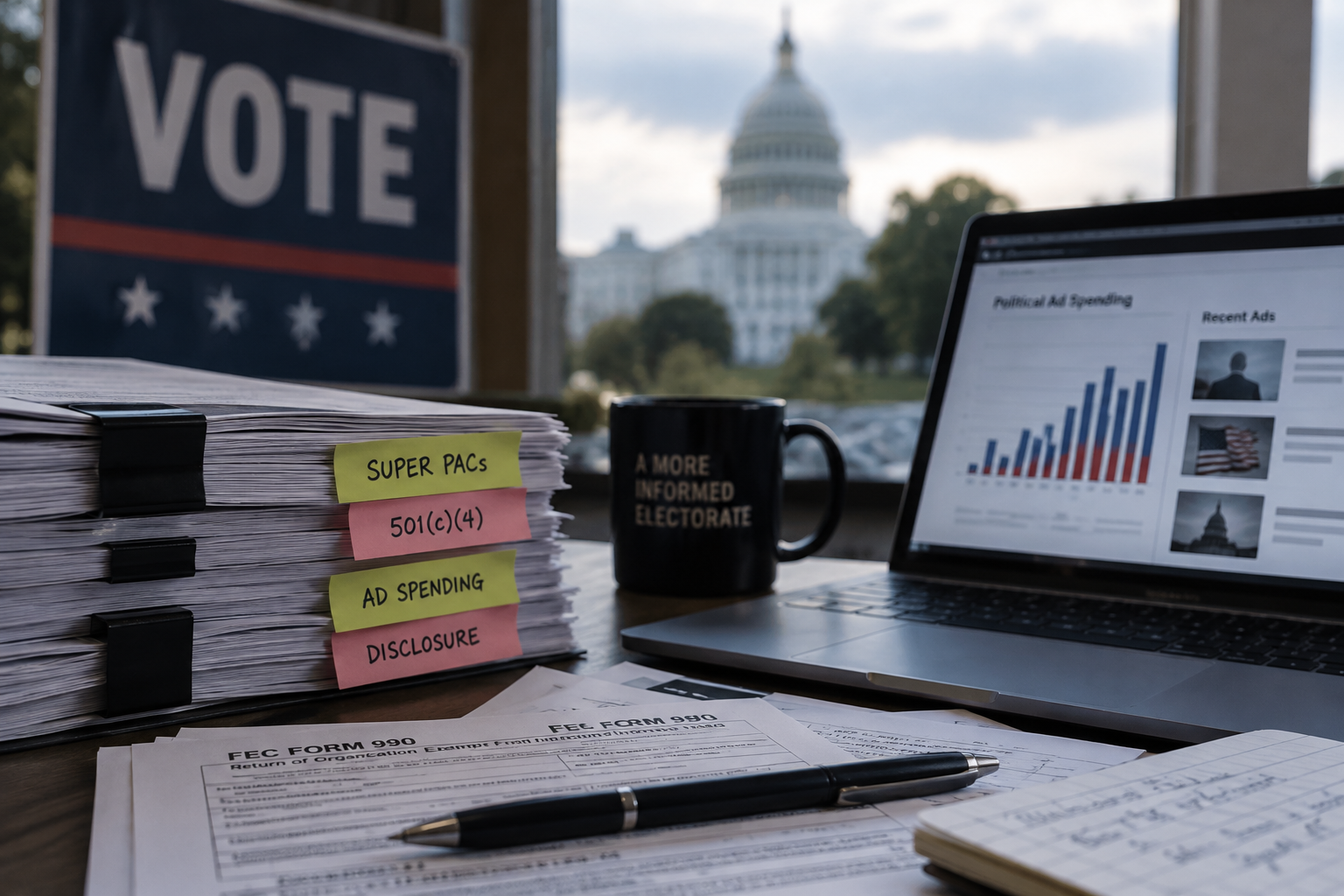
Political ads are already flooding televisions and social media feeds ahead of the November midterms, and a striking share of the money behind them cannot be traced back to an actual donor. Four of the biggest super PACs supporting House and Senate candidates have raised more than $714 million combined since the start of 2025, and roughly $198 million of that, more than a dollar of every four, came from nonprofit groups that are not required to name their donors at all. That is dark money, and it has become one of the defining features of how modern American campaigns get funded. Here is what is actually true about it, and what is not.
Myth: Dark money is some kind of illegal loophole nobody caught in time
It is legal, and it was not an accident. The system traces back to a mix of Supreme Court rulings and existing tax law. The Federal Election Campaign Act of 1971 first required disclosure of political donors, and for decades that stayed the norm. Then came the Supreme Court’s 2010 decision in Citizens United v. FEC, which allowed corporations and unions to spend unlimited money on independent political ads, followed shortly by a lower court ruling that let outside groups called super PACs raise unlimited sums as long as they did not coordinate directly with a candidate. The dark money piece comes from a separate corner of the tax code: certain nonprofits organized as 501(c)(4) social welfare organizations are allowed to spend on politics without disclosing their own donors, then legally transfer that money into a super PAC, which reports the transfer but not the original source. Nothing about that chain violates current law.
Myth: Only one political party relies on this kind of money
Both parties use it, at scale. Among the four largest super PACs, the Republican aligned Senate Leadership Fund received $70.7 million from its affiliated dark money group, One Nation, while the Democratic aligned Senate Majority PAC received $61 million from its own affiliated group, Majority Forward. Overall, Republican leaning groups accounted for 58 percent of this cycle’s dark money receipts and Democratic leaning groups accounted for 42 percent, a gap that has shifted from cycle to cycle rather than reflecting a permanent partisan pattern.
Myth: Super PACs and dark money groups are basically the same thing
They are legally distinct, and the difference is the entire point of the arrangement. Super PACs are required to publicly report their donors. Dark money groups, the 501(c)(4) nonprofits, are not. What makes the system work as a workaround is that a dark money group can write a check to a super PAC, the super PAC discloses that it received money from, say, One Nation, and the trail simply ends there, since One Nation itself owes the public no accounting of who funded it.
Myth: Citizens United means there are no disclosure rules left at all
This one surprises people. The Citizens United ruling itself actually upheld disclosure requirements by an eight to one margin, with the majority opinion explicitly stating that voters have a right to know who is trying to influence them. The dark money gap did not come from Citizens United weakening disclosure law. It came from separate IRS rules governing nonprofits that predate the ruling and were never updated to close the gap it opened. Legislation aimed at fixing that mismatch, including the Disclose Act and the Honest Ads Act, has passed the House multiple times but has never become law.
Myth: This is a small slice of political spending that does not really move elections
The numbers say otherwise. Anonymous donors spent at least $1.9 billion on federal races in 2024, nearly double the previous record, and dark money groups have poured a combined $4.3 billion into federal elections since Citizens United was decided. This cycle’s Texas Senate primary became the most expensive primary in American history, with more than a third of the tens of millions spent by one major super PAC traced back to undisclosed donors. A Kentucky House primary saw more than $25 million in outside spending, including attack ads built with AI generated imagery, in a race where both leading candidates raised the vast majority of their money from outside the state entirely.
How the system got this way
None of this happened overnight. Campaign finance law in the United States has swung between tightening and loosening for more than fifty years, from the post Watergate disclosure rules of the 1970s, to the McCain Feingold reforms of 2002 that restricted so called soft money donations to political parties, to Citizens United in 2010 undoing many of those restrictions for independent spending. Each shift created new categories of money and new workarounds, and dark money through 501(c)(4) groups is simply the version that has proven most durable so far.
Why this matters to voters
You do not need to land on one side of the campaign finance debate to notice the practical effect: a meaningful share of the ads shaping this fall’s House and Senate races were paid for by people whose names you will likely never see. Understanding the difference between a super PAC and a dark money group will not change how much gets spent, but it does change how skeptically you might read the fine print, or lack of it, the next time a political ad tells you who is really behind the message.
Watch:
“How ‘dark money’ makes its way into political campaigns”
References
Brennan Center for Justice, Money in Politics Roundup, May 2026
Brennan Center for Justice, Citizens United, Explained

- Dark Money Is Pouring Into the 2026 Midterms. Here Are Five Myths About How It Actually Works - September 21, 2026
- The Supreme Court Just Blocked Trump’s Mail Ballot Restrictions. Here’s What That Means - September 17, 2026
- What Happens If No Presidential Candidate Wins 270 Electoral Votes? - September 2, 2026