
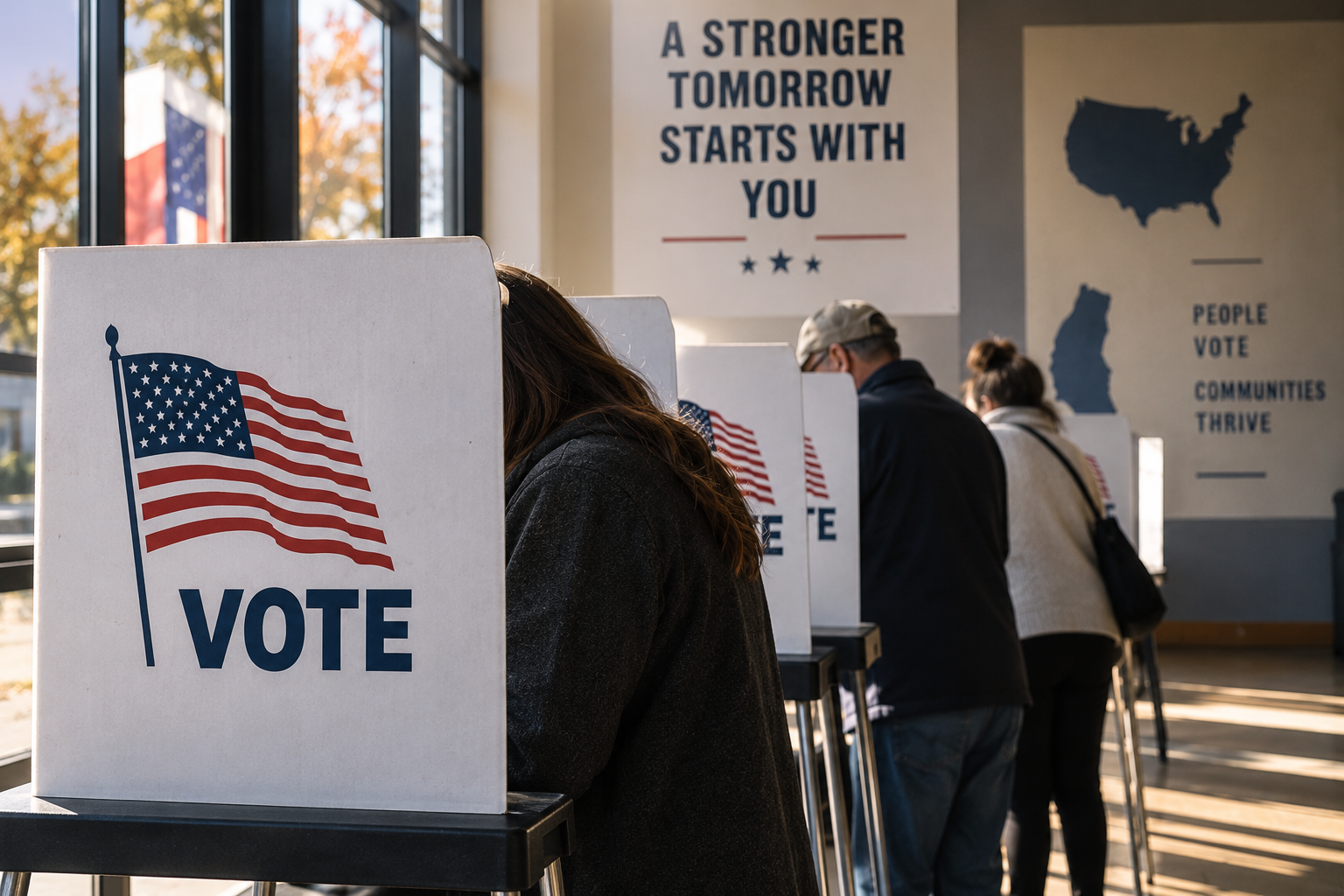
An eighteen year old college student walked into a local election office in Fairfax, Virginia this past Friday morning and became one of the first people in the country to cast a ballot in the 2026 midterms. Most of the country is still six weeks out from Election Day, but voters in Virginia, Idaho, Minnesota, and South Dakota were already lining up, well before most Americans have even settled on who they are voting for. There is no dramatic explanation for why those four states specifically. Early voting already began there simply because it is what each state’s own law happens to schedule, and the Constitution leaves the mechanics of running elections almost entirely up to the states themselves. That patchwork, more than anything else, is the real story behind what you are seeing on the news this week.
A patchwork older than it looks
Every state writes its own rulebook for early voting: when it opens, how long it runs, whether you need a specific reason to use it at all. Virginia allows weeks of no excuse in person absentee voting. Other states open only a short window right before November 3, and a handful still require voters to state a reason, like travel or illness, before they can vote ahead of time. According to a nonpartisan tracker of these rules, that variation exists because nothing in federal law sets a uniform early voting calendar, so each state legislature decides its own timeline independently of every other state.
From Civil War camps to a California reform
Rewind far enough and the roots of what happened in Fairfax this week trace back to a much stranger scene: soldiers voting from military camps during the Civil War. President Lincoln wanted Union troops serving away from home to be able to cast ballots in the 1864 election against George McClellan, so several states arranged supervised field voting for their soldiers. Louisiana formalized in person absentee voting in 1921, but for most of the twentieth century, voting before Election Day generally required a specific excuse tied to military service, travel, or illness.
That changed in the late 1970s, when California became the first state to drop the excuse requirement entirely, letting any voter request an absentee ballot for any reason. Texas went a step further by the late 1980s, opening dedicated early voting locations rather than just mailing out absentee ballots. Oregon then rewrote the playbook again, becoming the first state to run its elections entirely by mail in 2000 after voters approved the switch with 70 percent support two years earlier. The contested 2000 presidential recount in Florida gave the whole trend another push, as states looked for ways to spread out turnout and reduce Election Day chaos. By 2020, 43 states plus Washington, D.C. offered some form of early voting.
Why this fall carries extra weight
This year’s midterms matter more than most, since control of the House and Senate is genuinely in play and the outcome will shape the final two years of the current presidential term either way. The map itself has shifted underneath voters too: roughly one in ten Americans now lives in a different congressional district than they did in 2024, the result of an unusually aggressive round of mid decade redistricting. Voting rights advocates have also been pushing people to cast ballots earlier than usual this fall, pointing to recent Postal Service operational changes and the ongoing legal fight over mail ballot rules as reasons not to wait until the final week.
The fine print on voting early
Here is the short version, if you skip everything else: an early ballot, whether cast in person or by mail, counts exactly the same as one cast on Election Day. Nothing about it is provisional or secondary. The real tradeoffs are practical rather than legal. Voting early means sidestepping potential lines, weather, or scheduling conflicts, and it gets your ballot locked in before any late breaking rule changes or postal slowdowns can touch it. Most states will not let you undo or change your vote once it is submitted, so it is worth being genuinely settled on your choices before you cast one.
What it means when you vote
Early voting has quietly become the default way a large share of the country participates in elections, but the rules behind it are still a real patchwork built from decisions individual states made decades apart, from Civil War field ballots to a 1970s California reform to a Texas experiment in the 1980s. Knowing your own state’s window, and whether you are voting in person or by mail, is the difference between voting on your own schedule or scrambling in the final days of a cycle where every congressional seat could matter.
Watch:
References
News4Jax, Early voting begins in US midterm elections that could flip control of Congress
National Constitution Center, Early voting looms as key election factor
TIME, A Brief History of Voting by Mail
TIME, Early Voting: Why States Began Offering the Option

- Early Voting Just Started for the 2026 Midterms, and the Story Behind It Goes Back Further Than You’d Think - September 18, 2026
- When Elections End in a Dead Heat: The Wild (and Totally Legal) Ways America Breaks a Tie - August 19, 2026
- China vs America AI 2026: The Race That Closed Overnight and the Election Claim That Divides Washington - July 21, 2026