
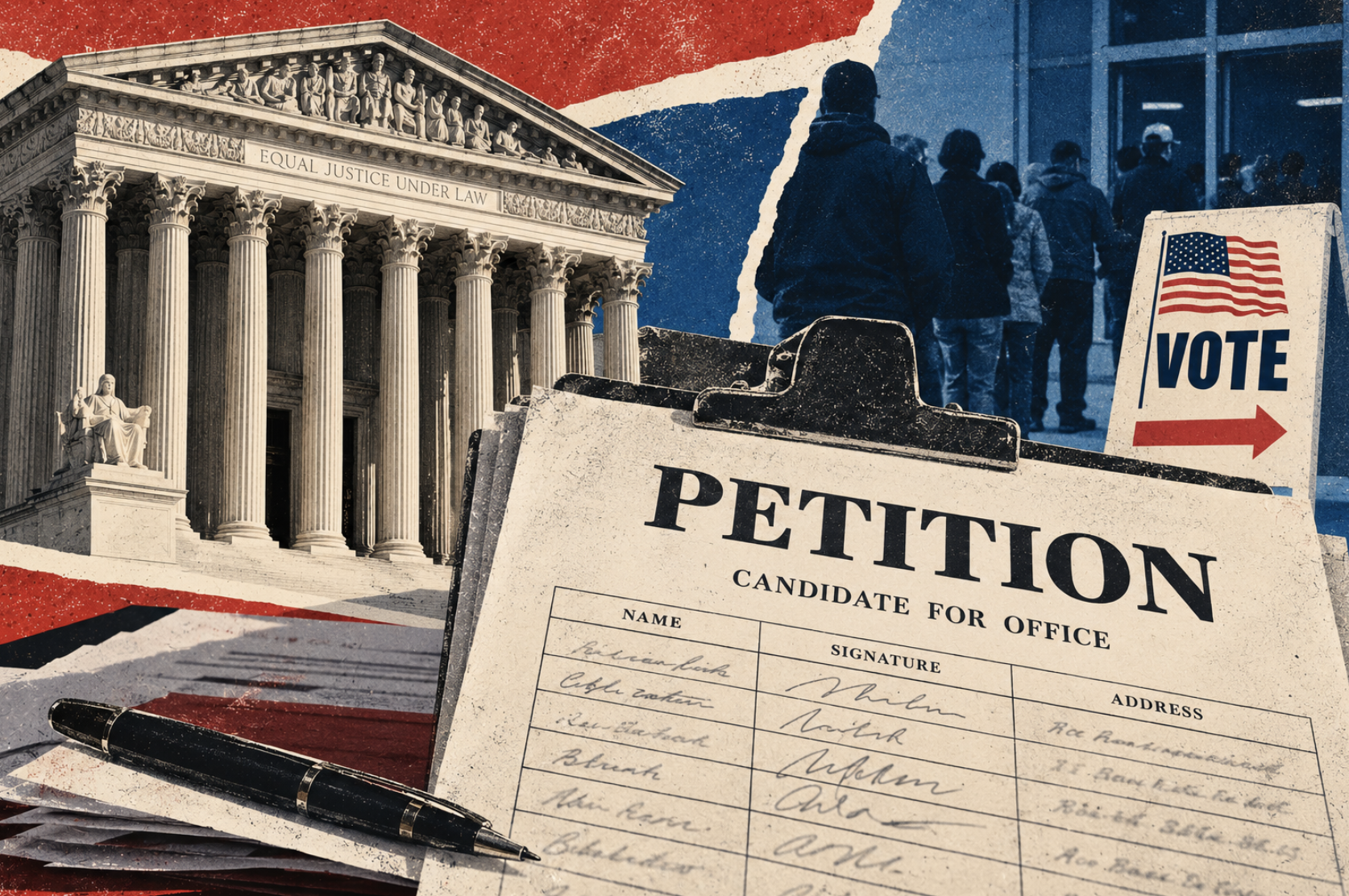
Most voters assume that if you want to run for office, you just file some paperwork and your name shows up on the ballot. For anyone outside the two major parties, that assumption is usually wrong. Getting on the ballot as an independent or minor party candidate typically means collecting a legally specified number of signatures, verified one by one against government records, within a fixed window of time. The rules governing that process trace back more than fifty years to a single Supreme Court case most voters have never heard of. Here is the timeline.
1. 1968: Ohio pushes too far, and the Supreme Court notices
Ohio’s election laws at the time were built to lock out anyone but the two major parties entirely, barring independent candidates outright, refusing to count write in votes, and requiring new parties to gather signatures from 15 percent of the electorate well before Election Day. In Williams v. Rhodes, the Supreme Court struck the scheme down, ruling that a state cannot engineer a complete monopoly for its two largest parties. The decision did not say what ballot access rules states could use, only that Ohio’s version went too far.
2. 1968: Georgia’s looser version gets tested in real time
That same year, segregationist former Alabama Governor George Wallace successfully petitioned his way onto Georgia’s presidential ballot as a third party candidate under the state’s existing signature requirement, proof that a petition process built around a 5 percent signature threshold could actually function in a real statewide race.
3. 1970: A Socialist Workers Party candidate challenges Georgia directly
Linda Jenness, the Socialist Workers Party’s nominee for governor of Georgia, sued over the same law, arguing it violated her supporters’ First Amendment rights. Georgia’s rule required parties that had not won 20 percent of the vote in the prior election to collect signatures from 5 percent of eligible voters within a 180 day window ending on the day of the major parties’ primary.
4. 1971: The Supreme Court upholds Georgia’s law, and sets the modern standard
In Jenness v. Fortson, the Court sided with Georgia, finding meaningful differences from the Ohio scheme it had just struck down. Georgia let any registered voter sign a petition regardless of party, allowed write in votes, gave candidates a longer window, and did not force minor parties through a primary. That comparison became the basic template courts still use today to decide whether a given state’s ballot access law is reasonable or an unconstitutional monopoly for major parties.
5. 2017 to 2018: The law gets tested again, and survives
The Libertarian Party of Georgia sued on behalf of congressional candidate Martin Cowen, arguing the signature requirement for independent U.S. House candidates was unconstitutional. The Eleventh Circuit Court of Appeals reversed a lower ruling and let the requirement stand, extending the Jenness era framework to congressional races nearly fifty years after the original decision.
6. 2020: Proof the system can still work for a motivated candidate
Keith Higgins collected enough signatures across multiple counties to qualify for a judicial race in Georgia’s Brunswick Judicial Circuit as an independent, and went on to win the election outright, showing that the decades old framework still leaves room for outsider candidates willing to do the organizing work.
7. 2024: A near miss by the numbers
Laura Khurana ran for an at large county commission seat needing 3,098 valid signatures. She submitted more than 3,600, comfortably more than the threshold, but roughly 1,000 of them were ruled invalid by county election officials during verification, and her bid for ballot access failed.
8. 2026: The margins get even tighter
This year, Rachael Thompson needed 508 signatures to qualify for a Glynn County school board seat. A judge found she was exactly one signature short, and she is now running as a write in candidate instead. In the same election cycle, Bradley Smith qualified for a McIntosh County commission race after meeting a 108 signature threshold, while James Daniels is running as a write in independent in Effingham County after falling short of his own district’s requirement.
Why this matters to voters
The same legal test from a 1971 case about a Socialist Workers Party candidate for governor is still the reason a school board hopeful can lose a race before Election Day even arrives, over a single missing signature. Ballot access rules rarely make headlines the way a presidential race does, but they quietly decide which names voters even get the option to consider, at every level from president down to school board, long before anyone casts a vote.
References
Ballotpedia, Jenness et al. v. Fortson, Secretary of State of Georgia (1971)
First Amendment Encyclopedia, Jenness v. Fortson
The Current, Georgia’s third party candidates struggle for ballot access

- How a 1971 Supreme Court Case Still Decides Who Makes Your Local Ballot - October 14, 2026
- The Supreme Court Is About to Decide a Major Voter Roll Case. Here Is the Timeline That Got Us Here - September 24, 2026
- Why Poll Workers Are Disappearing, And What It Means for Election Day - September 14, 2026