
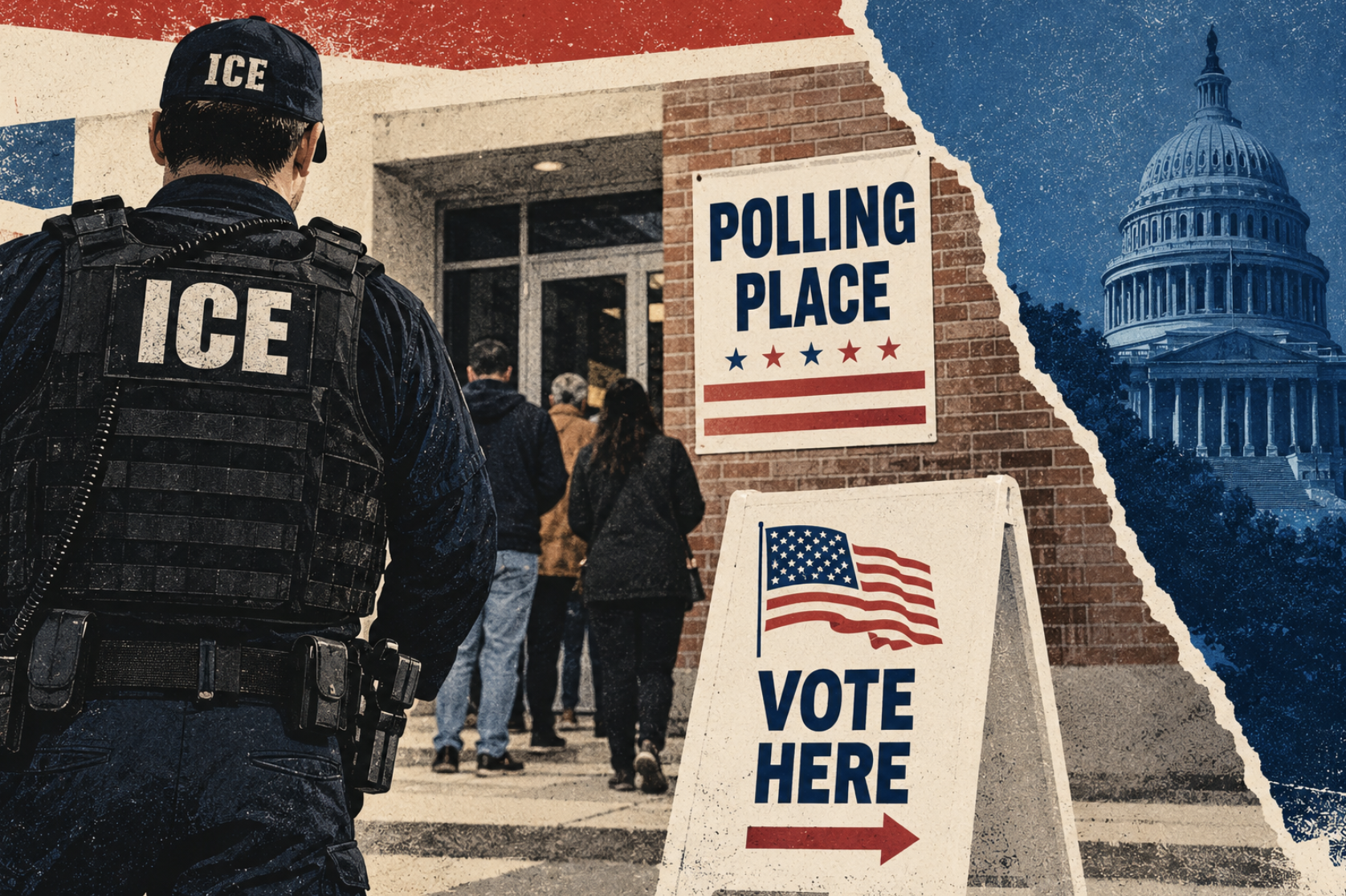
Ahead of this year’s midterms, at least six states have passed laws specifically restricting immigration enforcement near polling places, driven by fears that a visible ICE presence could intimidate voters, particularly in immigrant communities, away from the polls. The push has generated plenty of confusion about what is actually new here and what has been illegal for a very long time. Here are five common myths.
Myth: There was no law against federal agents at polling places until states started acting
This is the biggest misconception. Federal law has banned federal troops and armed officials from polling places since 1865. The statute, now codified as 18 U.S.C. Section 592, traces back to the Reconstruction era and makes it a crime for any federal official, civilian or military, to order, bring, or keep troops or armed personnel at a place where an election is held. The only exceptions are a service member voting at their own polling place or troops repelling an actual armed enemy of the United States. A violation carries a fine, up to five years in prison, and permanent disqualification from holding federal office, a remarkably strict penalty that has never actually been enforced in court, largely because no president has ordered troops to a polling place since Congress passed the Posse Comitatus Act in 1878.
Myth: Since federal law already covers this, the new state laws are redundant
Not exactly. The 1865 era statute was written with troops and armed federal officials in mind, and legal experts have pointed out it is genuinely unclear how cleanly that language extends to civilian immigration enforcement agents working for ICE, as opposed to soldiers. States have moved to close that ambiguity with their own explicit statutes. Rhode Island’s version, signed by Governor Dan McKee on June 22, 2026, bars ICE employees, agents, and officials from entering or remaining within 200 feet of any polling place during early voting or on Election Day, with an exception for anyone there to vote. It passed the Rhode Island House 58 to 13 and the Senate 31 to 7, largely along party lines. Rhode Island was one of at least six states to enact similar restrictions this year.
Myth: This is just partisan anxiety without any real basis in current events
The record here is genuinely mixed rather than one sided. In February, the Department of Homeland Security said ICE agents would not be deployed to polling places during the midterms. But President Trump has separately declined to rule out sending troops to polls, said in January that he regretted not seizing voting machines after the 2020 election, and said in May he would do “anything necessary” to ensure honest elections. In August, the Army’s top general, Dan Caine, assured Senator Elissa Slotkin in writing that the military had no plans to send federal troops or federalized National Guard members to polling places this cycle. That gap between official assurances and the president’s own ambiguous public statements is exactly why voting rights advocates in states like Pennsylvania have spent the fall building contingency plans in case ICE or other federal agents show up near polling sites on Election Day anyway.
Myth: A president could simply invoke the Insurrection Act to get around this ban
Legal scholars who have studied the statute argue otherwise. Writing for Just Security, analysts from the Center for American Progress contend that the Insurrection Act does not override the troops at polls ban, pointing to the Supreme Court’s 1952 Youngstown Sheet and Tube decision limiting presidential power and to the Constitution’s own division of election and military authority between Congress and the states. The argument has never actually been tested in court, since the scenario it addresses, a president deploying troops to polling places over objections, has not happened in the statute’s 160 year history.
Myth: These bans are only about soldiers, so ICE agents were never really the target of this legal tradition
The historical statute focuses on troops and armed federal officials generally, but this year’s wave of state laws is explicitly written with civilian immigration enforcement in mind, not just the military. That is precisely why Rhode Island’s law and similar measures elsewhere name ICE directly rather than relying on the broader, century and a half old language about troops and armed men. The new laws are best understood as states adding a specific, modern enforcement mechanism on top of an old and rarely tested federal framework, rather than inventing legal protection against federal interference from scratch.
Why this matters to voters
Whatever side of the immigration debate you fall on, the legal backdrop here matters for everyone who votes. A visible law enforcement presence at a polling place, federal or otherwise, can discourage eligible voters from showing up regardless of intent, which is exactly why this particular legal tradition has survived, mostly untested, for over a century and a half. Knowing that this protection already exists at the federal level, and that states are now reinforcing it with their own specific rules, is useful context the next time a headline raises the question of who might show up near your polling place this November.
Watch: “DHS says ICE agents will not be at polling sites in November”
References
Just Security, Boots Off Ballots: The Law
Ballotpedia News, Rhode Island legislators restrict immigration enforcement near polling places
Stateline, Blue states push to ban ICE at the polls amid federal voter intimidation fears

- Five Myths About States Banning ICE From Polling Places - October 12, 2026
- The Secret Ballot Is Newer Than You Think, and It Took a Body Count to Get Here - October 6, 2026
- Why Is Election Day Always a Tuesday in November? - September 4, 2026