
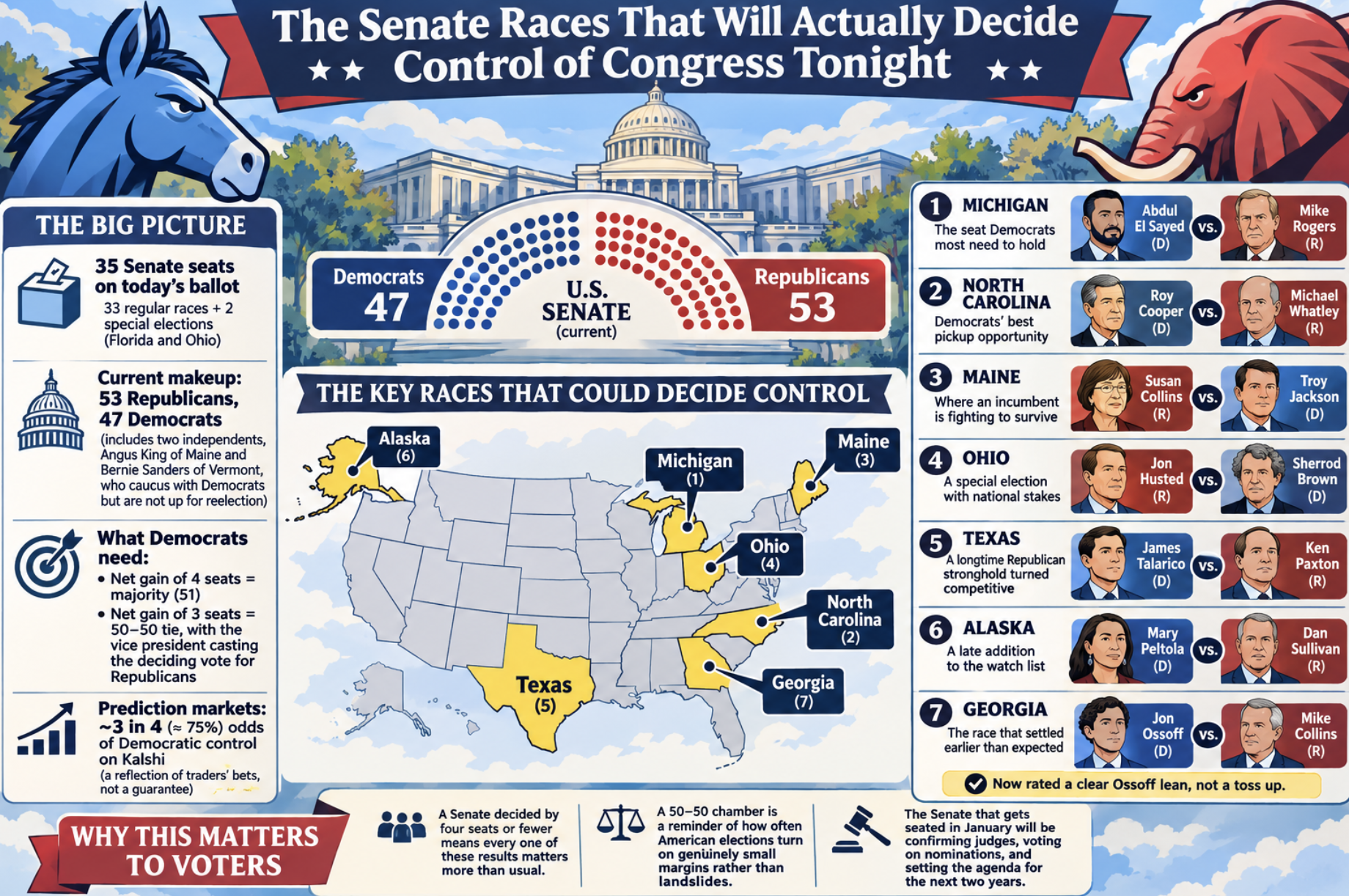
Thirty five Senate seats are on today’s ballot, thirty three regularly scheduled races plus two special elections in Florida and Ohio filling seats that opened up last year when Marco Rubio became secretary of state and JD Vance became vice president. Republicans currently hold 53 seats to Democrats’ 47, a count that includes two independents, Angus King of Maine and Bernie Sanders of Vermont, who caucus with Democrats but are not up for reelection this cycle. Democrats need a net gain of four seats to reach a majority of 51. A net gain of three would leave the chamber tied at 50 seats each, in which case the sitting vice president would cast the deciding vote for Republicans. As of the day before the election, prediction markets on Kalshi put the odds of Democratic control at roughly three in four, though markets like these reflect traders’ bets rather than a guarantee of anything.
Here are the races most likely to actually decide which party ends up with that majority.
1. Michigan, the seat Democrats most need to hold
Senator Gary Peters is retiring, and this open race between Democrat Abdul El Sayed and Republican Mike Rogers is rated a toss up. It is also the single Democratic held seat considered genuinely competitive this cycle, which makes it the race most likely to cost Democrats their path to a majority if it goes the other way.
2. North Carolina, Democrats’ best pickup opportunity
Senator Thom Tillis chose not to seek reelection, setting up a race between former Governor Roy Cooper and former Republican National Committee chair Michael Whatley for a seat Republicans currently hold. Cooper entered election day rated the clear favorite, making this the pickup Democrats are counting on most to offset any losses elsewhere.
3. Maine, where an incumbent is fighting to survive
Susan Collins is seeking a sixth term against Democratic state lawmaker Troy Jackson in a race rated a genuine toss up. Collins has survived difficult reelections before, but this is one of the few races where a sitting senator from either party is considered to be in real danger of losing.
4. Ohio, a special election with national stakes
Jon Husted, appointed to fill JD Vance’s old seat, faces former Senator Sherrod Brown in a toss up special election. Because this seat was never on a normal six year election cycle, whoever wins will immediately start serving, rather than waiting until January like winners of the regularly scheduled races.
5. Texas, a longtime Republican stronghold turned competitive
State Representative James Talarico is challenging Republican Attorney General Ken Paxton for an open seat in a state Republicans have not lost a Senate race in decades. Its toss up rating heading into tonight reflects just how unusual a genuinely competitive Texas Senate race actually is.
6. Alaska, a late addition to the watch list
Former Representative Mary Peltola is challenging incumbent Republican Dan Sullivan in a race that analysts rate a toss up, rounding out the small group of contests that will likely determine whether Republicans keep their majority or Democrats take it back.
Georgia, the race that settled earlier than expected
Incumbent Democrat Jon Ossoff was expected to be this cycle’s single most endangered senator after Republicans recruited Representative Mike Collins to challenge him. By election day the race had been rated a clear Ossoff lean rather than a toss up, a reminder that the races expected to be closest months out are not always the ones that actually stay close.
Why this matters to voters
A Senate decided by four seats or fewer means every one of these results matters more than usual, and a chamber that could end up tied at 50 seats each is a useful reminder of just how often American elections turn on genuinely small margins rather than landslides. Whichever way these races break, the same body that gets seated in January will be confirming judges, voting on nominations, and setting the agenda for the next two years, which is exactly why it is worth knowing which races actually moved the outcome rather than just which party ends up ahead.
References
Kalshi, Who will control the Senate in 2026?
Ballotpedia, United States Senate election in Georgia, 2026
Wikipedia, 2026 United States Senate election in North Carolina

- The Senate Races That Will Actually Decide Control of Congress Tonight - November 3, 2026
- Five Myths About States Banning ICE From Polling Places - October 12, 2026
- The Secret Ballot Is Newer Than You Think, and It Took a Body Count to Get Here - October 6, 2026