
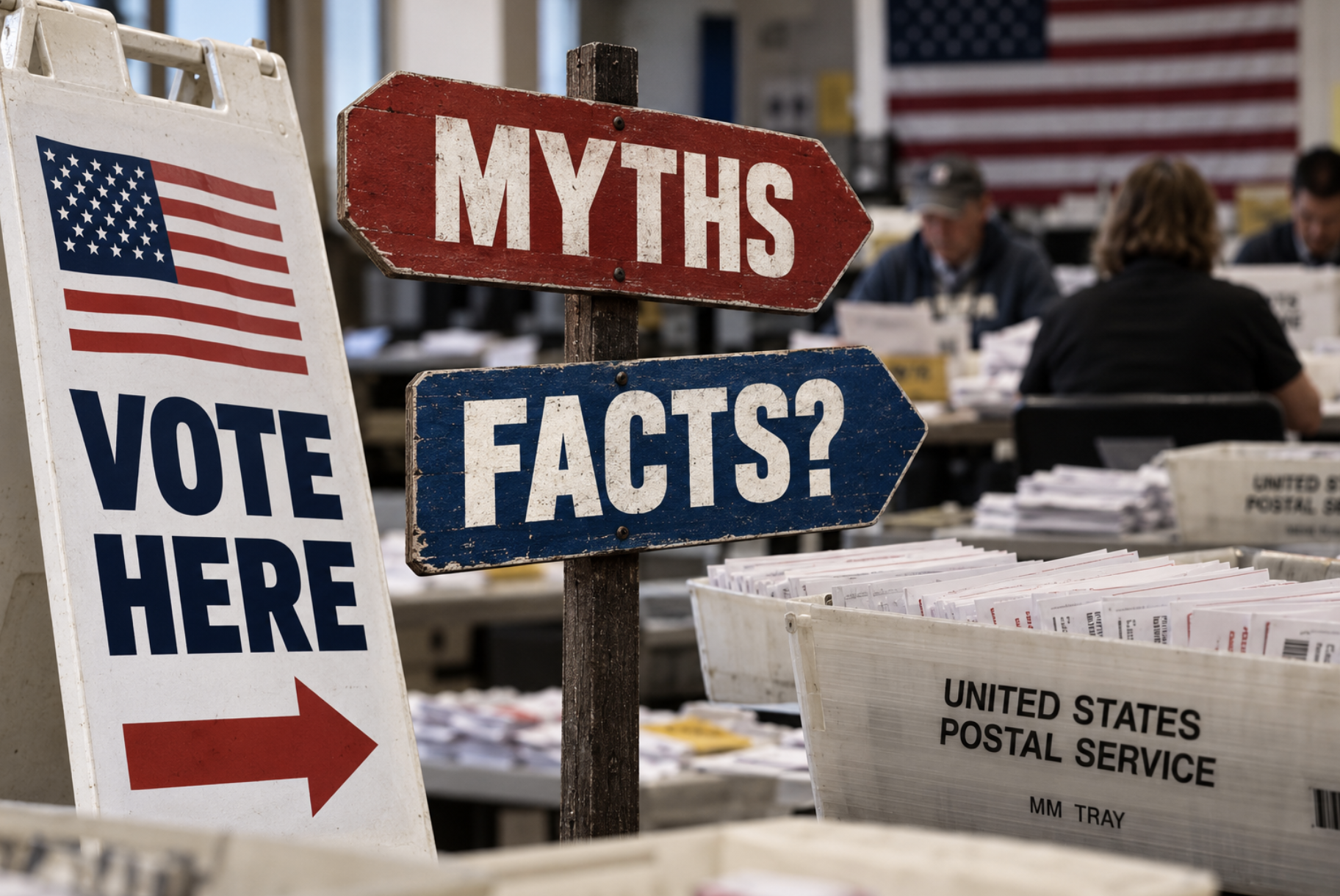
Every cycle produces the same confusion once polls close: some states call their competitive races within an hour, others take a week, and a lot of people assume the slow ones must mean something has gone wrong. Heading into the November 3 midterms, here are five common myths about how all of this actually works.
Myth: A race that isn’t called on election night means something has gone wrong
Stephen Richer, who used to run elections in Arizona’s Maricopa County, one of the most populous in the country, has pointed out that Utah’s races get called quickly and draw almost no scrutiny, even though Utah counts votes at a similar pace to slower states like Arizona or California. The real difference is margin, not competence. Utah’s contests are usually won by wide margins, so networks feel safe calling them early even with plenty of ballots still uncounted. Close races everywhere, regardless of state, take longer simply because there is less room for error in the call. Richer has described the perception that fast calling states have finished counting as an illusion of completeness, since no state actually finishes on election night itself.
Myth: Every state finishes counting its ballots on election night
None do, not even the ones that call races fastest. Alaska did not reach 95 percent of its ballots counted until well after election night in 2024, according to MIT Election Lab data, and California’s count regularly runs into the following week because the state allows mail ballots to be postmarked by Election Day and still counted if they arrive as late as November 10. A UCLA analysis found that millions of Californians cast mail ballots in the final days before an election, which makes a lingering count mathematically unavoidable rather than suspicious. Since newly elected members of Congress do not actually take office until January, a week or so of continued counting does not functionally delay anything.
Myth: Ballots that arrive after Election Day are illegal to count
This was a live legal question this year, and it has already been settled. The Supreme Court ruled on June 29 in a case brought by the Republican National Committee against Mississippi’s mail ballot rules, which let ballots postmarked by Election Day count if they arrived up to five business days later. In a 5 to 4 ruling, the Court held that federal law governs when a voter must finish casting a ballot, not when election officials must receive it. Justice Amy Coney Barrett, writing for the majority in an unusual coalition that included Chief Justice Roberts alongside the Court’s more liberal members, wrote that the electorate’s choice is made when voting is complete, not when ballots are received. Justice Alito dissented, warning at oral argument that “we don’t have Election Day anymore. We have election month, or we have election months.” Fourteen states plus Washington, D.C. currently have grace periods like Mississippi’s, and this ruling lets all of them keep operating as before.
Myth: A close race automatically triggers a recount
Not everywhere, and not automatically in every close contest. Twenty six states plus Washington, D.C. have automatic recount laws, but the trigger varies a lot. Arizona recounts automatically when a margin is 0.5 percent or less, Alaska only on an exact tie, and Iowa lowered its own threshold in 2025 from 1 percent down to 0.15 percent for statewide and federal races. California has no automatic recount provision at all. Any voter there can request one, but they generally have to pay for it themselves. A close margin in a given state might mean an automatic recount, a requested and paid for recount, or no recount at all, depending entirely on where the race happened to take place.
Myth: Grace periods for mail ballots mostly benefit one side, or are some kind of trick
A Votebeat analysis of eleven of the fifteen jurisdictions with grace periods found that more than 745,000 absentee ballots arrived after Election Day in 2024, never more than about 3 percent of the total vote in any single state. Groups like the Brennan Center argued in their Supreme Court brief that grace periods matter most for military voters and Americans living overseas, who often have no realistic way to vote except by mail and limited control over postal delays. Even officials in Mississippi, the state whose law was at the center of the case, did not ask the Court to scrap the grace period entirely after losing. Mississippi’s attorney general instead said she hopes the state legislature will require ballots to be received the same day they are cast at a polling place, a narrower fix rather than an argument that late arriving ballots as a category are illegitimate.
Why this matters to voters
A result that takes days to finalize is not evidence of anything going wrong. It usually just means the race was close enough, or the state’s mail ballot rules generous enough, that officials need the extra time to count every eligible vote accurately. Knowing which of your state’s deadlines and recount rules actually apply, rather than assuming every state works the same way, is the most useful thing you can know heading into this Tuesday.
Watch:
Vox, “How the US counts votes”
References
Votebeat, Supreme Court ruling in Watson v. RNC on mail ballots and absentee deadline grace periods
Wikipedia, Watson v. Republican National Committee

- Five Myths About Why Some Races Won’t Be Called on Election Night - October 30, 2026
- How to Actually Spot an AI Generated Election Fake Before You Share It - October 28, 2026
- Early Voting Just Started for the 2026 Midterms, and the Story Behind It Goes Back Further Than You’d Think - September 18, 2026