
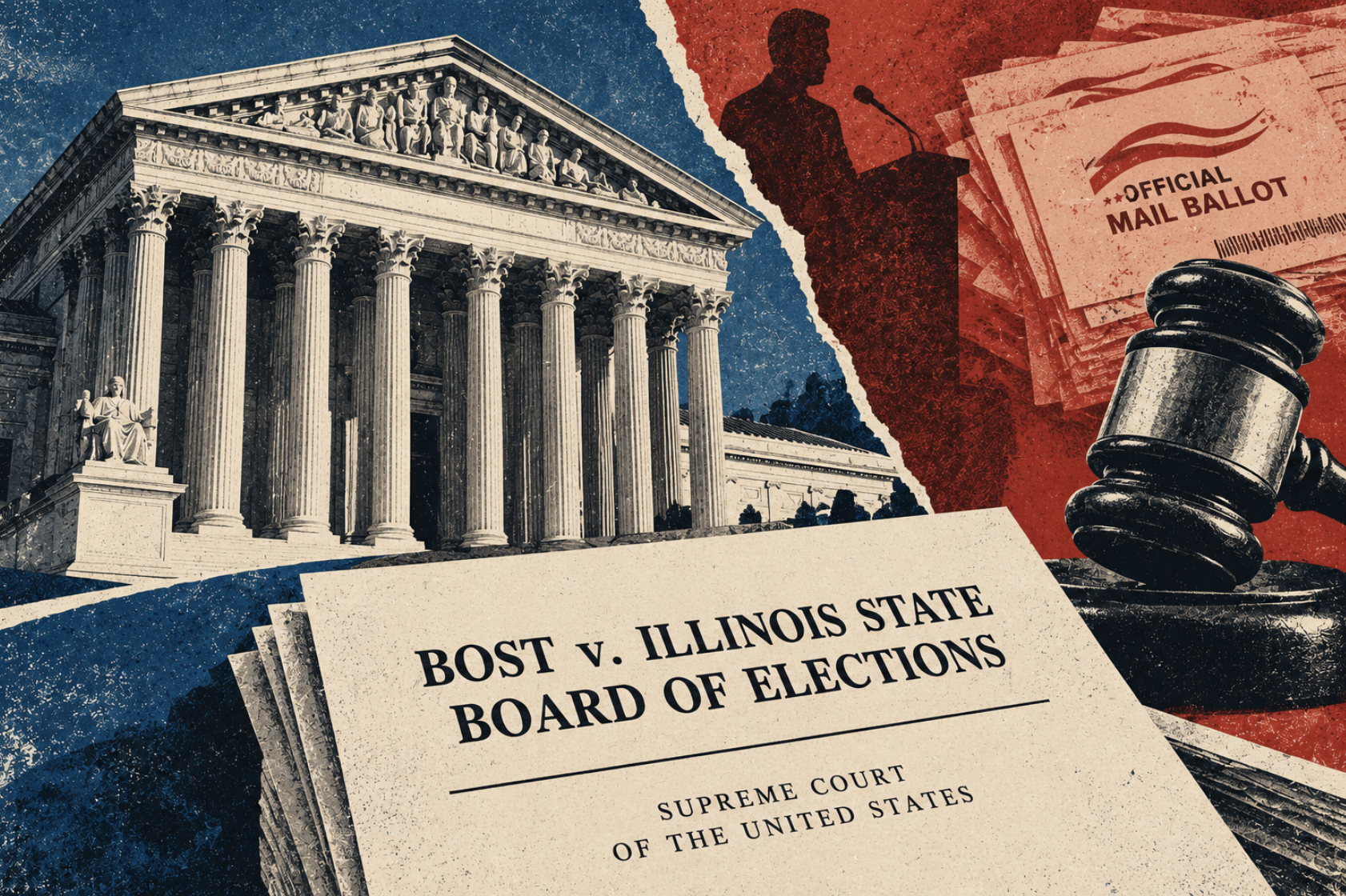
Most Supreme Court election cases make headlines because of what they decide about an actual voting rule. Bost v. Illinois State Board of Elections is a little different. The justices never actually ruled on whether Illinois’s mail ballot deadline is legal. Instead, they spent the entire case arguing about something much more technical, and arguably more consequential: whether the person challenging that deadline was even allowed to bring the lawsuit in the first place.
That question, in legal terms, is called standing, and it is one of the quieter gatekeeping rules in American courts. To sue over almost anything, you generally have to show you were actually harmed by whatever you are challenging, not just that you disagree with it on principle. Courts use standing to screen out lawsuits from people who have a policy objection but no real personal stake in the outcome. It sounds like a technicality, and most of the time it is treated like one. In this case, it was the entire ballgame.
The dispute started in Illinois, where state law allows mail ballots to be counted if they are postmarked by Election Day and arrive within the following fourteen days, or if they carry a voter’s signature and date even when the postmark itself is unreadable or missing. Representative Mike Bost, an Illinois congressman, sued the state election board in 2022 along with two Republican officials, represented by the conservative legal group Judicial Watch, arguing that counting ballots after Election Day conflicts with the federal law setting a single national Election Day for federal office.
A federal district judge dismissed the case in 2023 without ever reaching that argument, ruling that Bost had not shown he was personally harmed enough by the law to have standing to sue over it. The Seventh Circuit Court of Appeals agreed in a split decision later that year. For two straight rulings, the case died on a threshold question before anyone addressed whether Illinois’s actual ballot counting rule was lawful.
The Supreme Court saw it differently. The justices agreed to hear the case in mid 2025, heard oral argument that October, and ruled on January 14, 2026, reversing the lower courts by a 7 to 2 vote in an opinion from Chief Justice John Roberts. The majority held that a candidate running for federal office does have standing to challenge the time, place, and manner rules governing his own election, reasoning that a sitting or future member of Congress has an obvious personal stake in how ballots in his own race get counted. Justice Amy Coney Barrett wrote a separate opinion agreeing with the outcome, joined by Justice Elena Kagan, while Justices Ketanji Brown Jackson and Sonia Sotomayor dissented.
It is worth being precise about what the Court actually decided and what it did not. The ruling says nothing about whether Illinois’s fourteen day mail ballot window is legal. It only says Bost is allowed to make that argument in court, something two lower courts had refused to let him do. The case now goes back down to be argued on the merits, meaning the real fight over Illinois’s ballot counting rule is only now beginning, roughly four years after Bost first filed suit.
The broader significance reaches well past Illinois. Plenty of federal candidates in other states have wanted to challenge how their own elections get administered, from mail ballot deadlines to how write in votes get counted, and many of those lawsuits have been thrown out over the same standing objection that initially killed Bost’s case. By settling that candidates generally do have standing to sue over the rules governing their own races, the Court has effectively reopened a door that lower courts had been closing for years, which means more of these disputes are likely to actually reach a decision on the merits going forward, rather than getting dismissed before anyone addresses the underlying rule at all.
Why this matters to voters
You do not need to be a candidate, or even particularly interested in Illinois, to feel the effects of a ruling like this. Lawsuits over how ballots get counted shape the rules every voter operates under, and a decision that makes it easier for candidates to bring those challenges means more of this litigation will likely play out in the years ahead, sometimes uncomfortably close to an actual election. Knowing that this fight is often decided on a technical question of who gets to sue, long before anyone argues about the rule itself, is a useful lens for reading the next headline about an election lawsuit making its way through the courts.
References
Wikipedia, Bost v. Illinois State Board of Elections
SCOTUSblog, Bost v. Illinois State Board of Elections
Cornell Legal Information Institute, Bost v. Illinois State Bd. of Elections

- A Supreme Court Case You Probably Missed Could Open the Door to a Lot More Election Lawsuits - October 9, 2026
- Dark Money Is Pouring Into the 2026 Midterms. Here Are Five Myths About How It Actually Works - September 21, 2026
- The Supreme Court Just Blocked Trump’s Mail Ballot Restrictions. Here’s What That Means - September 17, 2026