
On April 28, 2026, Rep. Brandon Gill (R-TX) sat across from American University law professor Jessica Waters at a House Judiciary Subcommittee hearing and asked: “What is your favorite type of abortion?” Waters declined to answer. Gill then proceeded to read, one by one, clinical descriptions of four different abortion procedures, asking after each one whether she preferred that method. The exchange went viral, reaching 5.7 million views on X within 24 hours, and became one of the most discussed moments from a congressional hearing in 2026. The hearing was about the FACE Act. The FACE Act — the Freedom of Access to Clinic Entrances Act — is a 1994 federal law that was originally passed to stop violence at abortion clinics after a physician was shot and killed outside a Florida clinic in 1993. In 2026, it has been used to pardon anti-abortion protesters, charge journalists and church demonstrators, and become the subject of a congressional repeal bill. This article explains what the FACE Act actually says, why it was passed, how three administrations have enforced it differently, what happened at the April 2026 hearing, and why it matters for election updates in the US heading into November.
What the FACE Act Actually Says
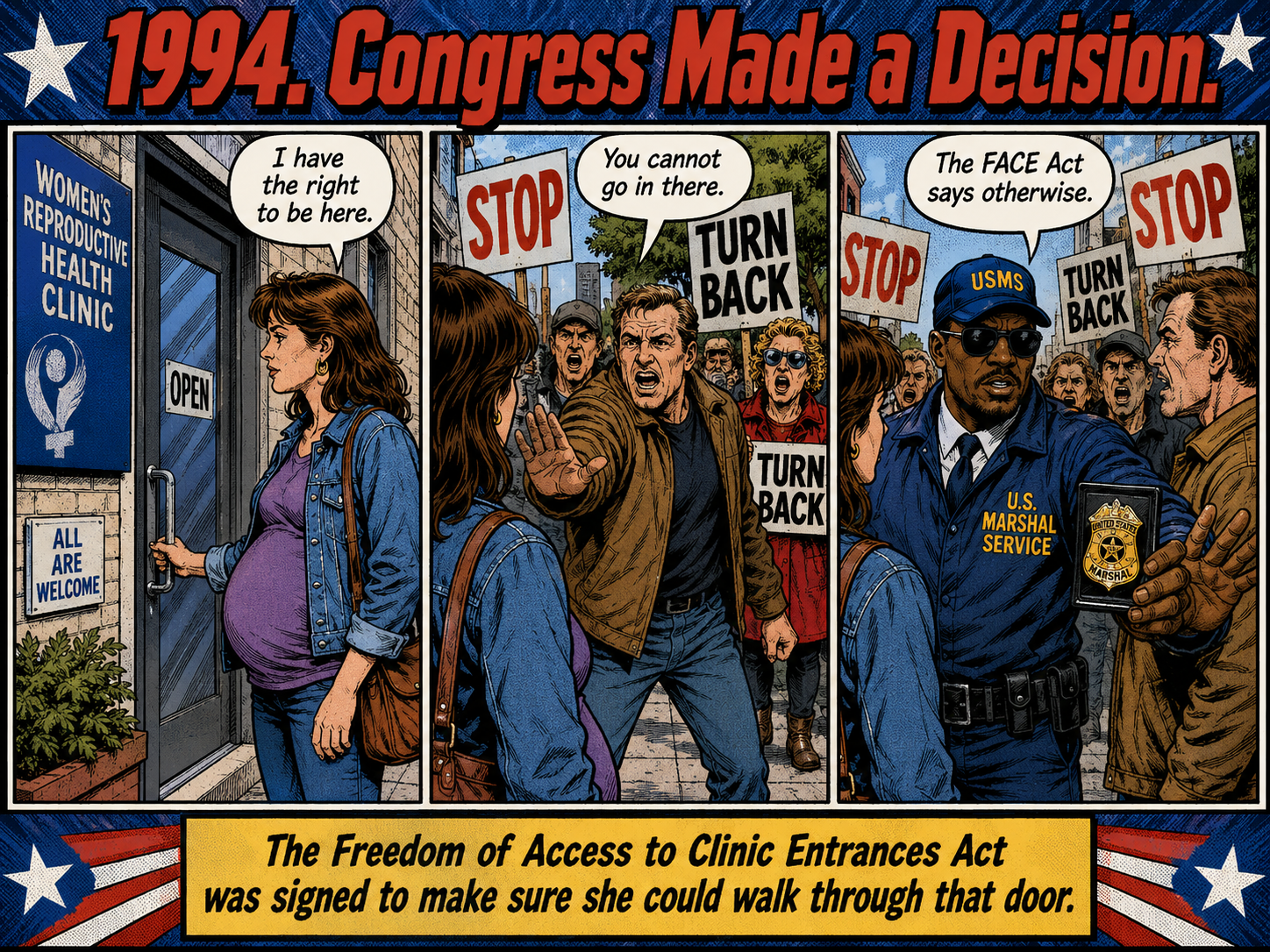
The full text of 18 U.S. Code § 248, published by Cornell Law School’s Legal Information Institute, establishes three prohibited acts:
Subsection (a)(1): Using force, threat of force, or physical obstruction to intentionally injure, intimidate, or interfere with any person who is obtaining or providing reproductive health services
Subsection (a)(2): The same conduct directed at any person lawfully exercising or seeking to exercise the First Amendment right of religious freedom at a place of religious worship
Subsection (a)(3): Intentionally damaging or destroying the property of a reproductive health facility or place of religious worship
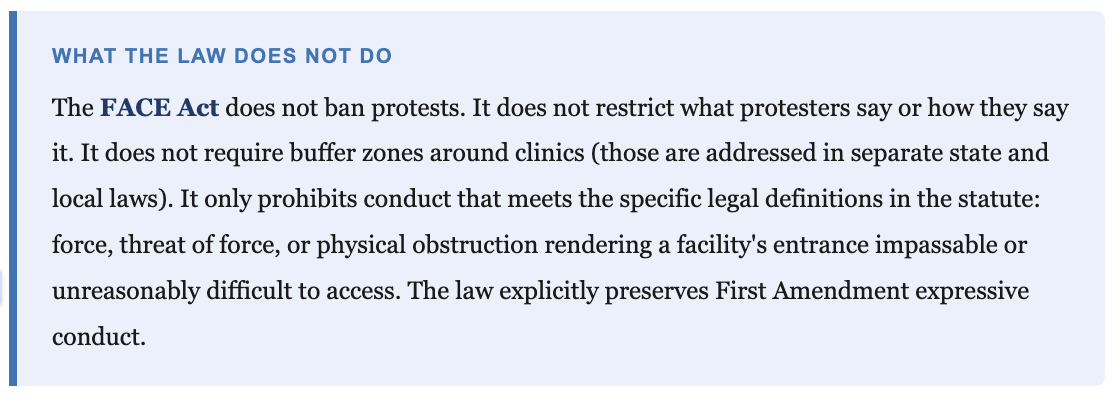
The law explicitly states in subsection (d)(1) that it does not prohibit “any expressive conduct (including peaceful picketing or other peaceful demonstration) protected from legal prohibition by the First Amendment.” Peaceful protest outside a clinic or church is lawful. Physical obstruction, force, or threat of force is what the law criminalizes.
The penalties under the statute are:
First offense: fine and/or up to one year in prison
Second and subsequent offenses: fine and/or up to three years in prison
First offense involving only nonviolent physical obstruction (such as a sit-in or blockade): fine up to $10,000 and/or up to six months in prison
If bodily injury results: up to 10 years in prison
If death results: any term of years or life in prison
The law also creates civil remedies. Any aggrieved person may sue for damages of $5,000 per violation. The Attorney General of the United States and state attorneys general may also bring civil enforcement actions, with civil penalties up to $15,000 for first violations and $25,000 for subsequent violations.
Why the FACE Act Was Passed: The Violence That Preceded It
According to the First Amendment Encyclopedia at Middle Tennessee State University, authored by Professor Susan Gluck Mezey of Loyola University Chicago, Congress passed the FACE Act in direct response to an escalating pattern of violence and clinic blockades in the early 1990s. By 1994, 52% of clinics reported experiencing severe violence, classified as blockades, invasions, bombings, arsons, chemical attacks, stalking, physical violence, gunfire, bomb threats, death threats, and murder.
The legislation was introduced in the House by Rep. Charles Schumer (D-NY) and Rep. Constance Morella (R-MD) in February 1993, two weeks after the March 1993 shooting death of Dr. David Gunn outside the Pensacola Women’s Medical Services clinic in Florida. Dr. Gunn was shot and killed by Michael F. Griffin, an anti-abortion activist, making him the first abortion provider murdered in the United States. A second physician was wounded in Wichita, Kansas, in the same period.
A further legal trigger for the legislation was the Supreme Court’s 1993 decision in Bray v. Alexandria Women’s Health Clinic, in which the Court held 6 to 3 that women seeking abortions were not within the class of people protected by the 1871 Ku Klux Klan Act, which had been used by some federal judges to restrain clinic blockades. That ruling removed an existing legal tool from prosecutors, creating the need for new federal legislation specifically addressing clinic access.
The bill passed with bipartisan support. Senate Bill 636 of the 103rd Congress cleared the Senate and was signed into law by President Bill Clinton on May 26, 1994. According to the National Abortion Federation’s FACE Act reference document, the Clinton administration prosecuted 17 defendants in 1997 alone and averaged approximately 10 defendants per year since the law’s enactment. In the years immediately following passage, the percentage of clinics reporting severe violence dropped significantly from the 52% recorded in 1994.
How Three Administrations Enforced the FACE Act Differently
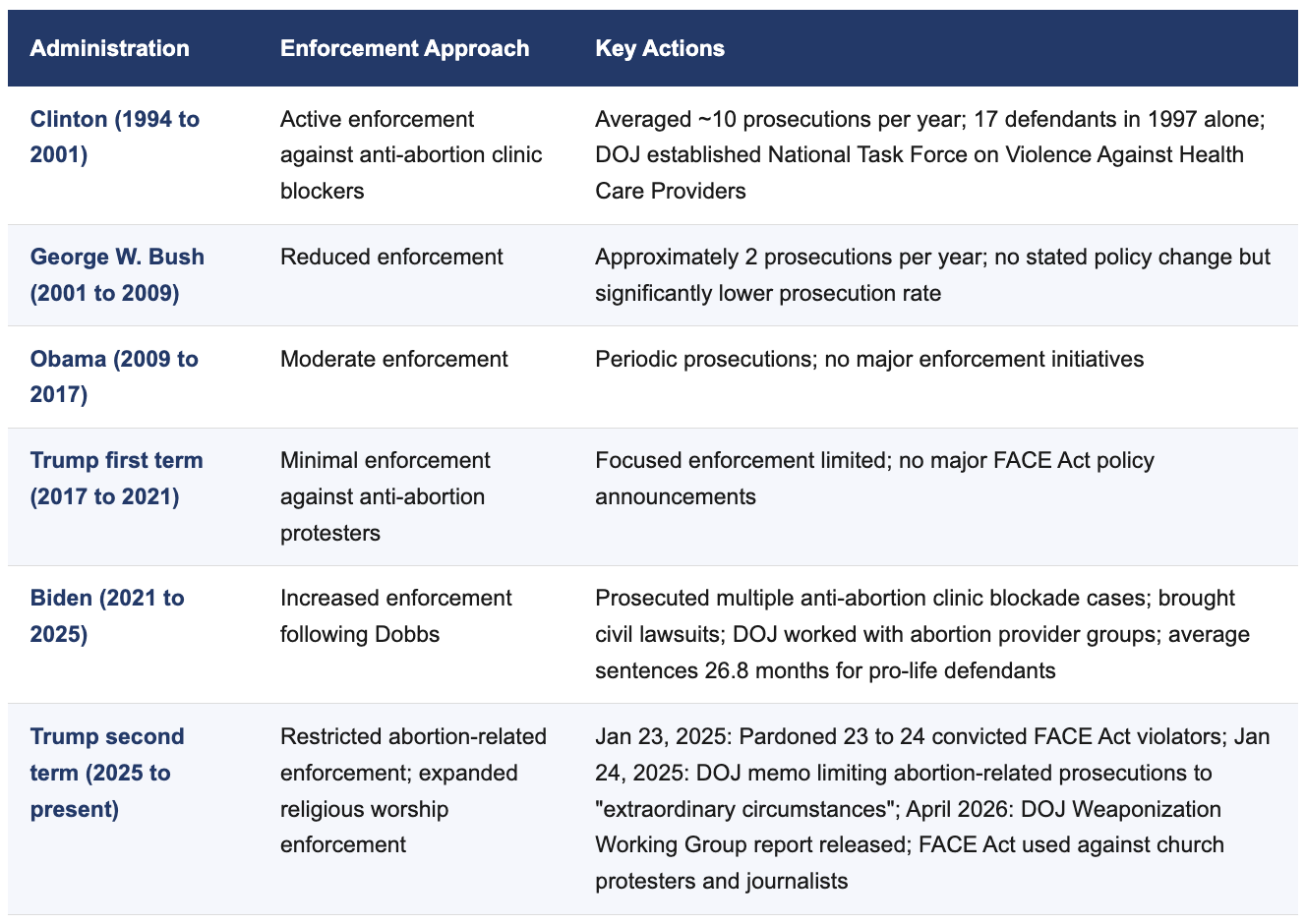
The DOJ’s April 14, 2026 Weaponization Working Group report stated that based on a review of over 700,000 internal records, the Biden DOJ coordinated with pro-abortion groups including the National Abortion Federation, Planned Parenthood, and the Feminist Majority Foundation to track pro-life activists and develop prosecution targets. The report stated that Biden-era prosecutors sought average sentences of 26.8 months for pro-life defendants convicted under the FACE Act, compared to 12.3 months for defendants convicted of attacks on crisis pregnancy centers.
Former DOJ civil rights attorneys who worked on FACE Act cases under the Biden administration publicly challenged the report’s characterizations. A detailed rebuttal published by Just Security, written by former DOJ civil rights division attorneys, stated the report “cherry picks through hundreds of deliberative internal emails, mischaracterizes the factual record, and disregards multiple court rulings and jury verdicts.” The rebuttal noted that the two-tiered standard the report criticized was in fact the opposite: the Biden administration did bring FACE Act cases involving attacks on crisis pregnancy centers, including the prosecution of Gabriella Oropesa for spray-painting threatening messages on a CPC.
How the Trump Administration Used the Law Against Protesters and Journalists
The most striking aspect of the current administration’s FACE Act enforcement is not what it stopped doing but what it started doing: using the law’s religious worship provision, subsection (a)(2), in ways that have generated significant legal controversy.
On January 18, 2026, protesters entered Cities Church in St. Paul, Minnesota, chanting “ICE out” during a service at which the pastor reportedly works with Immigration and Customs Enforcement. The protest was connected to the shooting death of Renee Good, a woman killed by an ICE officer, which had sparked demonstrations across the city.
On January 22, 2026, the DOJ announced charges against more than 30 people connected to the church protest under the FACE Act’s religious worship provision. Among those charged was Don Lemon, a former CNN anchor and independent journalist, who stated he was present to chronicle the protest as a journalist and was not a participant. Lemon stated publicly he would fight what he called “baseless charges.” The FACE Act’s place-of-worship provision carries a penalty of up to one year in prison for a first offense.
The First Amendment Encyclopedia notes that “the constitutionality of the FACE Act’s place-of-worship provision remains unsettled, creating litigation risk for prosecutions brought under it.” Constitutional scholars have noted that the religious worship provision has been invoked far less frequently than the clinic access provision and has less established case law supporting it.
Separately, in September 2025, the administration filed charges against protesters at a synagogue in West Orange, New Jersey, under the same religious worship provision. The event at the synagogue was described in charging documents as a real estate fair for property in the State of Israel and in Israeli settlements. Protesters who disrupted the event faced FACE Act charges alleging their actions were intended to interfere with the attendees’ right to freely exercise their religion.
The Push to Repeal: H.R. 589 and S. 223
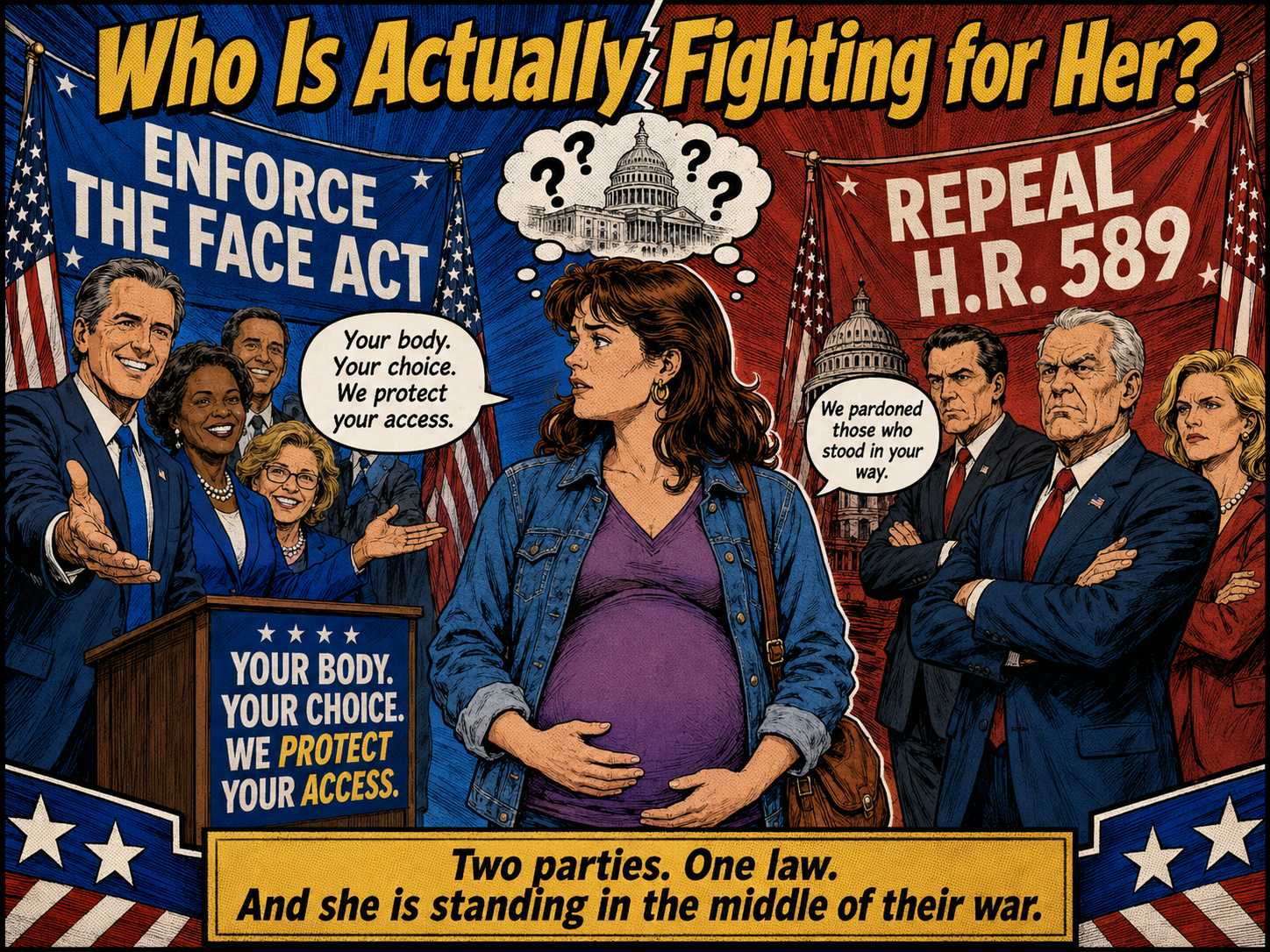
The April 28 hearing did not occur in isolation. It was held in part to build a legislative record for H.R. 589, the FACE Act Repeal Act of 2025, introduced by Rep. Chip Roy (R-TX). The bill would strike 18 U.S.C. § 248 entirely, applying retroactively to pending prosecutions. It passed the House Judiciary Committee on a 13 to 10 party-line vote on March 10, 2025, but had not received a floor vote as of the date of this article.
A companion bill in the Senate, S. 223, was introduced by Sen. Mike Lee (R-UT) in January 2025 and referred to the Senate Judiciary Committee. Neither bill has advanced past committee as of late June 2026.
Among the bill’s opponents is the National Abortion Federation, which has documented the law’s effectiveness since its passage. Its FACE Act reference document notes that by the late 1990s, severe violence at abortion clinics had declined significantly from the 52% reported in 1994, which the organization attributes in part to the FACE Act’s deterrent effect and active federal enforcement during the Clinton years. Critics of repeal argue that dismantling the law would return conditions at clinics to the environment that existed before 1994.
Supporters of repeal argue that the law has been selectively enforced, that its application to abortion-related conduct constitutes content-based restriction of political speech, and that attacks on crisis pregnancy centers — also covered by the law’s property destruction provision — were insufficiently prosecuted by the Biden administration. Witness testimony submitted to the subcommittee on behalf of the Heritage Foundation argued that the law as applied under the Biden administration constituted selective prosecution based on viewpoint.
Constitutional Questions: Does the FACE Act Violate the First Amendment?
A law review article published in the University of Colorado Law Review examining the constitutional dimensions of the FACE Act found that courts have consistently upheld the law against First Amendment challenges since its passage. The cases cited include Terry v. Reno (D.D.C. 1996), United States v. Weslin (2d Cir. 1998), and United States v. Dinwiddie (8th Cir. 1996). In each case, federal courts held that the FACE Act regulates conduct rather than speech, does not restrict any particular viewpoint, and applies evenhandedly to interference with reproductive health facilities and places of religious worship regardless of the actor’s beliefs.
The law’s constitutionality under the First Amendment is therefore settled for its clinic access provision. Its place-of-worship provision has been invoked far less frequently and has less established case law. The First Amendment Encyclopedia notes that the religious worship provision’s constitutionality “remains unsettled,” a distinction that matters given that the Trump administration’s most prominent current FACE Act prosecutions are under that provision rather than the clinic access provision.
Why the FACE Act Matters for the 2026 Midterms
For readers following election updates in the US, the FACE Act debate sits directly at the intersection of abortion policy, federal law enforcement, and congressional composition.
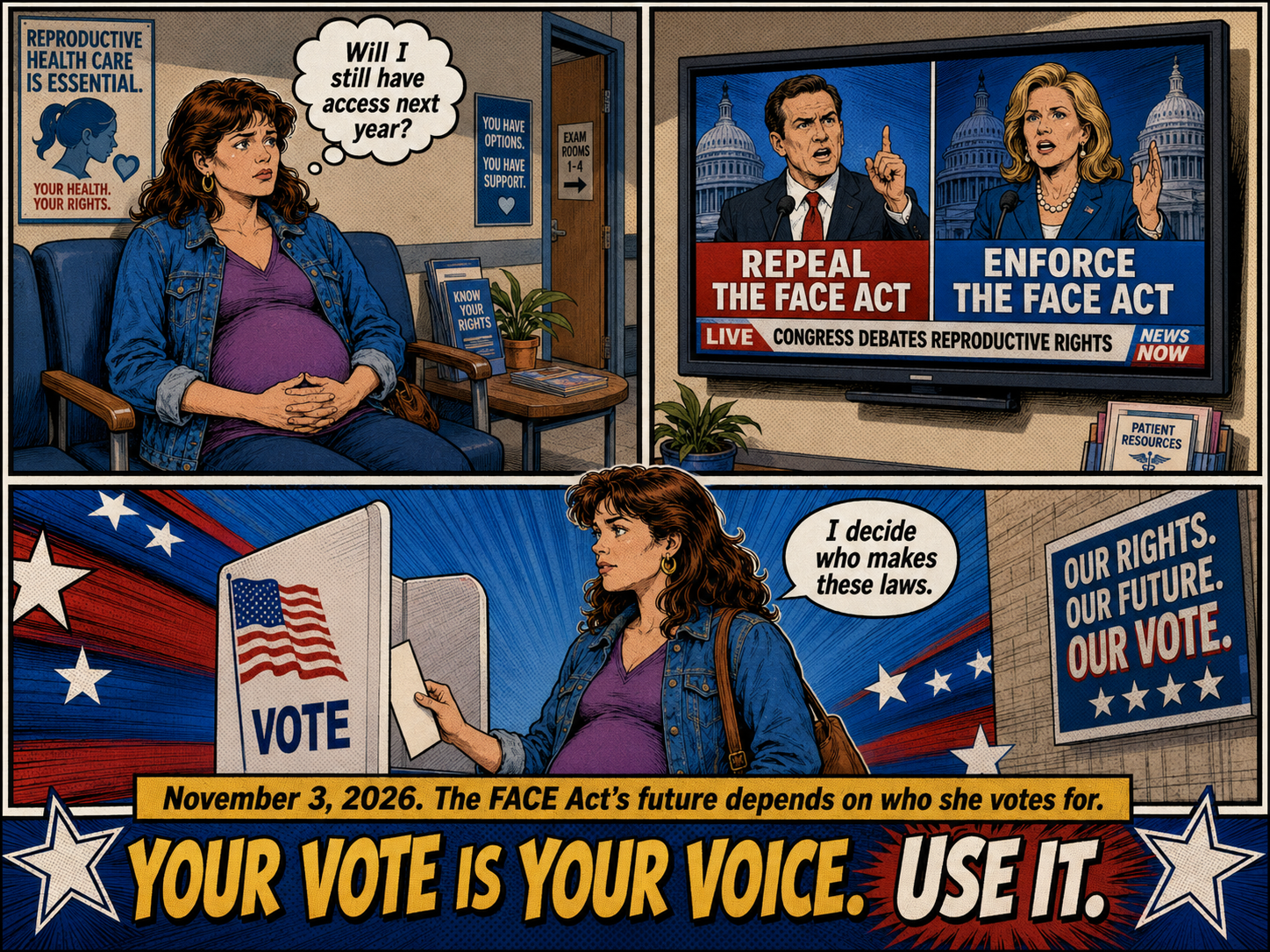
Whether H.R. 589 advances to a floor vote in the House, and whether it can pass the Senate, depends entirely on the composition of Congress after November 3, 2026. If Republicans expand their House majority and gain Senate seats, a FACE Act repeal has a more plausible legislative path. If Democrats flip the House or make gains in the Senate, the repeal bill stalls.
The enforcement question is equally consequential. The DOJ’s January 2026 memo restricting abortion-related FACE Act prosecutions to “extraordinary circumstances” is administrative policy, not law. A future administration could rescind it without any legislative action. Who holds the presidency and which party controls congressional oversight will determine how aggressively the clinic access provision is enforced after 2026.
The viral Gill/Waters exchange also signals how abortion will function as a campaign issue in 2026 beyond just ballot measures and candidate positions. The exchange reframed the FACE Act hearing from a technical debate about federal enforcement policy into a national conversation about abortion procedures themselves, which both parties have now publicly staked out positions on in ways that will be cited in campaign advertising and voter mobilization through November.
The Bottom Line
The FACE Act is a 32-year-old federal law with three provisions, a clear legislative history rooted in documented clinic violence, and a consistently upheld constitutional foundation for its clinic access provision. In 2026, it is simultaneously being restricted in one direction (abortion clinic enforcement), expanded in another (religious worship enforcement), and targeted for full repeal by a House subcommittee whose chairman is also its repeal bill’s sponsor.
The April 28 hearing, and the Brandon Gill and Jessica Waters exchange that emerged from it, crystallized why this law remains so politically charged: it sits at the exact point where First Amendment rights, abortion access, religious freedom, and federal law enforcement authority all converge. That convergence is not going to be resolved before November. The November 3 elections will determine who controls the Congress that decides whether the law survives, and who controls the executive branch that decides how it is enforced. Both decisions carry real consequences for anyone who enters a clinic, protests outside one, or worships in a building that may become the subject of the statute’s contested religious provisio.
References:
National Abortion Federation. Freedom of Access to Clinic Entrances Act
U.S. Congress. Witness Statement of Roger Severino, House Judiciary Committee Hearing
U.S. Congress. S.636, Freedom of Access to Clinic Entrances Act of 1994
Cornell Law School Legal Information Institute. 18 U.S. Code § 248, Freedom of Access to Clinic Entrances
The First Amendment Encyclopedia. Freedom of Access to Clinic Entrances Act of 1994
University of Colorado Law Review. Freedom of Access to Clinic Entrances Act Analysis

- A Supreme Court Case You Probably Missed Could Open the Door to a Lot More Election Lawsuits - October 9, 2026
- Dark Money Is Pouring Into the 2026 Midterms. Here Are Five Myths About How It Actually Works - September 21, 2026
- The Supreme Court Just Blocked Trump’s Mail Ballot Restrictions. Here’s What That Means - September 17, 2026