
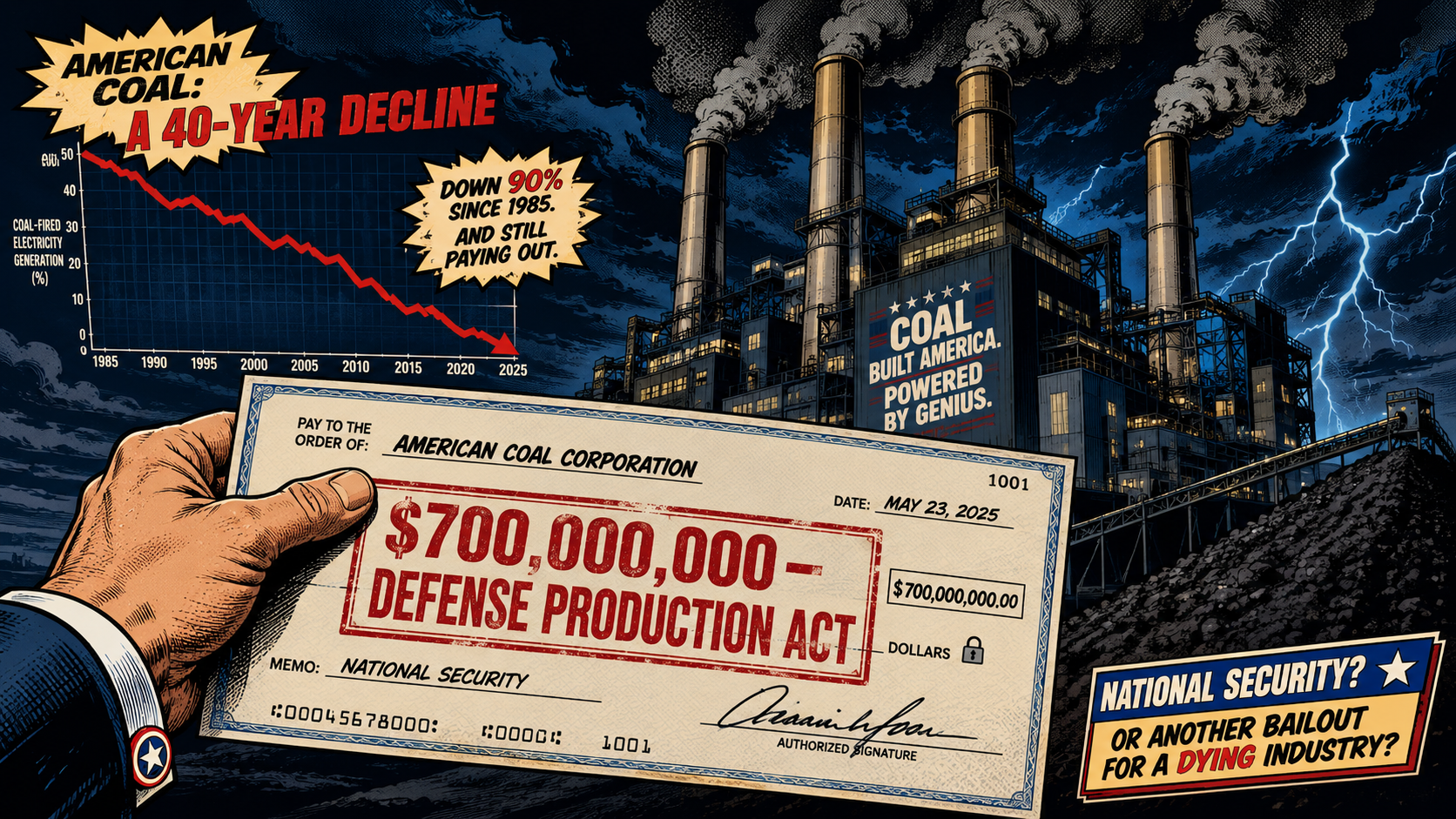
On June 4, 2026, President Trump announced nearly $700 million in new federal support for the US coal industry, invoking the Defense Production Act of 1950 to direct funds toward 13 existing coal plants, two new coal plants, and a proposed West Coast coal export terminal. As Axios reported, confirming a White House statement, the administration framed the announcement as part of a broader effort to revive an energy source that has been in sustained decline for nearly two decades. The question the announcement raises is not whether the federal government has the authority to spend this money on coal. It does. The question is what nearly $700 million in federal support actually changes for an industry that has seen its production fall by nearly half since 2014, that employs 44,060 people, and that now accounts for approximately 16% of US electricity generation. This article explains what the US coal industry is, what drove its decline, what the government is now doing, and what the evidence shows about whether federal intervention can reverse structural market forces.
The US Coal Industry in Numbers
The US Energy Information Administration’s Annual Coal Report provides the most complete factual picture of where the industry stands. All figures below are from EIA’s official data:
512.5MShort tons of coal produced in 2024, down 11.3% from 2023 (EIA)
524Active coal mines in the US in 2024, down from 560 in 2023 (EIA)
44,060Average number of coal mine employees in 2024 (EIA)
16%Share of US electricity generation from coal in 2026 (EIA)
410.9MShort tons of coal consumed in the US in 2024, down 64% from the 2007 peak (EIA)
$86.72Average sales price per short ton of bituminous coal in 2024, down 9.9% from 2023 (EIA)
EIA forecasts US coal production to decline from 512 million short tons in 2024 to 483 million short tons in 2025 and 467 million short tons in 2026, citing sustained competition from natural gas and renewable energy in the electricity sector. EIA further projects annual coal consumption will fall below 200 million short tons by 2050 under its reference case scenario.
The peak of US coal production was reached in 2008 at 1.17 billion short tons. According to the Congressional Research Service’s June 2025 report on US Coal Industry Trends, production declined 49% between 2014 and 2024. Coal accounted for 23% of US primary energy consumption in 2000. By 2024, that share had fallen to 8%.
What Actually Caused the US Coal Industry to Decline
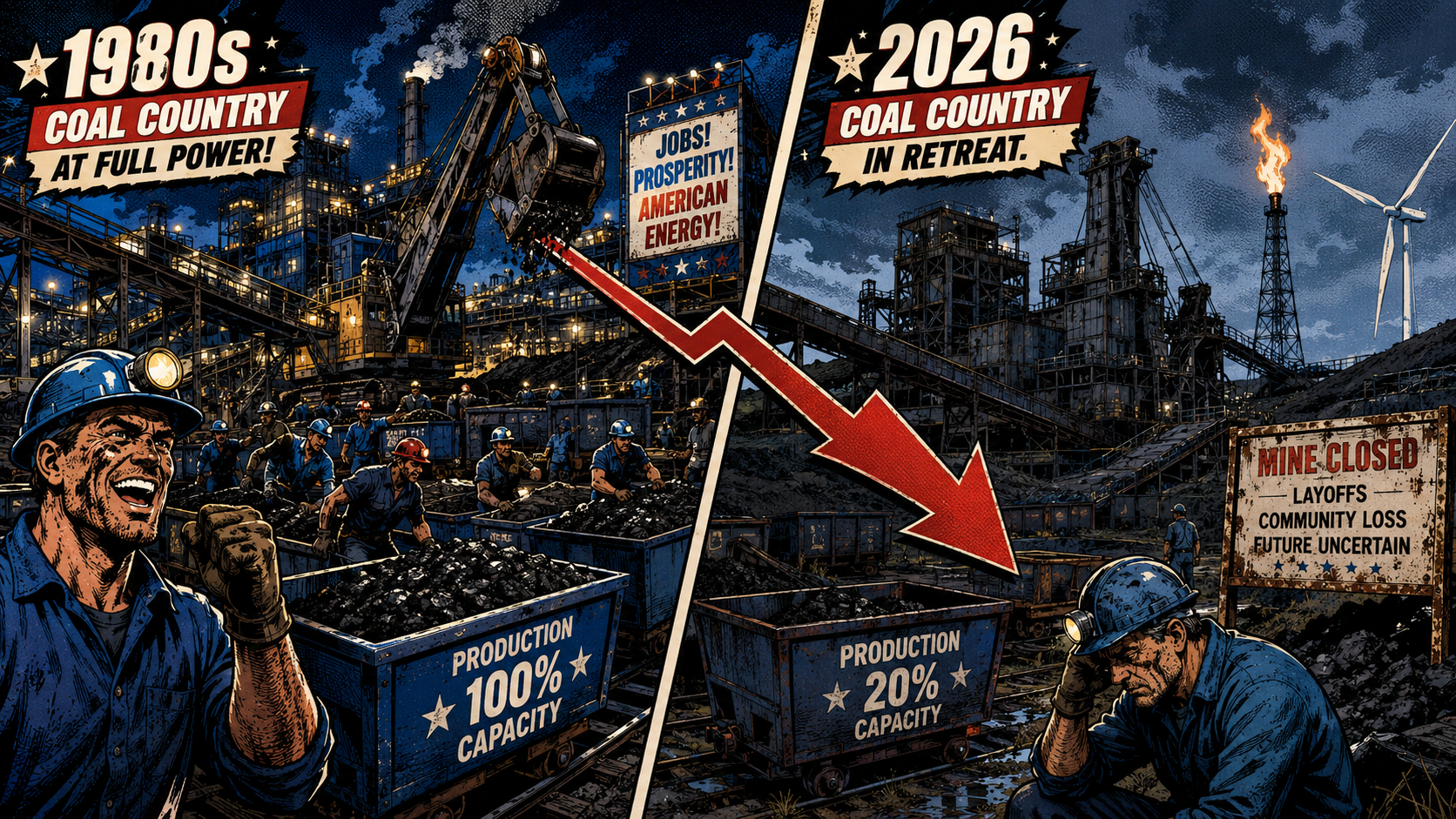
The causes of the US coal production decline are documented across multiple independent research sources and are not primarily attributable to a single policy decision or administration.
A policy brief by Charles D. Kolstad, Senior Fellow at the Stanford Institute for Economic Policy Research (SIEPR), examined the competing explanations for coal’s decline and reached a clear conclusion. Kolstad identified four suspects:
Environmental regulations — cited by some as the primary cause
Railroad deregulation in the 1970s — which shifted competitive advantage to cheaper Western coal, causing job losses in the labor-intensive Eastern coal industry
The fracking revolution — which drove down natural gas prices, making coal less competitive for electricity generation
Productivity gains in coal mining — meaning fewer workers are needed to produce the same amount of coal, reducing employment regardless of output levels
Kolstad’s conclusion, after examining the evidence for each factor: environmental regulations did not kill coal. Progress is the culprit. The fracking revolution and associated collapse in natural gas prices is the dominant force behind coal’s displacement in electricity generation. Productivity improvements in coal mining explain the job losses independent of output levels.
This finding is consistent with the Congressional Research Service’s assessment, which identifies the structural shift in US electricity markets as the core driver: in 2016, natural gas overtook coal as the leading fuel for US power generation. Coal-fired power plants are retiring at higher rates than other generators. Nearly 300 coal-fired power stations closed between 2010 and 2019 alone.
The Market Reality
Natural gas currently accounts for more than 40% of US electricity generation. Renewable energy accounts for approximately 24%. Nuclear power accounts for approximately 19%. Coal vs natural gas energy competition is the central force shaping coal’s market position, and that competition is driven by price, not by federal policy. When natural gas is cheap, coal plants become economically uncompetitive regardless of regulatory conditions.
The Trump Administration’s Coal Policy: Executive Orders and Federal Actions
The $700 million June 2026 announcement is the latest in a series of federal actions the Trump administration has taken to support the US coal industry since taking office in January 2025.
Executive Order 14261: April 8, 2025
On April 8, 2025, President Trump signed Executive Order 14261, titled “Reinvigorating America’s Beautiful Clean Coal Industry and Amending Executive Order 14241.” The order stated that in order to secure America’s economic prosperity and national security, lower the cost of living, and provide for increases in electrical demand from emerging technologies, the United States must increase domestic energy production, including coal.
The key provisions of Executive Order 14261 were:
Designated coal as a “mineral” under Executive Order 14241, entitling it to all benefits previously reserved for minerals including expedited permitting and priority access to federal land
Directed the Chair of the National Energy Dominance Council to assess coal resources and accessibility on federal lands within 60 days
Required federal agencies including the EPA, Departments of Transportation, Interior, Energy, Labor, and Treasury to assess anti-coal guidance and propose reversals
Directed agencies to expand use of categorical exclusions under the National Environmental Policy Act to facilitate coal production and export
Directed the Secretary of Energy to determine whether coal used in steel production qualifies as a critical material under federal law
DOE Actions Following the Executive Order
The Department of Energy’s January 2026 fact sheet on coal policy outlined what the department had done in response to the executive order:
Reinstated the National Coal Council (NCC), which had been terminated by the Biden administration in 2021, with its inaugural meeting held January 15, 2026. Jim Grech of Peabody Energy Corp. was named Committee Chair and Jimmy Brock of Core Natural Resources as Vice Chair
On September 29, 2025, DOE announced $625 million to expand and reinvigorate the coal industry, including up to $350 million under Topic 1 for coal commissioning, recommissioning, retrofitting, and modernization projects, and up to $175 million under Topic 2 for rural capacity and energy affordability coal projects. A minimum of 50% cost-sharing from awardees was required
On October 29, 2025, DOE closed a loan to support a coal-powered fertilizer facility in West Terre Haute, Indiana
Made available $200 billion in low-cost financing through DOE’s Loan Programs Office Energy Infrastructure Reinvestment Program for coal energy investments
The DOE’s “State of American Energy: Promises Made, Promises Kept” report framed these coal actions within the administration’s broader energy dominance agenda, which also included record oil and natural gas production, LNG export expansion, and deregulatory actions across the energy sector.
The June 2026 Announcement: What the $700 Million Actually Covers
The June 4, 2026 announcement represents the most direct federal intervention in the US coal industry to date under this administration. According to Axios, citing White House confirmation, and supplemented by reporting from Reuters, Bloomberg, and the Washington Times, the funding breaks down as follows:
| Allocation | Amount | Purpose |
| Existing coal plants | $425 million | Upgrades and support for 13 existing coal-fired power plants |
| New coal plant construction | $185 million | Two new coal plants: one in Alaska, one in West Virginia |
| West Gateway export terminal | $75 million | Proposed West Coast coal export terminal capable of handling 12 million tons per year |
| Total | $685 million | Funded under the Defense Production Act of 1950 |
The legal authority for this spending is the Defense Production Act of 1950, a Cold War-era law granting presidents broad authority over national security-related industries to direct private industrial production deemed vital to US security. The Trump administration has framed coal as essential to national and economic security, to grid reliability for AI data centers, and to reducing dependence on foreign adversaries holding large fossil fuel reserves.
Context on Scale
The $700 million in June 2026 DPA funding comes on top of the $625 million DOE announced in September 2025 for coal plant upgrades and rural energy projects, and the $200 billion in loan financing made available through the DOE Loan Programs Office. The combined federal commitment represents the largest coordinated federal support effort for the US coal industry in the modern era.
What the Defense Production Act Is and How It Is Being Used
The Defense Production Act of 1950 was originally enacted to ensure the United States could mobilize industrial production for national security needs during the Cold War. It grants the president authority to require businesses to prioritize government contracts for materials deemed essential to national defense, to allocate materials and services, and to provide financial incentives to expand domestic production capacity.
The DPA has been invoked by multiple administrations for purposes beyond traditional military production, including during the COVID-19 pandemic to accelerate vaccine manufacturing and personal protective equipment production. The Trump administration’s use of the DPA for coal is the first time the law has been explicitly invoked to fund coal plant construction and upgrades.
The administration’s legal rationale is grounded in the framing of coal as essential to grid reliability and national energy security, consistent with the policy declarations in Executive Order 14261 and a subsequent February 2026 executive order directing the Secretary of Defense to seek long-term power purchase agreements with coal-fired energy facilities for federal military installations.
What the Funding Can and Cannot Change
Federal funding can address specific structural barriers to coal facility operations. What the evidence shows it cannot do, based on independent economic research and EIA projections, is reverse the market forces that have driven the US coal production decline.
The Stanford SIEPR analysis by Charles Kolstad identified the primary driver of coal’s displacement as the price competitiveness of natural gas following the fracking revolution. That competitive dynamic is driven by the market price of natural gas relative to coal, not by federal policy. When natural gas prices are low, coal plants are economically uncompetitive for electricity generation regardless of regulatory conditions or federal subsidies.
The EIA’s own projections, published in the Annual Energy Outlook 2025, forecast coal consumption continuing to decline through 2050 under the reference case scenario, reaching below 200 million short tons per year. Those projections were made after accounting for existing federal policy support for coal.
What the $700 million in DPA funding can do is:
Extend the operational life of specific coal plants that might otherwise close due to deferred maintenance or capital needs
Fund construction of new coal plants in specific regions, particularly in Alaska where grid isolation creates different economic conditions than the contiguous lower 48 states
Build export infrastructure that could increase US coal exports to Asian markets where demand, particularly for metallurgical coal used in steel production, remains stronger than domestic electricity demand
Support coal communities that depend on plant operations for employment and local tax revenue
What independent economic research suggests the funding cannot do is change the underlying price relationship between coal and natural gas in electricity markets, or reverse the structural decline of coal’s share in the US electricity mix driven by that price competition.
Coal and the AI Data Center Argument
One of the administration’s central arguments for reviving the US coal industry is the anticipated surge in electricity demand from artificial intelligence data centers. The administration has argued that AI data centers require around-the-clock, reliable power that variable renewable energy sources cannot provide, and that coal can fill that gap.
This argument reflects a real phenomenon: data center electricity demand is projected to grow significantly through the 2020s and 2030s. Whether coal specifically is well-positioned to meet that demand is a separate question. EIA’s own projections show data center operators across the US primarily seeking long-term power contracts with natural gas, nuclear, and increasingly large-scale renewable energy facilities, rather than coal plants. Several major technology companies have announced commitments to power their data centers with zero-carbon sources.
The coal-for-AI-data-centers argument may be most relevant in specific geographic contexts where grid alternatives are limited and coal plants represent the most immediately available baseload power source.
Coal Jobs: What the Numbers Show
One of the most politically significant aspects of the coal industry jobs United States picture is the disconnect between coal output and coal employment. The Stanford SIEPR analysis explains this directly: coal mining jobs are declining because of the same productivity gains that have reduced manufacturing employment across the US economy. Workers can produce more coal per hour, meaning fewer workers are needed to maintain a given level of output.
The EIA’s 2024 Annual Coal Report confirms the trend: the average number of coal mine employees fell by 1,416 from 2023 to 44,060 in 2024. Mining productivity, measured as average production per employee hour, decreased 7.6% from 2023 to 5.22 short tons per employee hour in 2024, a figure that reflects both the decline in productivity and the reduced output at remaining mines.
The states most affected by coal employment declines include West Virginia, Kentucky, Wyoming, Pennsylvania, and Montana. These are states where coal communities depend on mine and plant operations for employment, local tax revenue, and economic activity. Federal funding directed at extending plant operations has a direct impact on these communities even when it does not change the broader market trajectory of the industry.
How Coal Policy Connects to the 2026 Elections
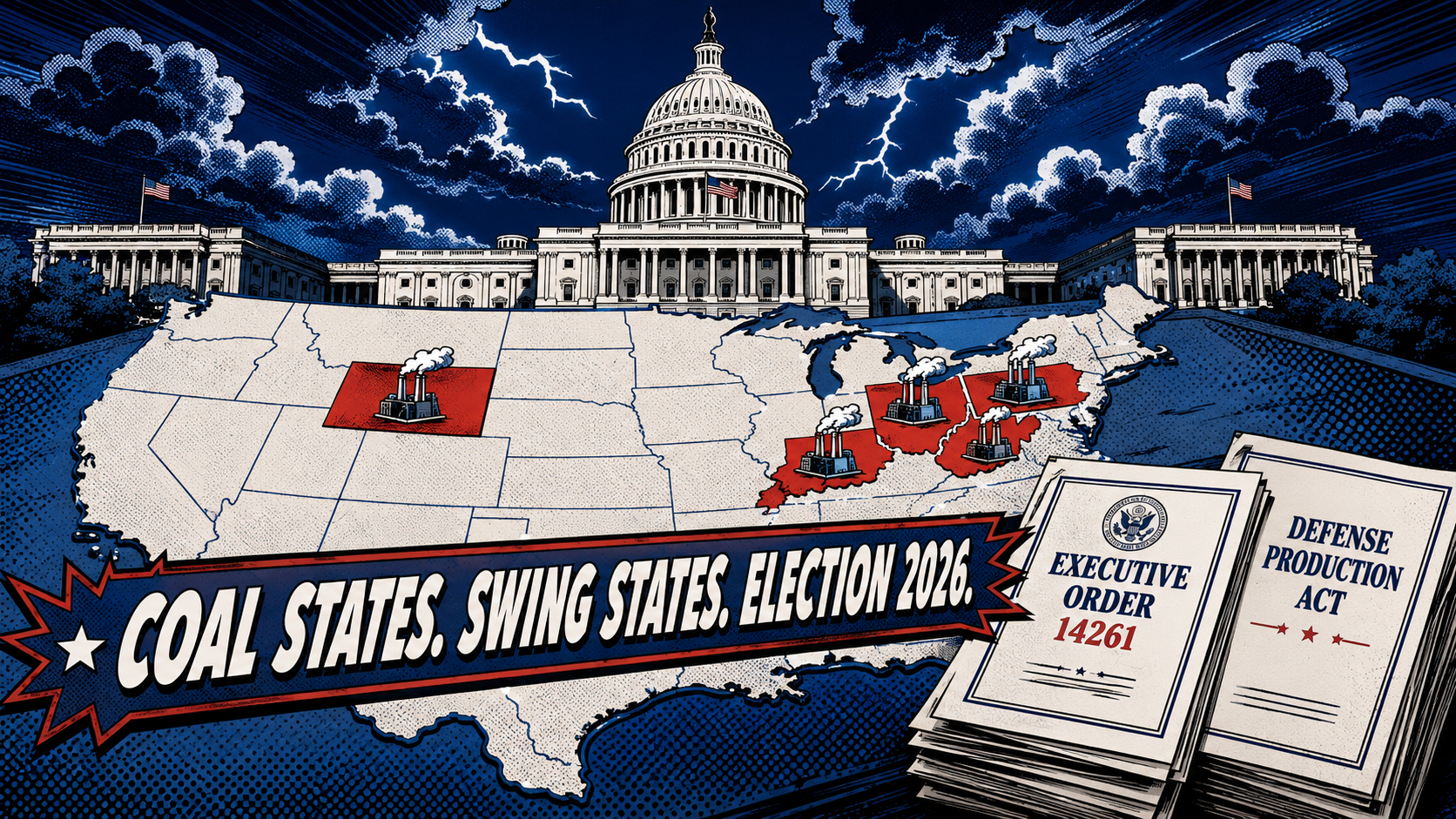
For readers following election updates in the US, coal policy is one of the most geographically concentrated issues in the 2026 midterm cycle. The states where coal employment and production remain significant overlap with competitive Senate and House races that will determine which party controls Congress after November 3, 2026.
West Virginia, where one of the two new coal plants announced in the June 2026 DPA funding will be built, is home to the Senate seat being vacated by a retiring Republican. Ohio, where coal plant upgrades are expected to be among the 13 funded facilities, is home to a competitive Senate special election and multiple competitive House races. Wyoming, which produces more coal than any other state in the Western region, has a Senate seat on the ballot.
The timing of the $700 million announcement, five months before the November general election, is consistent with a pattern the CRS Coal Industry Trends report describes: federal coal policy announcements have historically been timed and targeted to address the economic concerns of communities in coal-producing states that are also competitive in congressional elections.
The Bottom Line
The US coal industry in 2026 is producing 512 million short tons per year, down from a peak of 1.17 billion in 2008. It employs 44,060 people, provides 16% of US electricity, and is projected by EIA to continue declining through the 2020s and beyond. The Trump administration has committed nearly $700 million in Defense Production Act funding toward 13 existing plants, two new plants, and a West Coast export terminal, on top of $625 million in DOE grants announced in September 2025 and $200 billion in loan financing made available through the DOE Loan Programs Office.
What independent economic research from Stanford SIEPR and the Congressional Research Service shows is that the primary driver of coal’s decline is market competition from natural gas following the fracking revolution, not federal policy. Federal funding can extend the life of specific facilities and support specific communities. It cannot change the price of natural gas or reverse the structural shift in how the US generates electricity.
As election updates in the US continue to track the issues shaping November 2026, coal policy represents one of the clearest examples of how energy economics, federal spending authority, and electoral geography intersect in the current political environment.
Sources
Axios: “Trump to Announce Nearly $700 Million in Coal Support” (June 4, 2026)
US Energy Information Administration: Annual Coal Report 2024
US Energy Information Administration: Quarterly Coal Report, Q4 2025
Congressional Research Service: “US Coal Industry Trends” (Report R48587, June 30, 2025)
US Department of Energy: “The State of American Energy: Promises Made, Promises Kept” (2026)

- Why Is Election Day Always a Tuesday in November? - September 4, 2026
- How Does Ranked-Choice Voting Actually Work, and Why Is It Spreading and Getting Banned at the Same Time? - August 17, 2026
- What Happens If Congress Doesn’t Pass a Budget? - August 5, 2026