
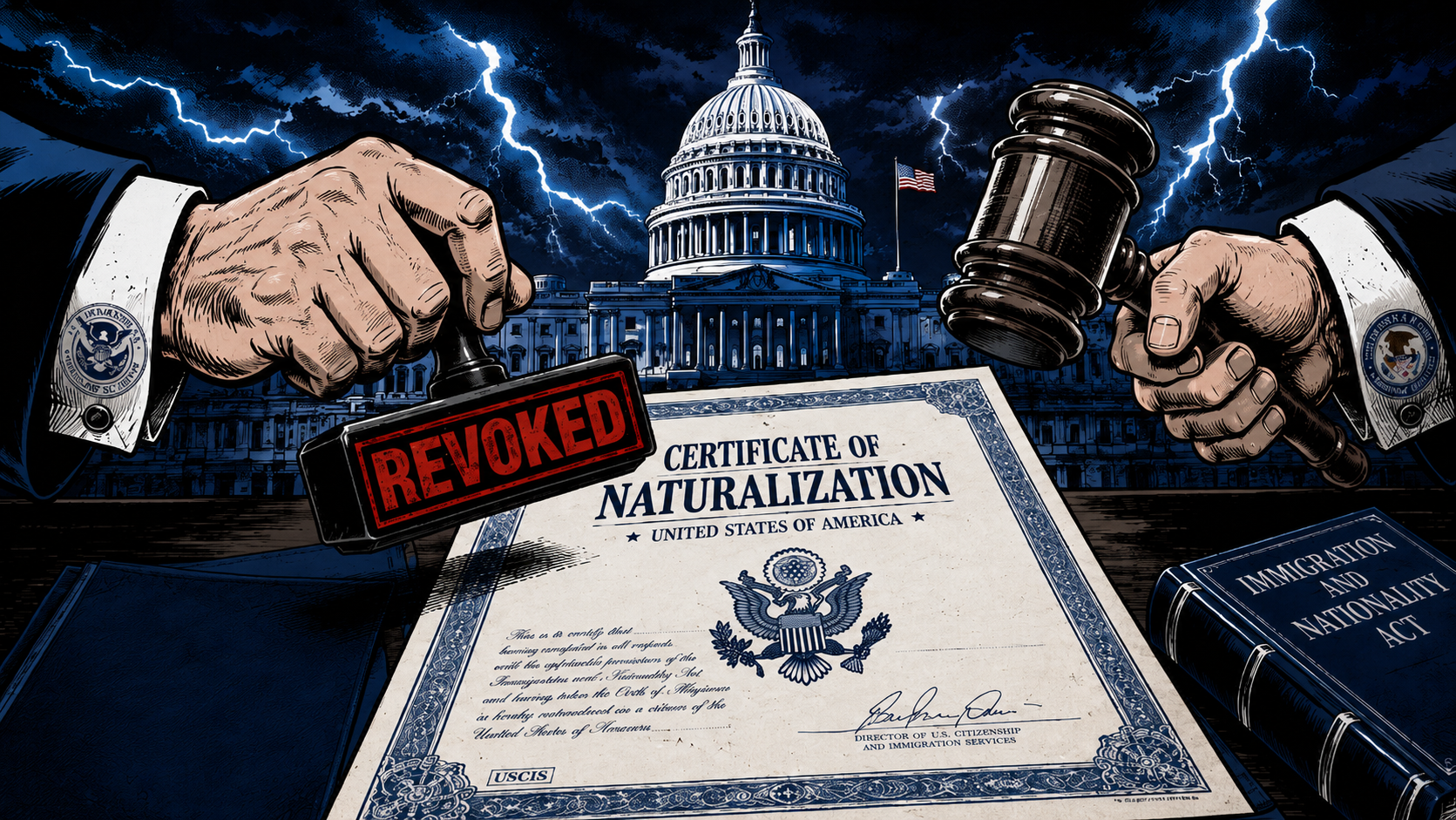
In June 2026, NPR reported that the Trump administration has filed more than 64 denaturalization cases in its first 16 months in office, surpassing the total number filed during all four years of the Biden administration. Acting Attorney General Todd Blanche described the effort as a border security tool, telling attendees at the Border Security Expo in Phoenix: “We’re saying you cannot stay here. You have to go. We’re trying to protect the integrity of the naturalization process.” The administration has vowed to revoke hundreds of citizenships. Legal experts and immigrant advocates say the process is proving harder than the rhetoric suggests. But the question it raises is one that millions of naturalized Americans are now asking: can US citizenship revocation actually happen, and if so, how? This article explains exactly what the law says, what grounds exist, what process the government must follow, and what protections remain in place for those who have taken the oath of citizenship.
US Citizenship Revocation: What the Law Actually Says
Before looking at the specific statute, it helps to understand where the government’s authority to revoke citizenship comes from at all. According to the Constitution Annotated, published by the Library of Congress, Congress’s power over denaturalization derives directly from Article I, Section 8, Clause 4 of the US Constitution, which grants Congress the power to “establish an uniform Rule of Naturalization.” Congress draws additional authority from the Necessary and Proper Clause to make laws carrying that naturalization power into execution. The Naturalization Act of 1906 was the first federal law to provide for denaturalization, authorizing judicial proceedings against a naturalized citizen for the purpose of setting aside and canceling a certificate of citizenship. The current framework was established by the Immigration and Nationality Act of 1952, which set out the denaturalization grounds and procedures that remain in effect today.
The legal authority for US citizenship revocation is grounded in federal statute. The primary law governing denaturalization is 8 U.S. Code Section 1451, titled “Revocation of Naturalization,” published by the Legal Information Institute at Cornell Law School. This statute sets out who may bring a denaturalization action, under what circumstances, and through what process.
Under Section 1451(a), it is the duty of United States attorneys for their respective districts to institute proceedings in federal district court to revoke and set aside a naturalization order when there is an affidavit showing good cause on one of two grounds:
The naturalization was illegally procured, meaning the person was not legally eligible for naturalization in the first place
The naturalization was procured by concealment of a material fact or by willful misrepresentation during the application or examination process
This is the legal framework the Trump administration is using. The DOJ argues that defendants in its filed cases concealed criminal conduct or material facts during the naturalization process, which makes their citizenship legally defective from the moment it was granted.
Key Legal Point
A denaturalization action under 8 U.S.C. Section 1451 must be filed in a federal district court, not an immigration court. This is a civil proceeding brought by the United States government against the naturalized citizen. The defendant has the right to challenge the evidence, present a defense, and appeal the decision to a higher federal court. A judge must sign off before any citizenship is revoked.
The Three Legal Grounds for Revoking US Citizenship
The USCIS Policy Manual, Volume 12, Part L, Chapter 2, sets out the three grounds on which a naturalized citizen is subject to revocation of naturalization. These are the only legally recognized bases for a denaturalization action under current federal law.
Ground 1: Illegally Procured Naturalization
A person is subject to US citizenship revocation if they procured naturalization illegally, meaning they were not eligible for naturalization in the first place. This includes failure to meet any eligibility requirement: residence, physical presence, lawful admission for permanent residence, good moral character, or attachment to the US Constitution.
Critically, the USCIS Policy Manual makes clear that this ground applies even if the person was innocent of any willful deception or misrepresentation. If a naturalization requirement was simply not met, the naturalization can be considered illegally procured regardless of the person’s intent.
Ground 2: Concealment of a Material Fact or Willful Misrepresentation
This is the most commonly used ground in the Trump administration’s denaturalization cases. Under this ground, the government must establish four elements, as defined in the USCIS Policy Manual and confirmed by the Supreme Court in Kungys v. United States, 485 U.S. 759 (1988):
The naturalized citizen misrepresented or concealed some fact
The misrepresentation or concealment was willful
The misrepresented or concealed fact was material
The citizen procured citizenship as a result of the misrepresentation or concealment
The Policy Manual also notes that misrepresentations can include oral testimony given during the naturalization interview, as well as information on the written application. Omissions are treated the same as affirmative misrepresentations. The courts determine whether a concealed fact is material, and the standard is whether the misrepresentation had a tendency to affect the outcome, not whether it would have definitively prevented naturalization.
This ground also covers membership in certain organizations. A person is subject to denaturalization if they become a member of or affiliated with the Communist Party, another totalitarian party, or a terrorist organization within five years of naturalization. Such involvement within five years is treated as prima facie evidence that the person concealed material information during the naturalization process.
Ground 3: Dishonorable Military Discharge Before Five Years of Honorable Service
A narrower ground applies to people who obtained citizenship through military service. A person is subject to denaturalization if they received citizenship based on honorable military service but subsequently received an other-than-honorable discharge before completing five years of honorable service in total.
| Ground for Revocation | Key Requirement | Intent Required? |
| Illegally procured naturalization | Eligibility requirement was not met at time of naturalization | No. Applies even without deliberate deception. |
| Concealment or willful misrepresentation | Material fact was deliberately concealed or misrepresented during the naturalization process | Yes. Misrepresentation must be willful. |
| Dishonorable military discharge | Citizenship obtained through military service; other-than-honorable discharge before five years | Not applicable. |
The Exact Legal Process the Government Must Follow
The denaturalization process in the US is not a quick or administrative action. It requires a formal federal court proceeding with specific procedural protections for the defendant. Here is the step-by-step process as established under 8 U.S.C. Section 1451:
Step 1: Affidavit showing good cause. A US Attorney must have an affidavit demonstrating good cause to believe the naturalization was illegally obtained or procured through misrepresentation before any action can be filed.
Step 2: Filing in federal district court. The action must be filed in the federal district court where the naturalized citizen resides at the time of filing. If the person does not reside in the United States, the action may be filed in the US District Court for the District of Columbia or the district where the person last resided.
Step 3: 60-day notice to the defendant. Under Section 1451(b), the person whose citizenship is being challenged must receive 60 days of personal notice before the proceedings begin, unless that notice is waived by the defendant. This notice requirement is a due process protection built into the statute itself.
Step 4: The defendant’s right to respond. The defendant has the right to make answers to the government’s petition, challenge the evidence presented, present their own evidence, and appear in court. NPR’s June 2026 investigation found that in a number of cases reviewed, defendants lacked legal representation and some did not appear, leading to denaturalization by default judgment.
Step 5: Federal court ruling. A federal judge reviews the evidence and issues a ruling. If the court finds that citizenship was illegally procured or procured through willful misrepresentation, it can revoke the naturalization. The revocation takes effect as of the original date the citizenship was granted, as though it had never been valid.
Step 6: Right to appeal. A defendant whose citizenship has been revoked retains the right to appeal the decision to a federal circuit court of appeals and, ultimately, to the US Supreme Court.
What the NPR Investigation Found
NPR reviewed 34 publicly announced denaturalization cases filed or resolved by the DOJ as of May 19, 2026. Of those, 11 resulted in revocation of citizenship. In several cases, defendants lacked legal representation. Some cases proceeded to denaturalization with minimal or no court appearance by the defendant. Boston College law professor Daniel Kanstroom, who specializes in immigration law, told NPR: “I’m not seeing a major surge of worrisome denaturalizations. To me, it’s not at the level of an emergency.”
How a US Citizen Can Also Voluntarily Lose Citizenship
Denaturalization by the government is one pathway to losing citizenship. A separate legal framework covers voluntary loss of nationality. 8 U.S. Code Section 1481 lists the specific voluntary acts that can result in loss of US nationality for both native-born and naturalized citizens, provided the act is performed voluntarily and with the intention of relinquishing US citizenship.
Under Section 1481(a), those acts include:
Obtaining naturalization in a foreign country after turning 18, if done with the intent to relinquish US nationality
Taking a formal oath of allegiance to a foreign country after turning 18, with the intent to relinquish US nationality
Entering or serving in the armed forces of a foreign country that is engaged in hostilities against the United States, or serving as a commissioned or non-commissioned officer in a foreign military
Serving in a formal government office of a foreign country after acquiring that country’s nationality
Formally renouncing US nationality before a US diplomatic or consular officer in a foreign country
Committing an act of treason against the United States, or attempting to overthrow the US government by force, when a court convicts the person
As USAGov confirms, both renouncing and losing citizenship result in no longer being a US citizen. Under either circumstance, the person no longer holds the rights and responsibilities of citizenship, may still be subject to certain US tax obligations, may be eligible for Social Security benefits, and must become a citizen of another country or risk becoming stateless. A former citizen may also need a visa to return to the United States.
Voluntary vs. Involuntary Loss
The key legal distinction is intent. Under 8 U.S.C. Section 1481, voluntary loss of citizenship requires that the act be performed voluntarily and with the specific intention of relinquishing US nationality. The government bears the burden of proving intent if it claims a citizen voluntarily relinquished their status. In contrast, denaturalization under 8 U.S.C. Section 1451 is an involuntary government action brought through a civil court proceeding.
Can a Birthright Citizen Lose Their Citizenship?
This is one of the most frequently asked questions in the current policy environment. The short factual answer is: birthright citizens cannot be denaturalized, because denaturalization applies only to naturalized citizens, not those who obtained citizenship by birth.
Birthright citizenship in the United States is grounded in the 14th Amendment to the US Constitution, which states: “All persons born or naturalized in the United States, and subject to the jurisdiction thereof, are citizens of the United States and of the State wherein they reside.” This constitutional protection means that a birthright citizen’s citizenship cannot be revoked through the denaturalization process established under 8 U.S.C. Section 1451, which applies specifically to naturalization orders.
A birthright citizen can, however, voluntarily lose their citizenship by performing one of the acts listed under 8 U.S.C. Section 1481 with the intent to relinquish nationality. A birthright citizen can also lose citizenship through a treason conviction. But neither the DOJ nor any federal agency can file a denaturalization action against someone who was born a US citizen.
What the Trump Administration’s Cases Actually Look Like
Based on NPR’s June 2, 2026 investigation, the DOJ cases filed during the Trump administration follow a consistent pattern: the government argues that the defendant concealed criminal conduct or material information during the naturalization application process, making their citizenship procured by willful misrepresentation under 8 U.S.C. Section 1451.
Two specific cases from the NPR report illustrate the pattern:
Melchor Munoz: The DOJ revoked Munoz’s citizenship after arguing he concealed his involvement in drug dealing during the naturalization process. The concealment of that criminal activity during the application was the legal basis for the denaturalization action.
Vladimir Volgaev: A native of Ukraine who became a US citizen in 2016, Volgaev was convicted in 2020 of smuggling gun components from the US to individuals in Ukraine and Italy, and of underreporting assets and income on federal housing benefit applications. The DOJ filed a denaturalization case in September arguing he had concealed his involvement in the smuggling operation during naturalization. A court summons was issued, but neither Volgaev nor an attorney filed a response or appeared in court, and the case proceeded to denaturalization.
The administration has framed the effort as targeting criminal actors who defrauded the naturalization system. “The Department of Justice is laser-focused on rooting out criminal aliens defrauding the naturalization process,” a DOJ spokesman said in a statement to NPR.
What Legal Experts Are Saying
Legal scholars quoted in NPR’s June 2026 investigation offered measured assessments of the administration’s campaign.
Boston College law professor Daniel Kanstroom, who specializes in immigration law, told NPR he was not seeing denaturalization at a level he would consider a systemic emergency. “I’m not seeing a major surge of worrisome denaturalizations. To me, it’s not at the level of an emergency,” he said.
However, another legal expert quoted in the investigation offered a broader concern about where expanded use of denaturalization could lead as a policy tool, regardless of the individual cases involved: “It’s just a dangerous road to go down for denaturalization. I might not feel sorry for the heinous child abuser who loses their citizenship. I’m not going to lose sleep over that. But I am going to lose sleep over what it does to the system. Because once it becomes easy to take somebody’s citizenship away, it becomes easy to take anybody’s citizenship away.”
The legal concern is structural: the denaturalization statute has existed for decades and has always been available to the government. What is new is the pace and the framing of the effort as a border security tool rather than a targeted tool reserved for the most serious fraud cases.
What Naturalized Citizens Should Know Right Now
For the approximately 23 million naturalized US citizens currently living in the United States, here is what the law as it currently stands requires and protects:
The government cannot revoke your citizenship without going to federal court. There is no administrative or executive process for stripping citizenship. A civil court proceeding in federal district court is required under 8 U.S.C. Section 1451.
You must receive 60 days notice. The statute requires personal notice to the defendant at least 60 days before proceedings begin, unless you waive it.
You have the right to contest the case. You can challenge the evidence, present your own evidence, appear in court, and appeal a ruling against you through the federal appellate system.
The grounds are specific and limited. The government must prove illegally procured naturalization or willful misrepresentation of a material fact. Good-faith errors or administrative mistakes do not meet the legal standard for willful misrepresentation.
Birthright citizenship cannot be revoked through this process. Denaturalization applies only to naturalized citizens, not those born in the United States.
How This Connects to the 2026 Elections
For readers following election updates in the US, the denaturalization push is directly relevant to the 2026 midterm cycle. Immigration enforcement, including citizenship policy, is one of the central issues shaping voter behavior and congressional debate heading into November 3, 2026.
The composition of Congress after the midterms will determine whether any legislative changes to denaturalization law advance, whether oversight hearings are held on how the DOJ is conducting these cases, and whether proposed reforms to due process protections in denaturalization proceedings gain traction.
For naturalized citizens who are also registered voters, the administration’s expanded use of an existing legal tool raises questions that extend beyond individual cases. The question of who has the power to define the terms of American citizenship, and under what circumstances that status can be challenged, is not just a legal question. It is a political one, and one that will be answered in part by which party controls Congress after November.
Also on roadtotheelection.org
US citizenship is one of the most powerful travel documents in the world — but its global standing has shifted in 2026. Find out where the US passport ranks and what that means for Americans traveling abroad: Is Your US Passport Still Strong in 2026? The Ranking May Surprise You.
The Bottom Line
US citizenship revocation is a real legal mechanism, grounded in federal statute, with a history of use by the government. What the Trump administration has done is accelerate the pace of denaturalization filings and reframe the tool as part of a broader border security strategy. The law requires a federal court proceeding, a specific legal ground, 60 days of notice to the defendant, and the right to challenge the evidence. Those procedural protections remain in place.
But the NPR investigation also found that the pace of cases is outrunning the resources assigned to defend against them, with some defendants proceeding without legal representation and some cases resulting in denaturalization without a court appearance. The legal framework is clear. Whether the process is being applied consistently with its own procedural requirements is a question that courts and Congress will continue to examine as this cycle of election updates in the US moves toward November.
References:
Cornell Law School Legal Information Institute. 8 U.S. Code § 1451, Revocation of Naturalization
U.S. Citizenship and Immigration Services (USCIS). Policy Manual, Volume 12, Part L, Chapter 2: Revocation of Naturalization
USA.gov. Renounce or Lose Your U.S. Citizenship
Cornell Law School Legal Information Institute. 8 U.S. Code § 1481, Loss of Nationality by Native-Born or Naturalized Citizen
Constitution Annotated, Congress.gov. Naturalization Clause, Article I, Section 8, Clause 4

- A Supreme Court Case You Probably Missed Could Open the Door to a Lot More Election Lawsuits - October 9, 2026
- Dark Money Is Pouring Into the 2026 Midterms. Here Are Five Myths About How It Actually Works - September 21, 2026
- The Supreme Court Just Blocked Trump’s Mail Ballot Restrictions. Here’s What That Means - September 17, 2026