
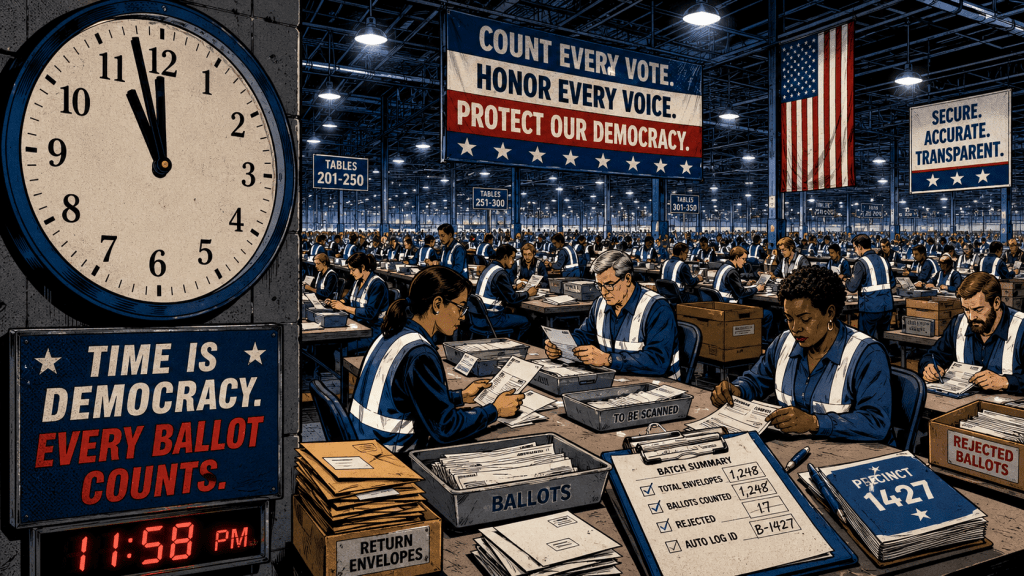
On June 2, 2026, California held its statewide primary election for governor, all 52 US House seats, and multiple state offices. Within 24 hours, President Trump posted on social media: “Why the vote counting DELAY???” and accused Democrats of trying to steal the elections. The US Attorney’s office in Los Angeles, led by Trump appointee Bill Essayli, announced multiple election fraud investigations. The DOJ sent a federal prosecutor to observe ballot processing at the Los Angeles County Ballot Processing Center. California elections had become, once again, the center of national political attention. California Secretary of State Shirley Weber responded directly: “We have a process that by law ensures both voting rights and the integrity of elections.” As of June 8, 2026, results were still being certified, with the official deadline set for July 10, 2026. This article explains why California elections attract this level of national scrutiny, what makes the state’s electoral system distinct, and why no other state carries the same combination of economic, demographic, and political weight in American politics.
California Elections and the Size of the Prize
The basic numbers explain much of California’s political significance. According to a comparative analysis published by the California State University system, California is the most populous state in the United States and hosts more Fortune 500 companies than any other state, with 57 as of 2024, including Apple, Alphabet, Chevron, Meta, Wells Fargo, Disney, and Nvidia.
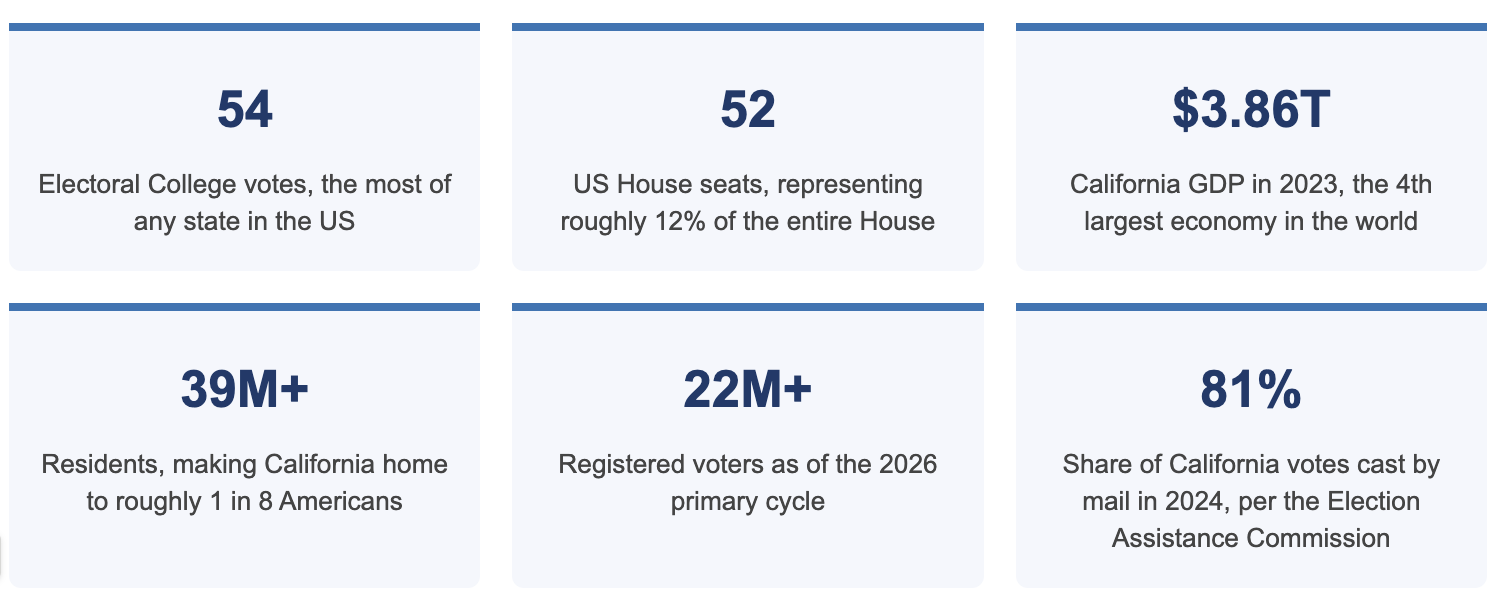
With 54 Electoral College votes, California alone represents 10% of the 538 total votes needed to win the presidency. No Republican presidential candidate has carried California since George H.W. Bush in 1988. That 38-year Democratic hold on the state’s presidential electors means Republican presidential candidates effectively compete for the White House while writing off the largest single bloc of electoral votes available. Democratic candidates, by contrast, can count California’s 54 votes as a near-certain baseline before the campaign begins.
In the House of Representatives, California’s 52 seats mean that competitive congressional races within the state alone can determine which party controls the chamber. In both 2022 and 2024, the final determination of House control came down to California races that took days or weeks to resolve because of the state’s ballot counting timeline. That direct connection between California elections and the composition of Congress is one reason they receive sustained national attention far beyond what any other single state generates.
Why California Takes So Long to Count Votes

Trump’s frustration over the 2026 primary count is not new. He made similar complaints after the 2020, 2022, and 2024 elections. The explanation for California’s slow count is factual and structural, not political.
California passed a series of election access laws over the past decade that, taken together, produce the longest counting timeline of any large state. A 2025 report from UC Berkeley’s Goldman School of Public Policy, authored by Associate Professor Jake Grumbach and graduate researcher Francesca Bitton, documented these reforms using the State Democracy Index (SDI), a 54-indicator quantitative measure of democratic performance across all 50 states.
The specific laws that slow the count are:
Universal all-mail voting. Every registered voter in California automatically receives a mail ballot. Mail ballots accounted for approximately 81% of all votes cast in California in 2024, compared to the national average of 30% that same year.
Seven-day postmark rule. California law allows mail ballots to arrive up to seven days after Election Day, provided they are postmarked on or before Election Day. This means millions of ballots legally arrive at county elections offices in the week following the election.
Same-day voter registration. Californians can register to vote on Election Day itself at polling locations. Same-day registrations generate provisional ballots that require additional verification before counting.
Automatic voter registration. California automatically registers eligible residents through transactions with state agencies, including the DMV. This has expanded the voter rolls significantly and increased provisional ballot volume.
The UC Berkeley SDI report found that these reforms collectively moved California from the 17th-ranked state in democratic performance in the 2000s to the 6th-ranked state by 2023. The same reforms that produce the slow count are the ones that produced the improved democratic performance score. The tradeoff is transparency: the count takes longer, but every eligible ballot is counted.
The California Jungle Primary: How It Works and Why It Matters
One feature that makes California elections structurally unique among large states is the jungle primary, formally called the nonpartisan blanket primary. California voters approved this system through Proposition 14 in 2010.
Under the jungle primary, all candidates from all parties compete on a single ballot in the primary election. The top two vote-getters, regardless of party affiliation, advance to the November general election. This means a November ballot in California can feature two Democrats, two Republicans, or any combination of candidates, depending on who finished first and second in the primary.
According to Brookings Institution senior fellow Elaine Kamarck, the jungle primary was designed to reduce the influence of party bases in primary elections and produce more moderate general election candidates. By forcing candidates to appeal to a broader cross-section of voters in the primary rather than just their party’s base, the system was intended to generate less polarized general election matchups.
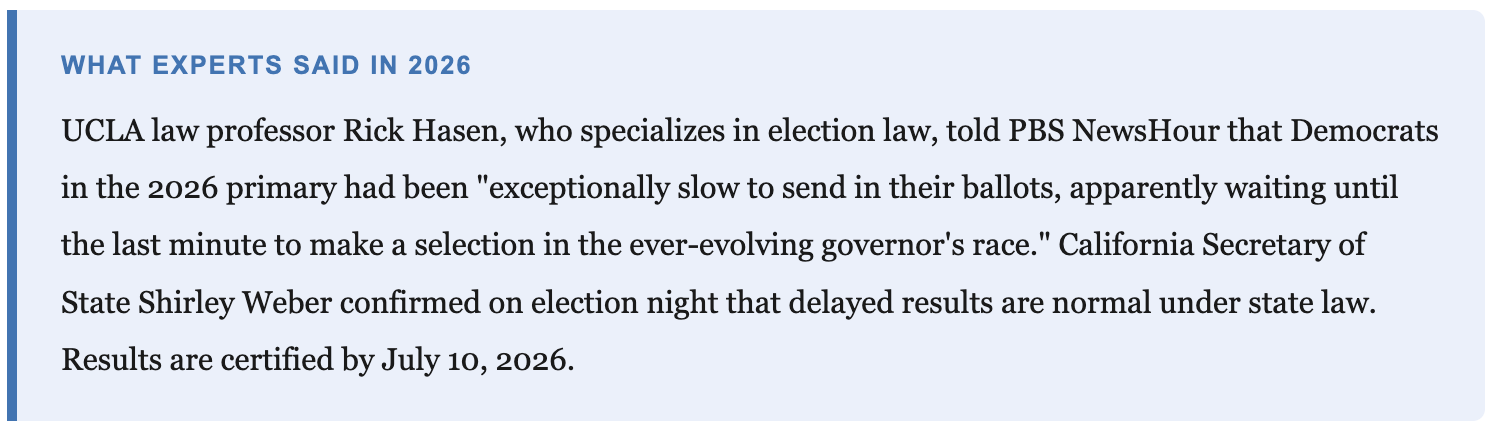
The 2026 California governor’s primary illustrated how the system operates in practice. With 61 candidates on the ballot, including Democrats Xavier Becerra, Tom Steyer, and Katie Porter, and Republican Steve Hilton, voters chose from a wide field in a single primary. The top two vote-getters, regardless of party, advanced to November. As of June 8, 2026, Xavier Becerra had been confirmed as advancing to the general election, with the second spot still being determined as counting continued.
The jungle primary also affects congressional races. In California’s 52 House districts, the top-two system can produce general election matchups between two members of the same party in districts where one party dominates heavily. This has produced situations where two Democrats or two Republicans face each other in November, effectively making the primary the decisive election in safe districts.
California’s Economy and Its Political Weight

A policy brief by Stanford SIEPR economists Mark Duggan and Sheila Olmstead compared California and Texas directly as the two most economically significant states in the US. Their key findings are directly relevant to understanding why California elections carry national economic consequences.
California’s state and local government revenues and spending are 60% higher than Texas on a per-resident basis. California has the nation’s highest top marginal income tax rate. California’s GDP in 2023 was $3.86 trillion, compared to Texas at $2.7 trillion. The Stanford researchers found that while Texas has seen faster population and employment growth, California’s per-capita income and GDP growth have been stronger in recent years.
The economic scale matters politically because California is both a major source of federal tax revenue and a major recipient of federal program spending. Policy decisions made in Washington about tax rates, healthcare, housing, and immigration have a disproportionate effect on California simply because of its size. And policy decisions made in Sacramento have a comparable effect on the rest of the country because of the state’s economic influence and regulatory reach.
One concrete example: California’s vehicle emissions standards, which have historically been stricter than federal standards and adopted by more than a dozen other states, effectively set a national standard for automotive manufacturing. When California elections determine which party controls state government, they indirectly determine which emissions standards apply to a significant share of the US vehicle market.
California as a Policy Laboratory
The concept of states as laboratories of democracy, attributed to US Supreme Court Justice Louis Brandeis in his dissent in New State Ice Co. v. Liebmann (1932), applies directly to California. The California State University comparative analysis uses this framework to describe how California and Texas represent opposite poles of US policy experimentation: California with high taxes, high public spending, and strong regulation; Texas with low taxes, minimal regulation, and limited public services.
Policies that originated in California and subsequently spread to other states or influenced federal policy include:
Vehicle emissions standards. California’s authority under the Clean Air Act to set stricter emissions standards than federal law has made it a de facto national standard-setter for automotive regulation.
Automatic voter registration. California implemented automatic voter registration through DMV transactions in 2016. Multiple other states subsequently adopted similar systems.
Universal mail voting. California’s shift to universal all-mail elections predates most other states and has been studied as a model by election administrators nationally.
Independent redistricting. California established an Independent Redistricting Commission in 2008. The UC Berkeley SDI report identified this commission as a primary driver of California’s improvement in democratic performance scores, and other states have since adopted similar models.
Minimum wage increases. California’s phased increases to the state minimum wage, reaching $16.90 per hour in 2026, preceded federal legislative efforts and influenced the national debate about wage floors.
The policy laboratory dynamic runs in both directions. California’s failures are also studied. The Stanford SIEPR analysis noted that California has the highest rate of homelessness of any US state and some of the lowest air quality scores, despite its high public spending on housing and environmental programs. Texas, meanwhile, has the highest rate of residents without health insurance of any US state. Both outcomes inform national policy debates about the tradeoffs of different governance models.
California Demographics and Their Electoral Consequences
California’s racial and ethnic composition makes it one of the most demographically complex electorates in the United States. Research published in Social Forces by John R. Logan of Brown University and co-authors on race, ethnicity, immigration, and political participation found that the political context of a state significantly affects how racial and ethnic minority groups engage with elections. California, with large Latino, Asian American, and Black voting populations alongside its white majority, represents one of the most studied cases of multiracial electoral politics in the country.
As of 2026, California’s population is approximately 39% Latino, 35% white non-Hispanic, 15% Asian American, and 6% Black, with the remainder identifying as multiracial or another category. No single racial or ethnic group constitutes a majority. This demographic composition has produced a state electorate that is more racially diverse than the national average and that has consistently elected candidates reflecting that diversity, including the state’s current US Senate delegation and its recent governors.
The demographic trajectory matters for national politics because California’s composition today is broadly similar to what demographers project the United States as a whole will look like in the 2040s. How California’s parties and campaigns build coalitions, mobilize voters, and compete for Latino and Asian American voters in particular is watched closely by national party strategists as a preview of the electoral challenges coming at the federal level.
California and the Balance of House Power
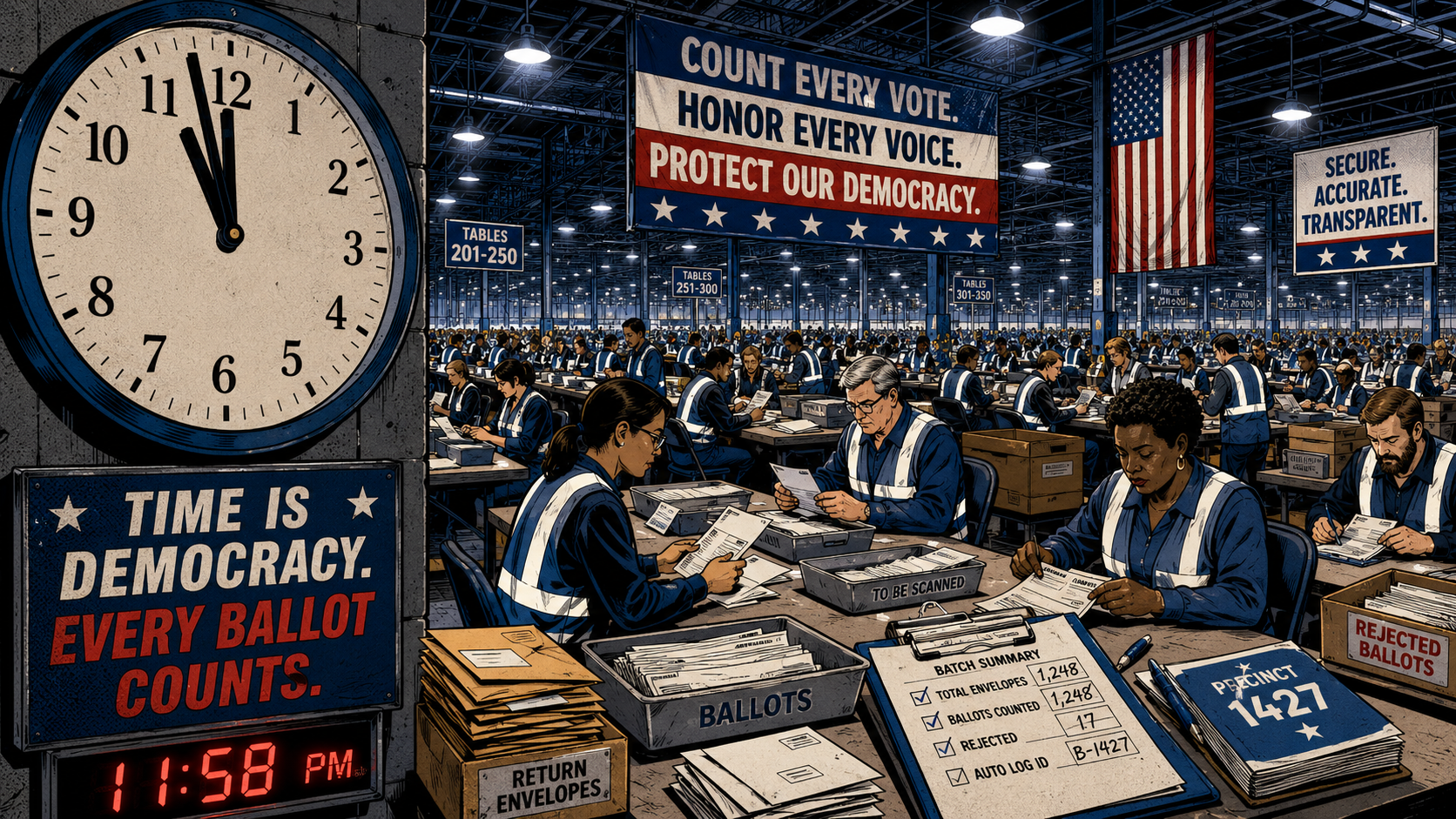
With 52 House seats, California holds more congressional representation than any other state. The next closest is Texas with 38 seats. The difference between winning 27 California seats versus 25, or holding 30 versus 28, can determine which party controls the House of Representatives.
This has happened in practice. After the 2022 midterms, Republicans won the House majority by a margin of roughly five seats. Several of those seats were decided by California races that were not called on election night and took two to three weeks to resolve because of the state’s ballot counting timeline. The slow count that frustrates politicians and commentators is the same process that produced the outcome that determined House control.
In 2026, California’s 52 House races are again directly relevant to which party controls Congress after November 3. Democrats redrew the state’s congressional map in a mid-decade redistricting effort specifically intended to counter Republican redistricting gains in other states. Several of the newly drawn districts are competitive, and their outcomes will contribute directly to the national House majority calculation.
Why California and Texas Are Compared So Often
In national political coverage, California and Texas are the two states most frequently compared as representing opposite models of governance. The Stanford SIEPR brief by Duggan and Olmstead found that this comparison is useful precisely because both states are governed by the same Constitution and face the same federal laws, meaning their policy differences originate within the states themselves rather than from different external constraints.
The key factual contrasts between the two states, as documented by Stanford SIEPR and the California State University analysis, include:
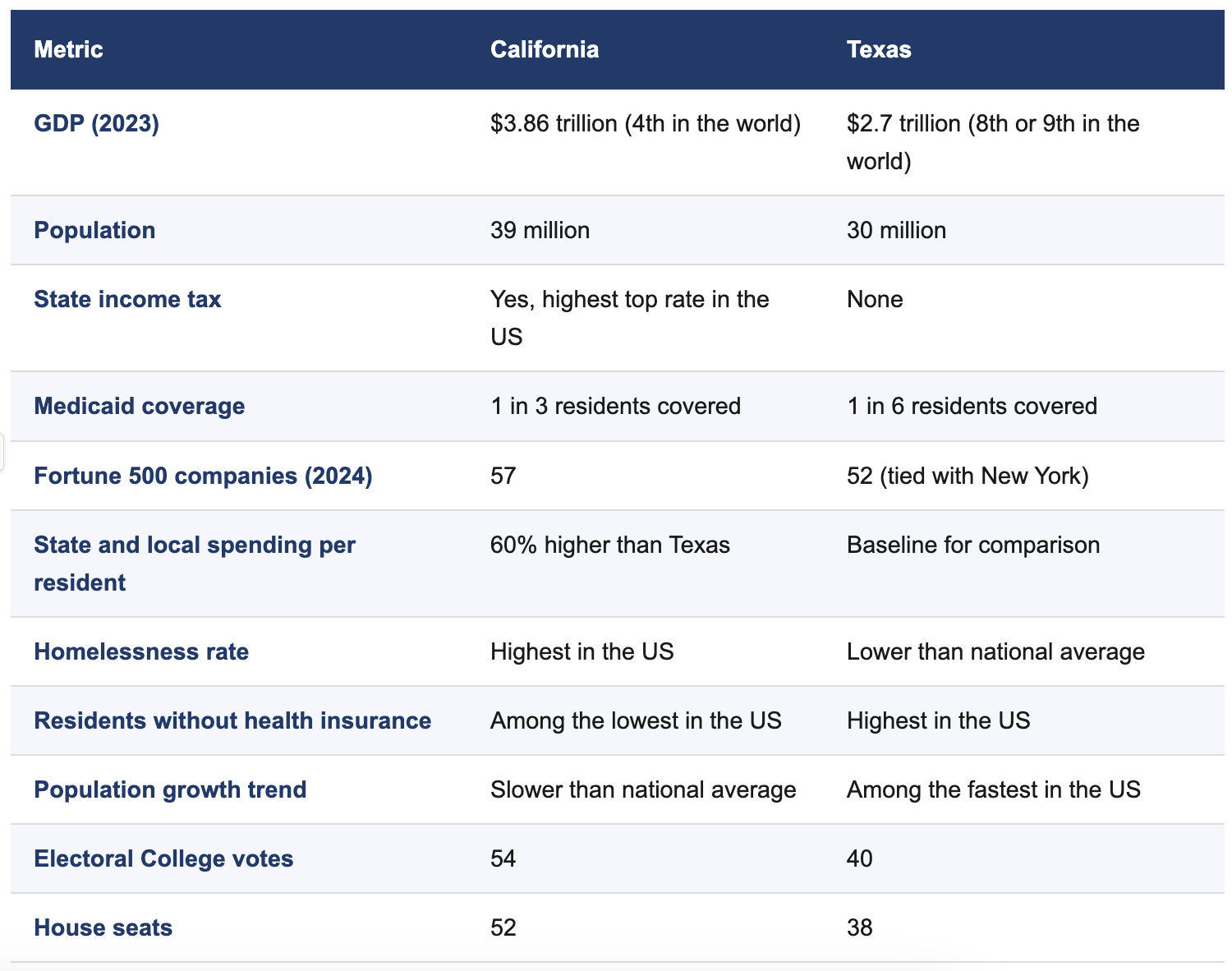
The Stanford SIEPR researchers concluded that both states have much to celebrate on economic performance but both have significant areas where outcomes fall short. California leads on per-capita income and GDP growth. Texas leads on population and employment growth. Crime rates and renewable energy production are similar in both states despite their very different policy approaches.
California’s Electoral Democracy Score
The UC Berkeley Goldman School report, using the State Democracy Index covering all 50 states from 2000 to 2023, found that California’s electoral democracy score improved from 17th nationally in the 2000s to 6th nationally by 2023. That improvement was driven primarily by four changes:
The establishment of the Independent Redistricting Commission in 2008, which produced more balanced legislative district maps for the 2010 and 2020 redistricting cycles
Automatic voter registration through state agency transactions
Universal all-mail voting
Restoration of voting rights to parolees
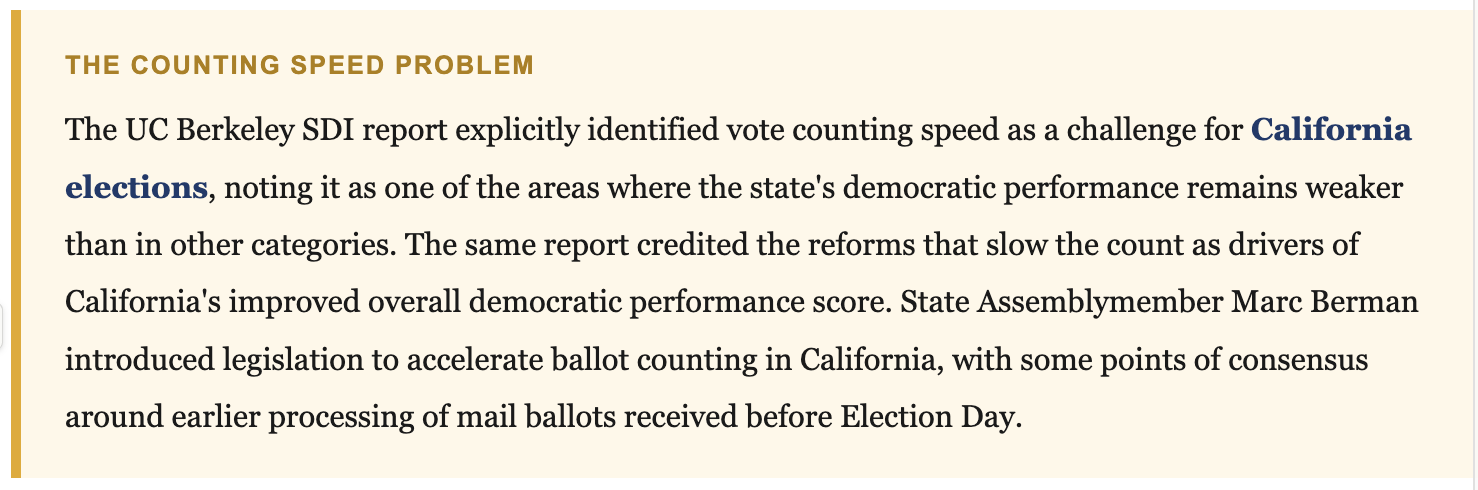
The same report identified ongoing challenges in California’s electoral system. The speed of vote counting was explicitly flagged as a problem. The report noted that California’s complex ballot initiative process, which allows citizens to place legislation directly on the ballot, creates a large and complicated ballot that takes additional time to count accurately. Uneven participation in local elections was also identified as an area where California’s democratic performance remains weaker than its statewide performance would suggest.
How California Elections Connect to the 2026 Midterms
For readers following election updates in the US, the 2026 California primary is not just a state story. The races it has set up for November 3, 2026, directly affect the national balance of power.
The governor’s race, with Xavier Becerra advancing to the general election and the second spot being determined as counting continues, will produce a November contest that draws national campaign spending and media attention as a test of whether Republicans can compete statewide in California under current political conditions.
The 52 House races will be among the most scrutinized in the country. Democrats drew new congressional maps specifically intended to maximize their seat count. Republicans are contesting multiple districts. The outcomes will be a significant factor in determining House control.
And the counting timeline means that on election night in November, California’s House races will almost certainly be unresolved. History from 2022 and 2024 shows that House control may not be determined until weeks after Election Day, once California finishes counting its approximately 20 million or more ballots. That timeline, and the national attention it generates, is a direct product of the election laws that have made California’s democratic performance one of the strongest in the country by quantitative measure.
The Bottom Line
California elections carry more weight in American politics than those of any other single state because of a combination of factors that cannot be replicated elsewhere. Fifty-four Electoral College votes. Fifty-two House seats that can determine chamber control on their own. The world’s fourth-largest economy. A demographic composition that previews the national electorate of the 2040s. A policy record that has influenced legislation and regulation across the country. And an electoral system specifically designed to maximize voter participation, which produces the slow counts that frustrate politicians and commentators but that independent researchers have measured as a genuine improvement in democratic performance.
The tension between vote counting speed and electoral thoroughness that played out in June 2026 is not unique to California. It is the central tradeoff in modern election administration. California has chosen thoroughness. The consequences of that choice, for election updates in the US and for the national political balance, will be visible again in November 2026.
References:
California State University Pressbooks. Blue and Red States: A Comparative Examination of California and Texas
Stanford Institute for Economic Policy Research. A Tale of Two States: Contrasting Economic Policy in California and Texas
UC Berkeley Goldman School of Public Policy, Democracy Policy Lab. The State of Electoral Democracy in California
Brookings Institution. Why Winning Primaries in Big States Like California Doesn’t Matter Anymore
National Institutes of Health, PubMed. The Impact of Race and Ethnicity, Immigration, and Political Context on Participation in American Electoral Politics
ABC7 News. Slow CA Vote Count Criticized by Trump, GOP Governor Hopeful Steve Hilton
PBS NewsHour. California’s Slow Ballot Count Makes It a Target for Critics. It Doesn’t Mean Elections Are Rigged.
CNN. DOJ Sends Prosecutor to Observe LA Ballot Counting Amid Trump’s Claims.

- A Supreme Court Case You Probably Missed Could Open the Door to a Lot More Election Lawsuits - October 9, 2026
- Dark Money Is Pouring Into the 2026 Midterms. Here Are Five Myths About How It Actually Works - September 21, 2026
- The Supreme Court Just Blocked Trump’s Mail Ballot Restrictions. Here’s What That Means - September 17, 2026