
Polls closed at 9 p.m. tonight across New York State for the June 23, 2026 primary election. According to the NYC Board of Elections, early voting ran from June 13 to June 21, with Election Day polls open from 6 a.m. to 9 p.m. Results are now beginning to come in. The New York primary 2026 features more than 2,600 positions on the ballot across the state, from US House seats and state legislative offices to judgeships and local positions. But the national political story tonight is concentrated in a handful of New York City congressional districts where the battle between NYC Mayor Zohran Mamdani’s left-wing slate and the Democratic Party establishment is playing out in real time. This article explains what positions were on the ballot, who the key candidates are, what the races mean for ordinary New Yorkers, and why the results matter for election updates in the US heading into November 3.
What Is the New York Primary 2026 and What Positions Are Being Decided?
A primary election determines which candidates from each political party advance to the November general election. New York holds closed primaries, meaning only voters registered with a party can vote in that party’s primary contest. Unaffiliated or independent voters do not participate unless they changed their party registration before the deadline.
According to Ballotpedia’s official 2026 New York elections page, the positions on the ballot in the June 23, 2026 primary include:
US House of Representatives: All 26 of New York’s congressional districts are holding primaries, with competitive contests in multiple districts across New York City and its suburbs
Governor: Both the Democratic and Republican nominations are uncontested. Democratic incumbent Kathy Hochul faces no primary challenge after Lt. Gov. Antonio Delgado withdrew. Republican Bruce Blakeman, endorsed by Trump, also runs unopposed after Rep. Elise Stefanik withdrew in December 2025.
New York State Comptroller: Democratic and Republican primaries for the statewide office that oversees state finances and public pension funds
New York State Senate: All 63 state senate seats are on the ballot for a two-year term
New York State Assembly: All 150 assembly seats are up for a two-year term
Judicial offices: Multiple state supreme court and civil court judgeships across New York City’s five boroughs and upstate counties
Local offices: City council, district attorney, and other local positions depending on jurisdiction
What the New York Primary 2026 Means for Ordinary New Yorkers
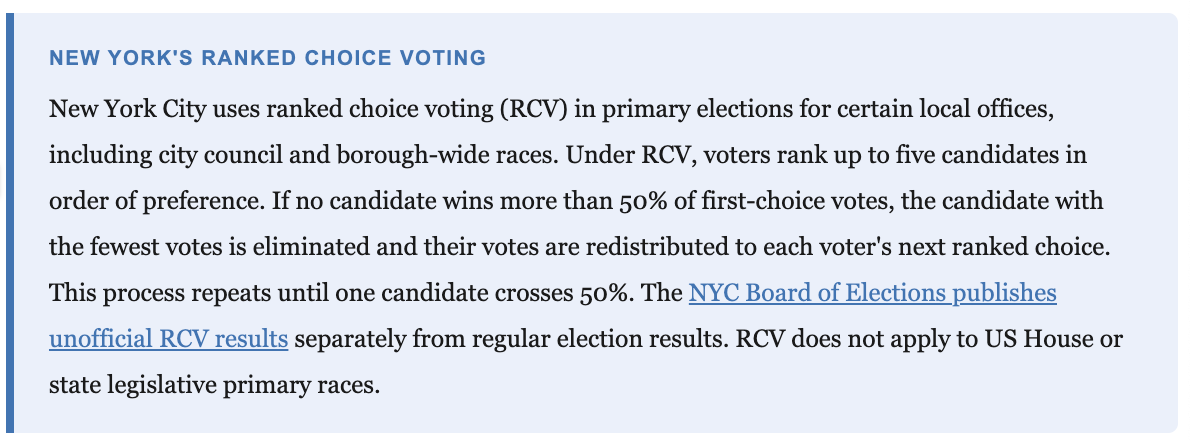
Primary elections in New York carry direct consequences for residents because the state’s most populated districts are so heavily Democratic that the primary winner often runs uncontested or faces only token opposition in November. In practice, for millions of New Yorkers living in deep-blue congressional and state legislative districts, tonight’s primary is the election that actually decides who represents them in Washington and Albany for the next two years.
The positions decided tonight have concrete effects on daily life in New York:
US House members vote on federal spending, healthcare, housing, immigration enforcement, and tax policy. With the House majority currently held by Republicans by a narrow margin, every New York congressional race feeds directly into which party controls federal legislation after November 3.
State senators and assembly members control New York’s budget, set the state minimum wage, determine housing and rent policy, and pass criminal justice legislation. New York’s state legislature has passed some of the most significant tenant protection and public housing laws in the country in recent years, and its composition determines whether those policies continue, expand, or face rollback.
The State Comptroller manages New York’s $277 billion public pension fund, oversees state agency spending, and serves as the state’s chief fiscal watchdog. The Democratic primary for this office tonight will determine who carries the party banner into November against the Republican nominee.
Judges elected tonight will preside over civil and criminal cases affecting millions of New Yorkers for years. State supreme court justices in New York are elected, not appointed, making judicial primaries directly consequential for how the law is applied in the state’s busiest courts.
The Biggest Story Tonight: Mamdani’s Slate vs the Democratic Establishment
The most watched narrative of the New York primary 2026 is not about the governor’s race, which has no primary contest. It is about whether NYC Mayor Zohran Mamdani can extend his political movement beyond City Hall.
Mamdani, 34, was elected mayor of New York City in 2025 after a surprise primary victory that made him the youngest and first openly socialist mayor of the nation’s largest city. He ran on a platform of free public transit, universal childcare, and an end to what he called corporate influence over New York’s Democratic Party. His victory, backed by the NYC chapter of the Democratic Socialists of America (DSA) and Justice Democrats, was one of the most significant shifts in New York City politics in decades.
One year later, Mamdani is attempting to turn his coalition into a congressional force. He endorsed three candidates in the June 23 primaries, each challenging a Democratic incumbent or running in a competitive open seat:
NY-13: Darializa Avila Chevalier vs Rep. Adriano Espaillat
This is the race attracting the most national attention tonight. Darializa Avila Chevalier, 32, is a Harlem-based community organizer, member of the United Auto Workers legal services local, and PhD student at the CUNY Graduate Center who launched her campaign in November 2025. She received endorsements from Mamdani, the NYC DSA, Justice Democrats, former Rep. Jamaal Bowman, and Sen. Bernie Sanders.
Her opponent, Rep. Adriano Espaillat, 71, has represented the district covering Upper Manhattan and parts of the Bronx since 2016. He is the chair of the Congressional Hispanic Caucus, a close ally of House Democratic Leader Hakeem Jeffries, and the first formerly undocumented immigrant elected to Congress. He is backed by Gov. Kathy Hochul, AIPAC’s United Democracy Project super PAC, Latino Victory Fund, and Project 218.
The central issues dividing the two candidates are US policy toward Israel and Gaza, immigration enforcement, and the role of corporate PAC money in Democratic politics. Pre-election polling showed the race too close to call, with a Data for Progress poll giving Chevalier a four-point edge at 39% to 35%, while prediction markets on Kalshi and Polymarket showed Espaillat favored at 67 to 70%.
NY-10: Brad Lander vs Rep. Dan Goldman
Former New York City Comptroller Brad Lander is challenging incumbent Rep. Dan Goldman in the district covering Lower Manhattan and parts of Brooklyn. Lander ran against Mamdani in the 2025 mayoral primary before becoming one of his most prominent backers. Goldman, a former federal prosecutor who became known for his role in Trump’s first impeachment trial, has the backing of the Democratic establishment and a pro-Goldman super PAC that has spent more than $300,000 in the race. Prediction markets show Lander at 98% to win, suggesting he has a commanding lead heading into tonight.
NY-7: Claire Valdez in the Open Seat
The third member of Mamdani’s endorsed slate, Assemblywoman Claire Valdez, is running in the NY-7 Democratic primary to replace retiring Rep. Nydia Velázquez, who represented the Brooklyn-based district for more than three decades. Valdez faces Brooklyn Borough President Antonio Reynoso, City Councilmember Julie Won, and public defender Vichal Kumar. The open-seat race has no incumbent advantage for either side.
NY-12: The Open Seat With a Kennedy and $10 Million in Outside Money
New York’s 12th Congressional District, which covers Manhattan’s West Side, is holding an open-seat Democratic primary to replace retiring Rep. Jerry Nadler, who has served since 1993. Ballotpedia lists eight candidates in the race. The three most prominent are:
Assemblyman Alex Bores — backed by tech-aligned groups and considered the frontrunner by prediction markets
Assemblyman Micah Lasher — Nadler’s endorsed successor and former aide to ex-NYC Mayor Michael Bloomberg, who has put $10 million into an independent expenditure supporting Lasher
Jack Schlossberg — grandson of President John F. Kennedy, who generated early attention but has not shown competitive polling numbers in the final stretch
The NY-12 race has become a national proxy fight over AI regulation. Bores’ record on artificial intelligence policy and the tech industry money behind his campaign has drawn sharp contrast attacks from opponents arguing he would be too deferential to Silicon Valley on regulatory questions. The $10 million Bloomberg spent on Lasher makes NY-12 the most expensive primary in New York tonight by outside spending.
What These Results Mean for the Democratic Party
Beyond the individual races, the New York primary 2026 is a test of two competing theories about the direction of the Democratic Party heading into the November midterms.
If Mamdani’s three endorsed candidates win tonight, it signals that the progressive-left coalition that swept New York City’s 2025 mayoral race can be exported to congressional politics. It would validate the DSA-Justice Democrats model of challenging incumbent Democrats from the left in safe blue districts and replacing them with candidates who are more openly critical of US foreign policy, corporate PAC funding, and the party establishment represented by Hakeem Jeffries.
If the incumbents and establishment-backed candidates hold on, it suggests Mamdani’s political appeal is personal rather than transferable, and that AIPAC spending, incumbent name recognition, and machine-backed coalition politics remain the dominant forces in New York Democratic primaries.
A CNN/Siena poll taken before the primary found that 43% of New York City Democratic voters called the primary challenges to incumbents healthy for the party, compared with only 13% who called them a divisive distraction. That number suggests the Democratic base in the city is more open to internal competition than party leaders have historically preferred.
How New York’s Primary Results Connect to November 2026
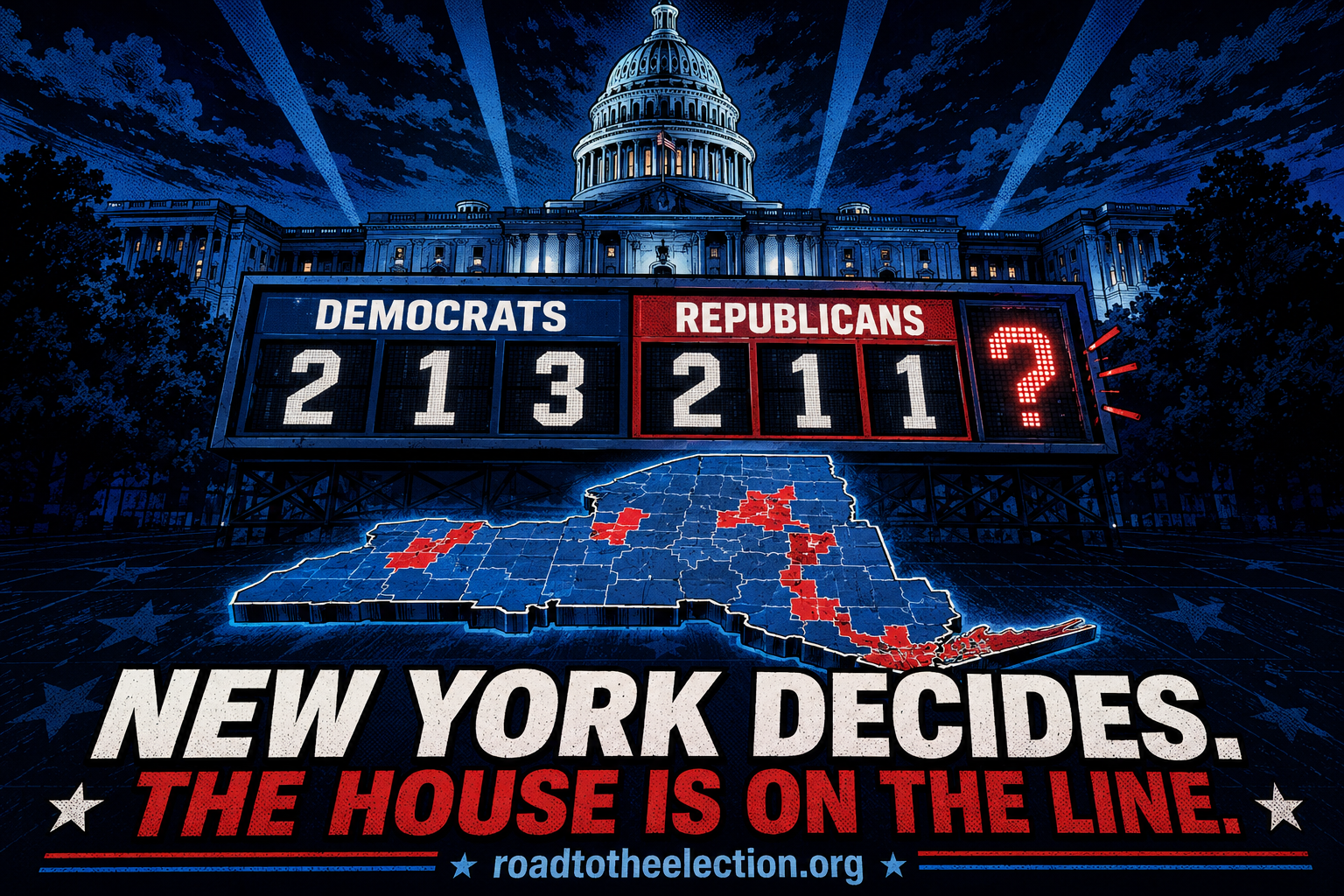
New York holds 26 US House seats. Democrats currently hold 20 of them. Republicans hold 6, including several in competitive suburban districts on Long Island and in the Hudson Valley that are considered genuine toss-ups in November. The primary results tonight determine which Democratic nominees face those Republican incumbents in the fall.
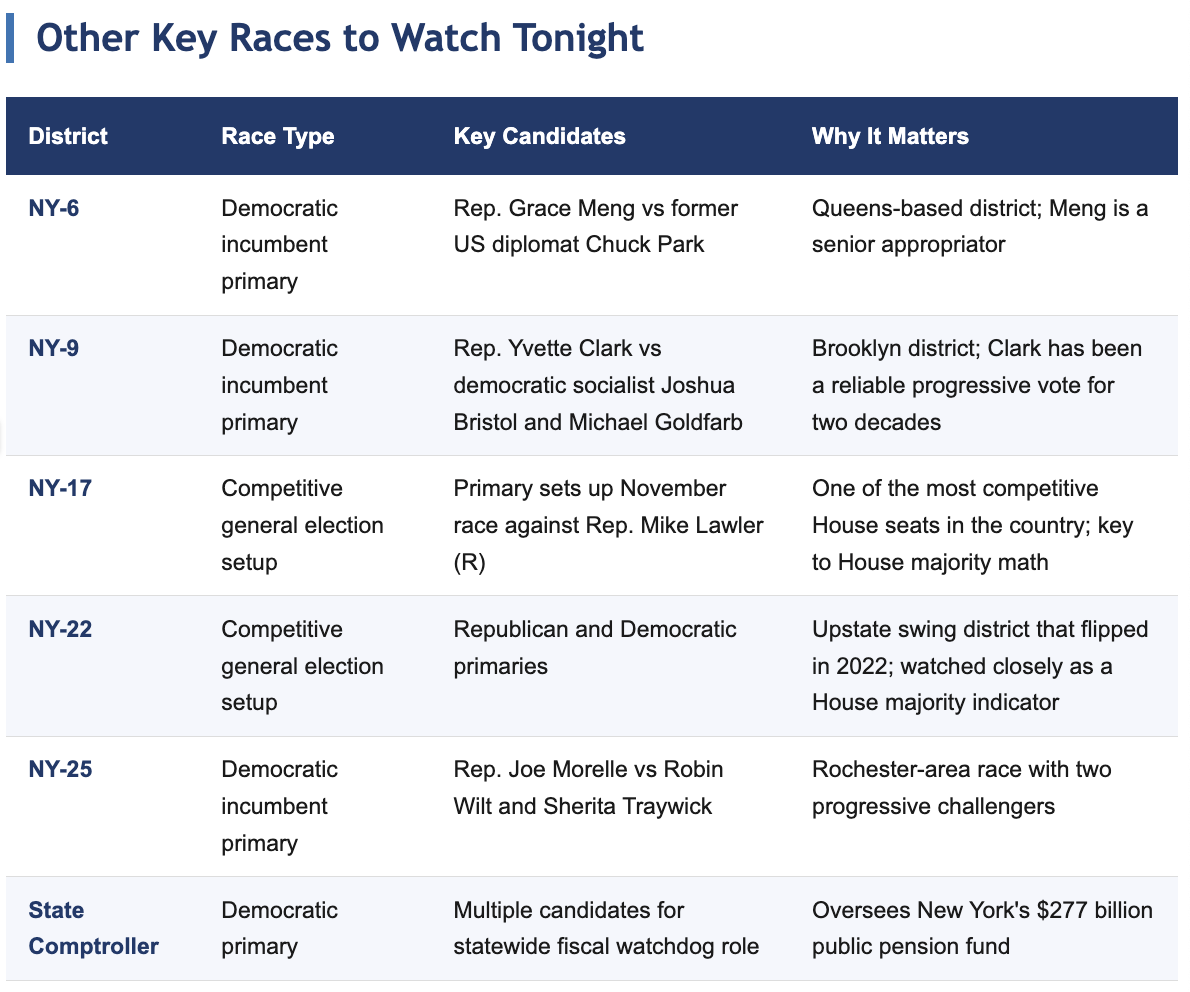
In NY-17, Democrat versus Republican Michael Lawler is one of the most closely watched House races in the country. The Democratic primary tonight sets up who gets that November shot. In NY-3 on Long Island, both parties held primaries to determine their nominees for another competitive seat.
With Republicans holding the House majority by a margin of roughly four to five seats, New York’s competitive districts alone could determine which party controls the chamber after November 3. The nominees chosen tonight in primaries like NY-17 and NY-22 will carry those races in the fall.
Also on roadtotheelection.org
New York is not the only state where primary elections carry national consequences. California’s 52 House seats went through a similar primary battle in June, with results that are also directly tied to House majority math. Read our full breakdown: Why California Elections Matter More Than Most States in American Politics
How to Follow Tonight’s Results
Results are counted and reported by the NYC Board of Elections unofficial results page and the NYC Board of Elections main elections page for New York City races. Statewide results including upstate congressional and legislative races are reported by the New York State Board of Elections.
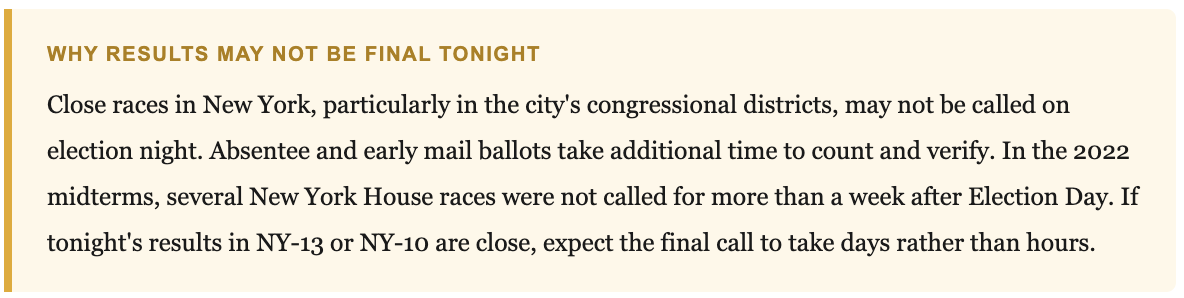
New York does not have California’s seven-day postmark rule for mail ballots, but mail and absentee ballots received by Election Day are counted alongside in-person votes. The unofficial results reported on election night reflect votes counted through that evening; final certified results typically take several days to weeks as remaining absentee and provisional ballots are processed.
The Bottom Line
The New York primary 2026 is deciding positions that directly affect housing costs, federal spending, immigration enforcement, healthcare access, and the balance of power in Congress. The governor’s race is uncontested on both sides. The real story is in the congressional primaries, particularly the three districts where Mamdani’s endorsed slate is testing whether the progressive coalition that won City Hall can win in Congress.
The results coming in tonight will tell two stories simultaneously: which specific candidates advance to November, and which wing of the Democratic Party has the organizational strength and voter enthusiasm to shape the midterm environment. Both stories are central to understanding where election updates in the US stand heading into the final stretch before November 3, 2026.
References:
New Yorker. New York Primary Elections Map and Live Results
New York City Board of Elections. 2026 Elections and Voting Information
Ballotpedia. New York Elections, 2026

- Five Myths About States Banning ICE From Polling Places - October 12, 2026
- The Secret Ballot Is Newer Than You Think, and It Took a Body Count to Get Here - October 6, 2026
- Why Is Election Day Always a Tuesday in November? - September 4, 2026