
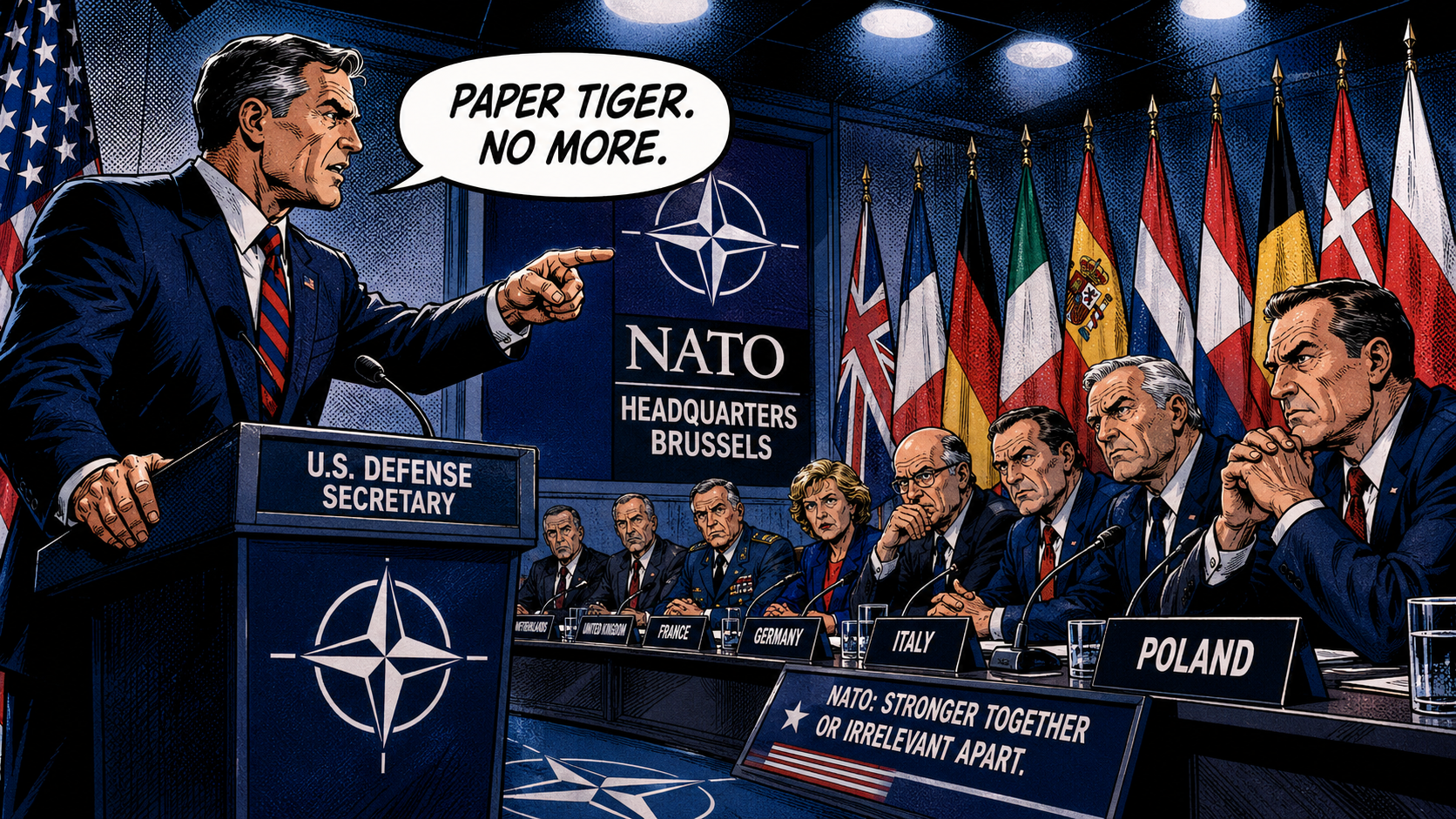
On June 18, 2026, US Defense Secretary Pete Hegseth stood before NATO defense ministers in Brussels and announced a six-month Pentagon review of American troop levels in Europe, telling allies the alliance had become a “paper tiger” and a “one-way street.” He called for what he termed “NATO 3.0,” demanding that European members take primary responsibility for their own conventional defense. Hegseth’s remarks followed weeks of tension: the US had already withdrawn 5,000 troops from Germany, scaled back the fighter jets and warships it commits to NATO’s crisis response force, and accused several allies of refusing US forces base access during the recent war with Iran, calling that refusal “shameful.” NATO Secretary General Mark Rutte responded that there would be no immediate operational impact, noting that European allies and Canada had increased defense spending by $90 billion in the past year, a 20% rise over 2024. The exchange captured, in real time, a tension that has defined the US NATO relationship since the alliance was founded 77 years ago: how much should the United States carry, and how much should its allies carry. This article explains the legal and historical foundation of that relationship, what the alliance actually requires of its members, how defense spending burden sharing works, and why the current friction is not new, even if its intensity is.
What NATO Actually Is
NATO, the North Atlantic Treaty Organization, is a security alliance of 32 countries from North America and Europe. According to the US Mission to NATO, the alliance’s fundamental goal is to safeguard the freedom and security of its members by political and military means. It remains the principal security instrument of the transatlantic community and an expression of shared democratic values.
The alliance was formed through the signing of the North Atlantic Treaty, also called the Washington Treaty, in Washington, D.C., on April 4, 1949. According to the US State Department’s historical record, NATO was the first peacetime military alliance the United States entered into outside the Western Hemisphere. The treaty’s purpose was to provide collective security against the Soviet Union at a moment when Western Europe’s economies and militaries were still recovering from the Second World War.
The Founding Members
Twelve countries signed the original treaty in 1949: the United States, Canada, Belgium, Denmark, France, Iceland, Italy, Luxembourg, the Netherlands, Norway, Portugal, and the United Kingdom. Since then, NATO has expanded through ten rounds of enlargement, growing to 32 members. Greece and Turkey joined in 1952, West Germany in 1955, and a wave of Central and Eastern European countries joined following the collapse of the Soviet Union in 1991, including Poland, the Baltic states, and most recently Finland and Sweden.
How the US NATO Relationship Began
The path to NATO’s founding ran through a series of crises in 1947 and 1948 that convinced US officials that Western Europe’s security could not be guaranteed through American economic aid alone. The State Department’s account identifies the specific events that pushed Washington toward a formal military alliance: a Soviet-backed communist coup in Czechoslovakia, communist gains in Italian elections, and the Soviet blockade of West Berlin in 1948, which brought the United States and the Soviet Union to the brink of direct conflict.
Western European countries had already begun organizing their own collective defense. Great Britain, France, Belgium, the Netherlands, and Luxembourg signed the Brussels Treaty in March 1948, committing to defend one another if attacked. At the same time, the Truman administration instituted a peacetime draft and increased military spending. Republican Senator Arthur H. Vandenberg proposed a resolution in May 1948 suggesting the president seek a security treaty with Western Europe, a measure that passed and opened formal negotiations for what became the North Atlantic Treaty.
Those negotiations were not simple. European nations wanted assurance that the United States would intervene automatically if attacked. Under the US Constitution, the power to declare war rests with Congress, not the president, so American negotiators worked to find treaty language that reassured European allies without committing the US to act in violation of its own constitutional structure. That tension between alliance commitment and constitutional war powers remains a live legal question in the US NATO relationship today.
The result was the North Atlantic Treaty, a deliberately short document of just 14 articles and roughly 1,000 words. Its core purpose, as the US Mission to NATO describes it, is simple: a joint pledge by each member country to assist the others if attacked.
Article 5: What Collective Defense Actually Requires
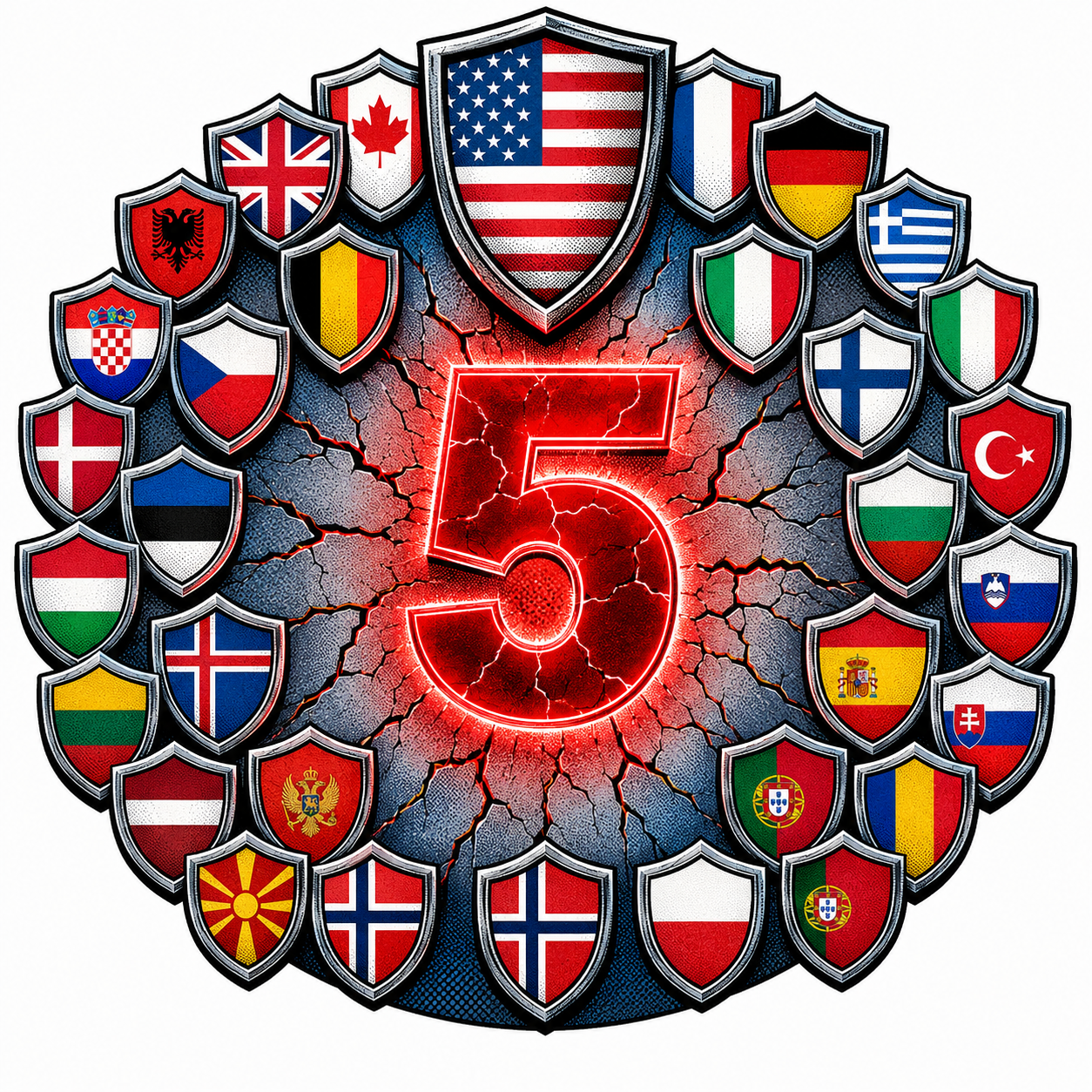
The single most important provision in the North Atlantic Treaty is Article 5, which states that an armed attack against one NATO member shall be considered an attack against all of them. This is the legal foundation of NATO’s collective defense principle, and it is the clause most frequently misunderstood by the public.
Article 5 does not obligate any member to take a specific military action. Each member nation determines for itself how to respond to an invocation of Article 5. The treaty text states that members will assist the attacked party “by taking forthwith, individually and in concert with the other Parties, such action as it deems necessary, including the use of armed force, to restore and maintain the security of the North Atlantic area.” That phrasing is intentionally flexible. A member’s Article 5 response can range from military deployment to diplomatic support to economic measures, and the decision to invoke Article 5 at all requires unanimous agreement among all NATO members.
Article 5 Has Been Invoked Only Once
In NATO’s 77-year history, Article 5 has been formally invoked exactly one time: on September 12, 2001, the day after the terrorist attacks on the World Trade Center and the Pentagon. NATO allies agreed unanimously to treat the attacks as an Article 5 case, and NATO subsequently launched Operation Eagle Assist, in which allied aircraft helped patrol US airspace, followed by Operation Active Endeavour, a Mediterranean naval mission that continued until 2016.
Article 4 of the treaty is a separate and less restrictive provision that ensures consultation among allies on security matters of common interest, without requiring the same unanimous threshold as Article 5. Article 4 consultations have expanded over the decades from narrowly defined Soviet threats to peacekeeping missions, cyberattacks, and other emerging security concerns.
Article 3 of the treaty is the legal basis for NATO’s defense spending expectations. It states that members will maintain and develop their individual and collective capacity to resist armed attack through continuous self-help and mutual aid. This article, not Article 5, is what underlies the defense spending targets that have become central to the current friction within the alliance.
How Much the US Spends on NATO and What “Burden Sharing” Means
The term burden sharing refers to how the costs and responsibilities of NATO’s collective defense are divided among members. It has been a point of friction within the alliance since its earliest years. A Congressional Budget Office analysis of NATO burden sharing found that the issue dates back to NATO’s founding, when the United States agreed to provide economic and military aid to help Western Europe rebuild and stationed troops in Europe to defend those nations. As Europe grew more prosperous in subsequent decades, the US Congress increased its calls for European allies to shoulder a greater share of their own defense costs, a pattern that has continued for over seven decades.
The modern benchmark for burden sharing is a target percentage of GDP that each member commits to defense spending. This target has changed substantially over time:
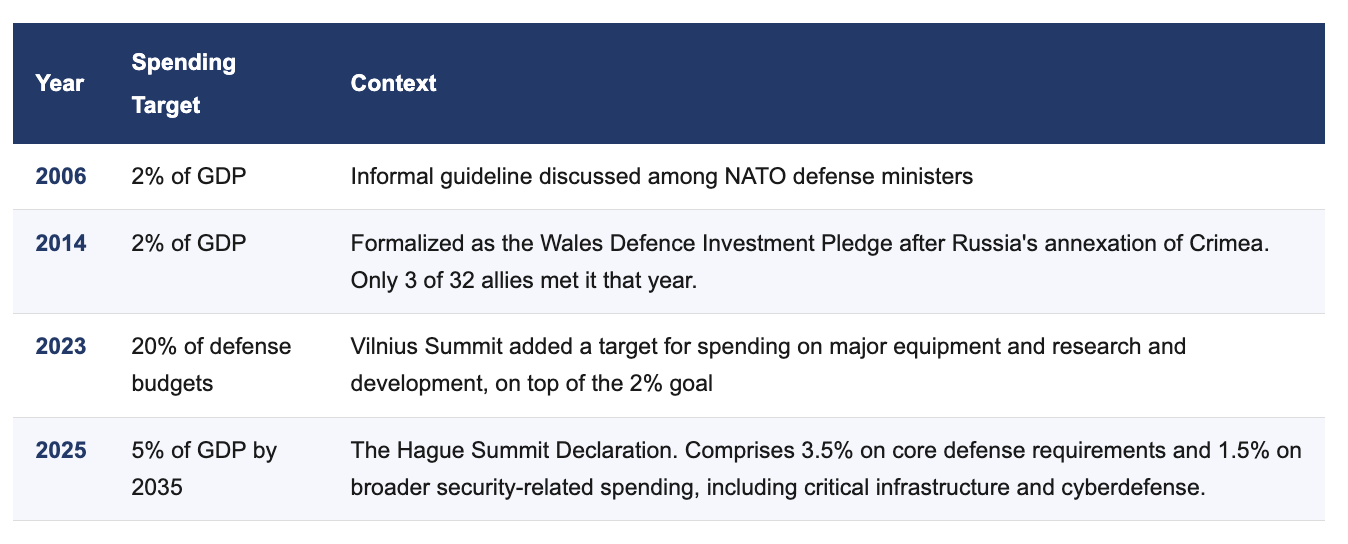
By 2025, all 32 NATO allies met or exceeded the prior 2% target, compared to only 3 allies in 2014. European allies and Canada increased their combined defense spending by 20% compared to 2024, spending more than $574 billion in 2025 in 2021-adjusted prices. Despite that progress, most members have not yet reached the newer 3.5% benchmark set in 2025, which is the figure Hegseth referenced when criticizing allies during the June 2026 Brussels meeting.
One ally, Spain, formally requested an exemption from the 5% target, with Prime Minister Pedro Sánchez describing the goal as “unreasonable and counterproductive” and arguing that Spain could meet its capability targets at 2.1% of GDP. Spain was ultimately excluded from the 5% requirement in the final summit declaration text, a carve-out that has drawn criticism from other allies and from US officials, including direct criticism from Hegseth in June 2026.
What the 2% and 5% Targets Actually Pay For
The defense spending targets are not direct payments to NATO as an organization. NATO’s own shared budget, which funds its headquarters, permanent military command structure, and joint operations, totaled approximately EUR 4.6 billion in 2025 and up to EUR 5.3 billion in 2026, representing only about 0.3% of total allied defense spending. The 2% and 5% targets instead refer to each country’s own national defense budget, covering its own troops, equipment, and military readiness. The expectation is that a well-funded national military strengthens the alliance’s collective capability, not that the money flows to NATO directly.
US Troops in Europe: The Current Drawdown Debate
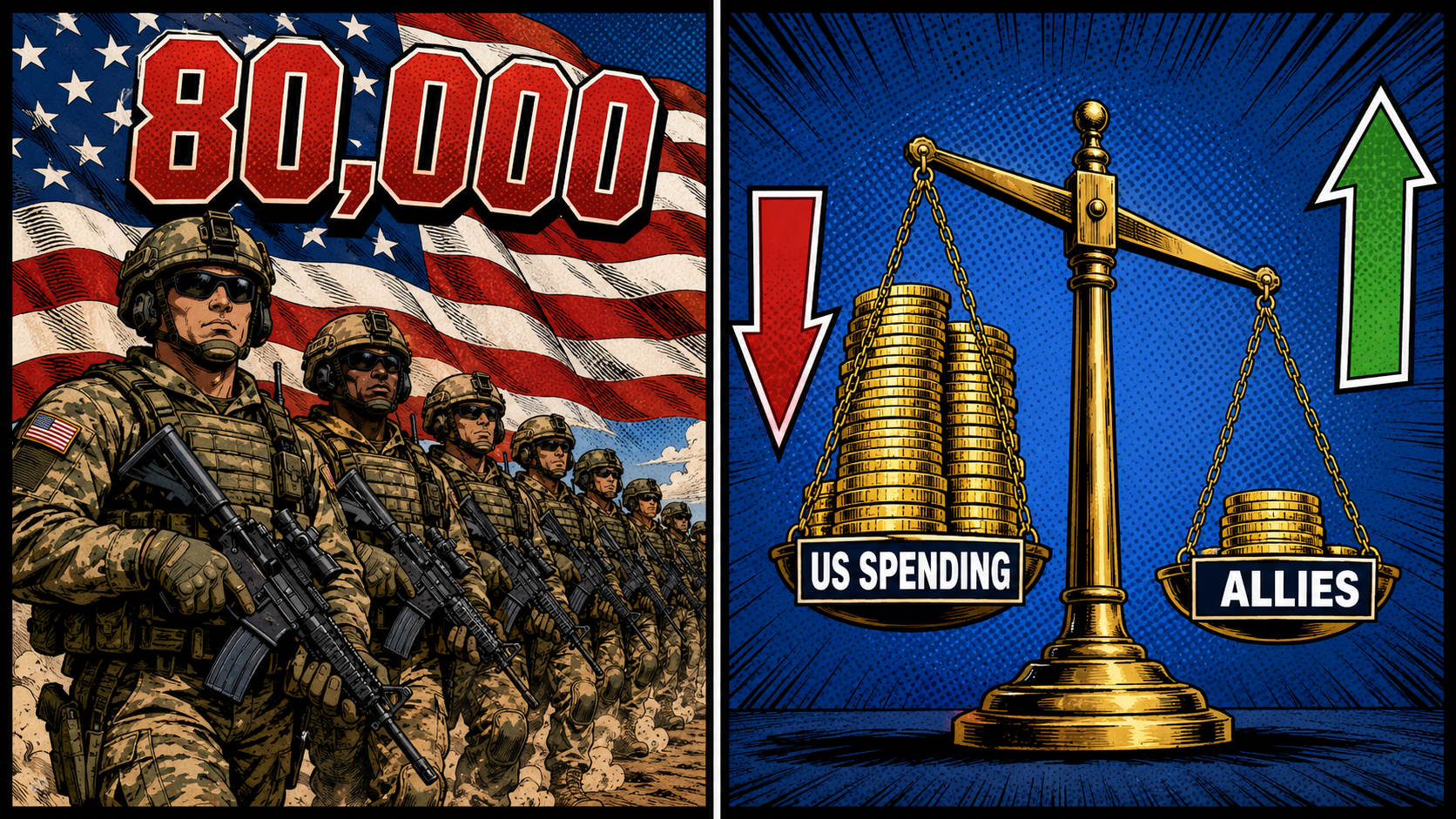
As of mid-2026, the United States has approximately 80,000 troops deployed across Europe, a presence that has become the focal point of the current dispute within the alliance. The Trump administration’s approach has shifted multiple times over recent months. In May 2026, the Pentagon withdrew roughly 5,000 troops from Germany, leading to the cancellation of a planned armored brigade deployment to Poland. That decision drew bipartisan criticism in Congress, with members of the Senate Armed Services Committee warning it could send the wrong signal to Russian President Vladimir Putin. President Trump subsequently announced 5,000 troops would be sent to Poland instead, though the Pentagon has not detailed where those troops would be drawn from.
Separately, NATO’s top commander, US Air Force General Alexus Grynkewich, confirmed in early June that the United States had told allies it would reduce the number of fighter jets, strategic bombers, and warships it commits to NATO’s crisis response force, a move described as an effort to remedy what he called an “unhealthy co-dependence” on US forces within NATO’s force model. Reuters reported the number of US F-15 and F-15E fighter jets available to NATO would fall by a third to 99, and the number of MQ-4 and MQ-9 Reaper drones would fall by half to 12.
The six-month review Hegseth announced on June 18 will examine US force posture and basing across Europe and will include consultations with Congress, which has legislated a minimum number of US forces in Europe. Hegseth said the review’s purpose is to ensure NATO moves “fast and irreversibly” toward European allies taking primary responsibility for the continent’s conventional defense, framing the goal as a “NATO 3.0” modeled on the alliance’s original Cold War posture.
NATO Secretary General Mark Rutte sought to reassure allies that the changes would not have an immediate operational impact, stating, “This is not about where forces and assets are currently located. It’s about who would do what if our defense plans were activated.” Rutte also said NATO’s top commander believes European allies either currently have, or will soon have, sufficient capability to compensate for any gaps left by a US drawdown.
The Iran War and the Base Access Dispute
A significant driver of the current friction is the war between the United States and Iran earlier in 2026. Hegseth told NATO defense ministers in Brussels that several European allies refused to grant US forces access to bases in Europe for operations related to the conflict, calling that refusal “shameful” and saying it put American service members “at risk” by denying predictable access, basing, and overflight rights. Spain in particular faced criticism from Washington over base access, raising questions about the future of the US Navy’s presence at Rota, a key base supporting NATO’s missile defense mission. Other countries, including Germany, Romania, Greece, and the United Kingdom, did provide bases that supported US Middle East operations during the conflict.
President Trump separately referred to NATO as a “paper tiger” in March 2026 over the alliance’s collective response to Iran’s closure of the Strait of Hormuz during the conflict.
The Cost of Political Pressure on Allies
The current strategy of applying public pressure to NATO allies is not new, even though its current intensity is. An analysis published by the Georgetown Journal of International Affairs examined a similar episode from 2020, when then-Secretary of Defense Mark Esper announced the withdrawal of 11,900 US military personnel from Germany. That analysis identified a structural tradeoff that remains relevant today: pressuring allies to increase defense spending can produce short-term increases in European military investment, but it carries a longer-term risk. The tenser the relationship between the US and its NATO allies becomes, the more those allies may begin to question the reliability of US security guarantees, a dynamic that could invite the kind of testing behavior from adversaries like Russia that collective defense is designed to deter in the first place.
That same tension is visible in the current moment. German Defense Minister Boris Pistorius warned in June 2026 that withdrawing US capabilities, particularly deep strike missile systems, without a clear timeline for European replacement creates what he called “dangerous capability gaps” for the alliance’s eastern flank. Belgium’s defense minister said his country would contribute more to NATO’s crisis response force, including F-16 fighter jets and surveillance drones, to help offset the reduced US commitment.
How the US Supports NATO Partners Beyond Membership
The US NATO relationship extends beyond the 32 formal member states to a network of partner countries that cooperate with NATO without being full members. According to a fact sheet published by the American Presidency Project, NATO’s partnership programs include the Partnership for Peace, established in 1994 with 22 European partners, and several regional dialogue frameworks covering the Mediterranean and Gulf states.
US bilateral support to NATO partners typically falls into three categories: direct security assistance, training and military exercises, and long-term reform of defense and security institutions. Ukraine has been the most significant recipient of this kind of support since 2014, receiving training for conventional and special operations forces, equipment including counter-artillery radar systems and secure communications, and advisory support aimed at improving defense governance and reducing corruption. Georgia and Moldova have also received intensified support through similar channels, reflecting their status as countries seeking closer alignment with NATO without full membership.
Why This Matters for US Politics and the 2026 Elections
For readers following election updates in the US, the NATO debate is not a purely foreign policy question. It carries direct domestic political consequences heading into the November 2026 midterms.
Congress has legislated a minimum troop presence requirement for US forces in Europe, meaning any significant drawdown resulting from the Pentagon’s six-month review would require congressional engagement and could become a campaign issue in competitive House and Senate races, particularly in districts with constituents who have family serving in deployed units. The bipartisan pushback that followed the May 2026 Germany withdrawal, including criticism from Republican members of the Senate Armed Services Committee, illustrates that NATO policy does not divide cleanly along party lines in Congress, even when the Trump administration’s rhetoric is sharply partisan.
The debate also intersects with the broader question of US fiscal priorities. Higher European defense spending commitments are, in part, a response to direct pressure from the Trump administration, a policy outcome the administration has claimed credit for achieving. Whether voters view reduced US troop commitments in Europe as a prudent reallocation of resources toward domestic priorities and the Indo-Pacific, or as a destabilizing retreat from a 77-year alliance commitment, is likely to shape how candidates in both parties discuss foreign policy through November 3, 2026.
NATO leaders are scheduled to meet again at a summit in Türkiye on July 7 and 8, 2026, where the outcomes of the current US troop review and the broader burden sharing dispute are expected to be a central topic of discussion.
The Bottom Line
The US NATO relationship has always rested on a tension between collective commitment and individual national discretion. Article 5 promises that an attack on one member is an attack on all, but it does not specify what any single member must do in response, and it has been invoked only once in 77 years. Article 3’s call for self-help and mutual aid has evolved from an informal 2% of GDP guideline in 2006 into a 5% target by 2035, with the United States now applying direct pressure, through troop withdrawals, reduced equipment commitments, and public criticism, to accelerate that European buildup.
What is unfolding in 2026, including the six-month Pentagon review announced in Brussels, the reduced US contributions to NATO’s crisis response force, and the unresolved friction over base access during the Iran war, is the latest chapter in a burden sharing debate that has run continuously since 1949. How it resolves, and how the American public and Congress respond to it, will shape both the future of the alliance and a meaningful piece of the foreign policy debate heading into the 2026 midterm elections.
References:
U.S. Mission to NATO. About NATO
U.S. Department of State, Office of the Historian. North Atlantic Treaty Organization (NATO), 1949
U.S. Department of Defense. NATO Spotlight
Georgetown Journal of International Affairs. The US-NATO Relationship: The Cost of Maintaining Political Pressure on Allies
The American Presidency Project. Fact Sheet: U.S. and NATO Efforts in Support of NATO Partners, Including Georgia, Ukraine, and Moldova

- A Supreme Court Case You Probably Missed Could Open the Door to a Lot More Election Lawsuits - October 9, 2026
- Dark Money Is Pouring Into the 2026 Midterms. Here Are Five Myths About How It Actually Works - September 21, 2026
- The Supreme Court Just Blocked Trump’s Mail Ballot Restrictions. Here’s What That Means - September 17, 2026