
Claiming a rigged election in the US took place is one of the most serious allegations that can be made in a democracy. It triggers legal processes, agency investigations, and in some cases, federal prosecution. But it also runs into a hard reality: the United States has no single authority with the power to declare an election fraudulent, no one agency that handles every complaint, and no simple process that moves from allegation to verdict.
What the US does have is a layered system — federal agencies, state officials, courts, and constitutional mechanisms — each with distinct roles, distinct limits, and distinct standards for what counts as proof. Understanding how that system actually works is essential for any voter, journalist, candidate, or citizen trying to make sense of election updates in the US in 2026 and beyond.
This article explains who investigates, who decides, what the law requires, what the evidence shows about how common election fraud actually is, and what happens — legally and constitutionally — when an election outcome is seriously challenged.
First: Voter Fraud vs. Election Fraud. They Are Not the Same.
Before getting into who investigates what, it helps to understand a distinction that most reporting on this topic collapses: voter fraud and election fraud are different things, and they are handled differently under the law.
Voter fraud refers to illegal acts by individual voters, casting a ballot in someone else’s name, voting more than once, registering under a false address, or voting as a non-citizen. These are individual-level crimes, often prosecuted under 52 U.S.C. § 10307 and 18 U.S.C. § 611.
Election fraud, sometimes called election subversion, refers to illegal acts by officials or organized efforts to manipulate the administration of an election itself. This can include ballot box stuffing, unlawful tampering with vote tabulation, interference with ballot counting, certification misconduct, or organized efforts to alter election administration outcomes. Federal prosecutors may use statutes including 18 U.S.C. §§ 241 and 242, depending on the facts of the case.
Professor Richard Hasen of UCLA School of Law, writing in the Harvard Law Review, draws the distinction clearly: voter suppression is about laws and rules that make it harder for people to register and vote; election subversion is about attempts to manipulate the counting or aggregation of ballots, or to prevent an actual election winner from taking office. The two are related, but they involve different actors, different legal mechanisms, and different investigative agencies.
How Widespread Is Election Fraud in the US?
Before examining who investigates, it is worth establishing what the evidence actually shows about the scale of the problem — because the frequency of proven fraud directly affects how the investigative system is calibrated.
According to research from the Brookings Institution, documented cases of voter fraud in the United States are exceedingly rare. Experts found no evidence of widespread fraud capable of altering national election outcomes, and in specific states like Arizona, the percentage of fraudulent votes over 25 years of elections was measured at a fraction of a fraction of one percent.
A July 2023 working paper from the University of Chicago’s Becker Friedman Institute, Electoral College and Election Fraud, by economists Georgy Egorov and Konstantin Sonin, offers a structural explanation for why this is so. Their research shows that under the Electoral College system, the states where fraud would matter most — swing states — are also the states where it is hardest to commit, because opposing parties have sufficient representation in the administrative bodies responsible for detecting and preventing it. In a close state like Georgia, Arizona, or Wisconsin, both parties have election observers, legal teams, and officials watching the same count. Organizing fraud at a scale sufficient to flip results is, the authors argue, structurally difficult under the current system.
This does not mean fraud never occurs. It means that documented, outcome-altering fraud is rare — and that the investigative system is designed to handle credible, specific allegations rather than broad claims.
Who Can Report a Rigged Election?
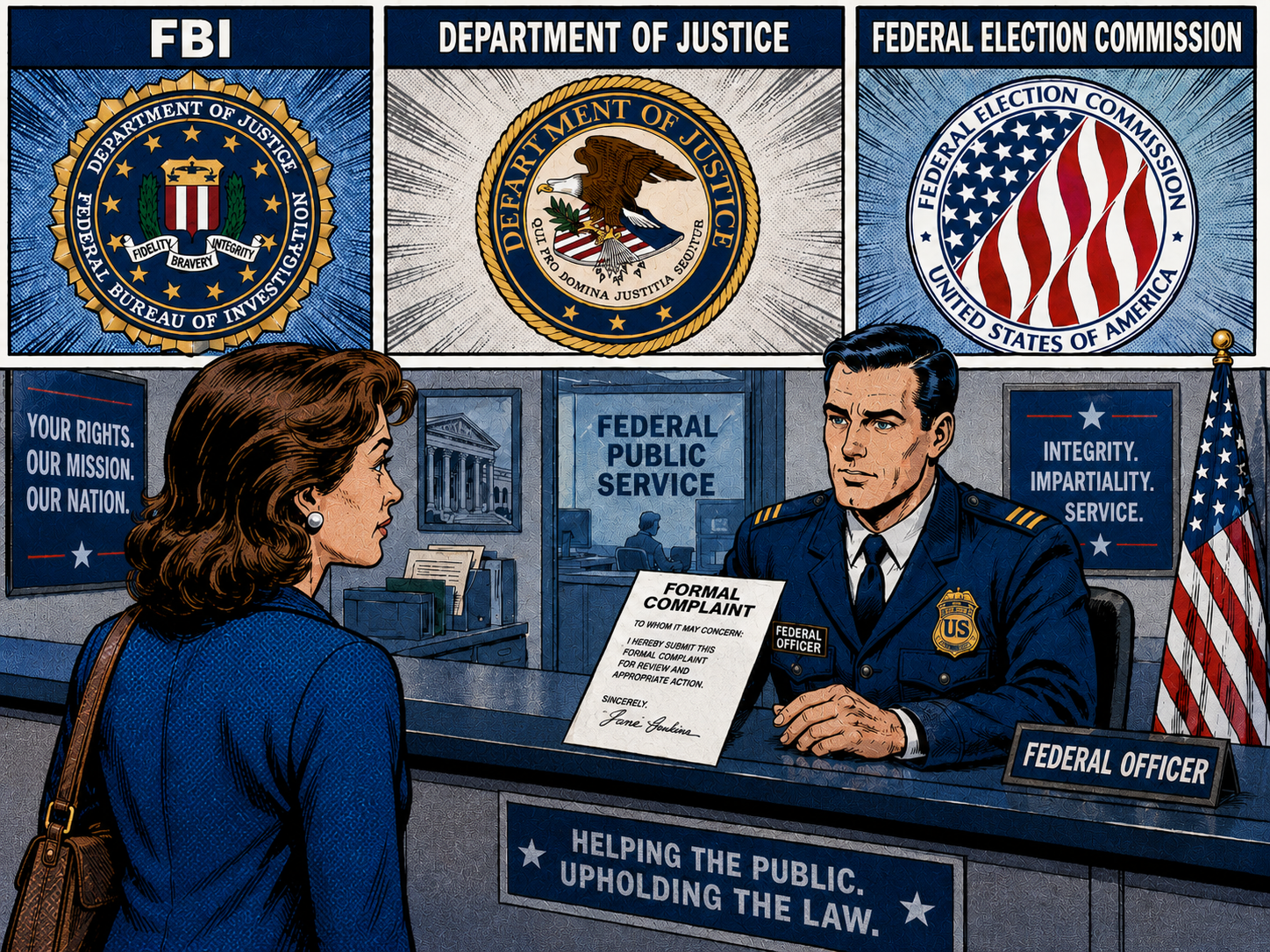
Any person with credible information about suspected election misconduct may report it to federal or state authorities. A person does not need to be a candidate, election worker, or registered voter to submit a complaint. According to USAGov, the following people can all file complaints:
Individual voters who witness or experience irregularities at the polls or in their community
Candidates and their campaigns
Election workers and poll watchers
Political party officials and representatives
Members of the public with specific, documented information
Journalists or advocacy organizations with evidence
The operative word is “specific.” The DOJ’s own published guidance, in its Federal Prosecution of Election Offenses handbook, instructs prosecutors to distinguish between credible allegations that could affect an election’s outcome and claims that are described directly in the handbook as “specious, speculative, fanciful, or far-fetched.” Vague claims based on rumor, social media posts, or general distrust do not trigger formal federal investigations.
Who Actually Investigates?
There is no single federal election authority in the United States. The investigative responsibility is distributed across agencies depending on the type of alleged violation.
The Department of Justice — Election Crimes Branch
The DOJ’s Election Crimes Branch, created in 1980 within the Public Integrity Section, is the central federal body overseeing the government’s response to election crimes. It handles five categories of cases:
Voting fraud — vote buying, absentee ballot fraud, impersonation of voters
Campaign finance crimes — violations of the Federal Election Campaign Act
Patronage crimes — political shakedowns and misuse of federal programs for political purposes
Frauds affecting elections — scam political action committees, fraudulent fundraising
Criminal violations of federal voting rights statutes — violations not based on race or national origin, which are handled separately by the Civil Rights Division
The Director of the Election Crimes Branch reviews all major election crime investigations nationwide and all proposed criminal charges relating to election crimes. Major federal election crime investigations and proposed charges are typically reviewed through the DOJ’s Election Crimes Branch to ensure consistency nationwide.
The DOJ Civil Rights Division — Voting Section
Voter intimidation, voter suppression, and denial of voting rights on the basis of race, color, religion, or national origin are handled by the DOJ’s Civil Rights Division, not the Election Crimes Branch. The Voting Section enforces the Voting Rights Act, the National Voter Registration Act, and related statutes. It can be reached at 1-800-253-3931 or by filing a report online.
The Federal Bureau of Investigation
The FBI investigates potential federal election crimes in coordination with the DOJ’s Public Integrity Section. The FBI’s role is particularly relevant when allegations involve organized efforts to suppress or manipulate votes, cybersecurity threats to election infrastructure, or disinformation campaigns designed to deceive voters about the time, date, or location of elections. Reports can be filed at tips.fbi.gov or by calling 1-800-CALL-FBI.
The Federal Election Commission
The FEC handles campaign finance crimes — violations of the Federal Election Campaign Act, including illegal contributions, coordination between campaigns and outside groups, and disclosure failures. The FEC has civil enforcement authority and can refer criminal matters to the DOJ. It does not investigate vote counting, ballot handling, or election administration.
State and Local Election Officials
The majority of election administration in the United States is governed by state law. Most complaints about how ballots are handled, how voter rolls are maintained, or how results are certified are handled at the state level, not the federal level. As USAGov confirms, contacting your state or local election office is often the most direct first step for administrative complaints that do not rise to the level of a federal crime.
What Happens After a Report Is Filed?
Once a credible complaint reaches a federal agency, the process moves through several stages:
1. Intake and jurisdictional review. The receiving agency determines whether the allegation falls within federal jurisdiction. Federal jurisdiction attaches when the election involves a federal candidate, when a federal official acts under color of law, or when the conduct involves voter registration — which is unified across federal and state elections in all 50 states.
2. Preliminary inquiry. Agents or attorneys assess whether the complaint has a factual basis sufficient to warrant formal investigation. Speculative or generalized allegations typically end here.
3. Formal investigation. If the complaint clears the preliminary stage, agents collect evidence, interview witnesses, and examine records. Grand jury proceedings may be used to compel testimony or documents under oath.
4. Prosecutorial review. DOJ attorneys assess whether the evidence supports federal charges. For most election fraud statutes, the violation must be “knowing and willful” — meaning accidental errors or administrative mistakes do not meet the bar for criminal prosecution.
5. Charges or declination. If the evidence meets the legal standard, charges are filed. If not, the case is declined. Prosecutors are not required to publicly explain declination decisions, which is one reason many reported complaints appear to disappear without public resolution.
One critical timing constraint: the DOJ’s own published guidance instructs prosecutors not to conduct overt investigative steps during an active election where doing so could suppress legitimate voter participation or inject the investigation itself into the electoral contest. Federal investigators are historically directed to wait until after an election closes before taking visible investigative steps — except in cases involving immediate threats of violence or clear criminal conduct that cannot wait.
Who Decides If the Claim Is Real?
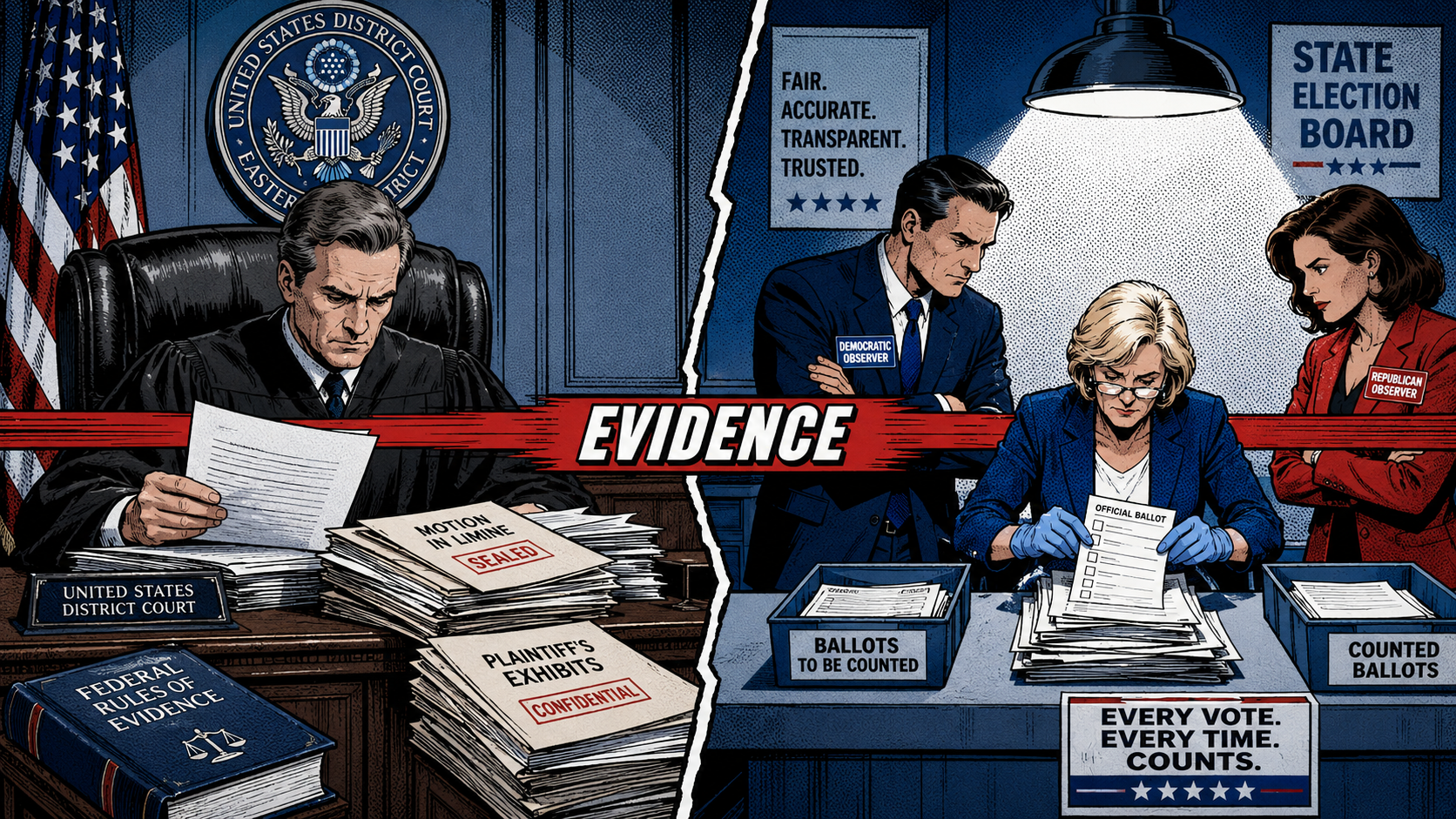
This is the question most people actually want answered — and the answer is that no single person or agency makes that call alone.
At the investigative level, the DOJ’s Election Crimes Branch Director makes the initial determination of whether a matter warrants federal investigation. US Attorneys in each district also have authority over local election fraud complaints. The FBI assesses credibility of tips independently.
At the adjudicative level, federal prosecutors decide whether to bring charges, and federal courts — ultimately — determine guilt or innocence. No executive agency has the power to declare an election fraudulent and void its results. That determination, if it happens at all, goes through the courts.
At the constitutional level, Harvard Government Professor Daniel Carpenter, speaking to the Harvard Gazette, explained that the most severe scenarios — such as a state legislature refusing to certify results or attempting to send alternative electors — ultimately land in the federal courts and potentially in Congress itself. Under the 12th Amendment, if the Electoral College is underpopulated because states refuse to certify results, rare constitutional scenarios where no presidential candidate receives a certified Electoral College majority, the election may be decided by the House of Representatives under the 12th Amendment.
Professor Hasen’s Harvard Law Review analysis identifies three primary mechanisms by which election subversion could occur in the US: usurpation of voter choice by state legislatures claiming authority over electors; fraudulent or suppressive conduct by law-breaking election officials; and violent or disruptive private action that prevents voting or interferes with vote counting. Each mechanism requires a different legal and institutional response — and none of them is resolved simply by filing a complaint with the FBI.
What Are the Legal Remedies?
Beyond criminal prosecution, several civil and procedural remedies exist:
Election contests. Under state law, candidates or parties may formally contest election results. Rules vary by state but generally require filing within a strict deadline after certification and providing evidence that irregularities were large enough to have changed the outcome.
Civil rights litigation. Under the Voting Rights Act and the Equal Protection Clause of the 14th Amendment, individuals and organizations can bring civil lawsuits to remedy voting rights violations without requiring a criminal conviction first.
Recount processes. Most states have statutory procedures for requesting a recount, either automatically triggered by a close margin or by petition. Recounts address counting errors; they do not address fraud in how votes were cast.
Congressional certification challenges. Under the Electoral Count Reform Act, signed into law in 2022, Members of Congress may object to the certification of Electoral College votes on narrow, specified grounds. The Act clarified and tightened the procedures following the disputes of January 6, 2021, raising the threshold for objections and specifying that the Vice President has no discretionary authority over the process.
Federal civil enforcement. The DOJ Civil Rights Division can bring civil enforcement actions — separate from criminal prosecution — to remedy demonstrated patterns of voter discrimination or suppression.
The Structural Reality: Why “Rigged” Is Hard to Prove and Harder to Reverse
The United States does not have a centralized election authority. Elections are administered by approximately 10,000 local jurisdictions across 50 states, each operating under its own state law with its own ballot design, voting equipment, and counting procedures. That decentralization is simultaneously the system’s greatest protection against large-scale fraud and its greatest source of inconsistency and confusion.
As the University of Chicago’s Becker Friedman Institute research shows, the Electoral College structure specifically makes large-scale manipulation in consequential states structurally difficult: the places where stolen votes would matter most are the places where both parties have the most oversight capacity.
And as Professor Hasen’s Harvard Law Review analysis emphasizes, what has historically protected American elections from subversion is not law alone — it is the refusal of most election and elected officials to disobey or ignore legal constraints, even when pressured. Law provides the framework; the commitment of individual officials to follow it provides the enforcement.
For anyone following election updates in the US in the 2026 cycle and beyond, that distinction matters. The system for investigating a rigged election in the US exists, is accessible, and carries real legal consequences when violations are proven. But it is a system built on evidence, jurisdiction, legal thresholds, and institutional commitment — not on the volume or persistence of a claim.
Quick Reference: Where to Report
Voting rights violations, intimidation, or suppression: DOJ Civil Rights Division at 1-800-253-3931 or civilrights.justice.gov/report
Voter fraud (illegal votes, impersonation, registration fraud): Local FBI field office or local US Attorney’s Office
Campaign finance crimes: Federal Election Commission
Election disinformation (false info about voting dates, locations): FBI at tips.fbi.gov
General election administration complaints: Your state election office
Physical threats at a polling place: Call 911 first, then report to federal authorities
References:
USA.gov. Voter Fraud
Becker Friedman Institute for Economics at the University of Chicago. Electoral College and Election Fraud
Federal Bureau of Investigation. Election Crimes and Security
U.S. Congress. Hearing on Election Fraud and Related Issues
U.S. Department of Justice. Election Crimes Branch
Harvard Gazette. Stealing an Election
Harvard Law Review. Identifying and Minimizing the Risk of Election Subversion and Stolen Elections in the Contemporary United States
Brookings Institution. How Widespread Is Election Fraud in the United States? Not Very

- Five Myths About States Banning ICE From Polling Places - October 12, 2026
- The Secret Ballot Is Newer Than You Think, and It Took a Body Count to Get Here - October 6, 2026
- Why Is Election Day Always a Tuesday in November? - September 4, 2026