
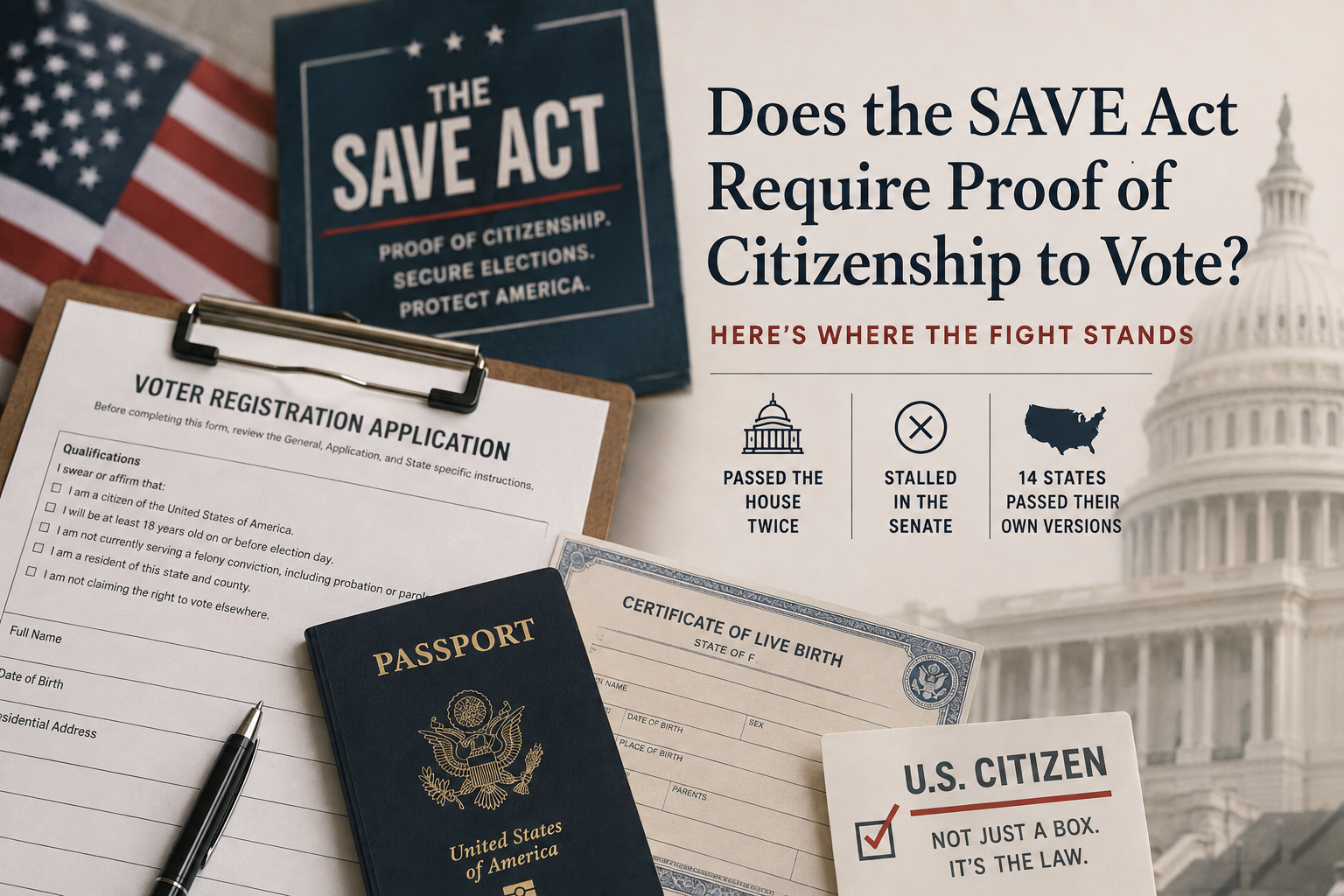
If you’ve registered to vote in the U.S. before, you probably just checked a box swearing, under penalty of perjury, that you’re a citizen. No passport required, no birth certificate, nothing notarized. A bill called the SAVE Act would change that nationwide, and after more than a year of fighting over it in Congress, it just hit a wall in the Senate. Here’s what it would actually do, what’s already happened without it, and why the outcome still matters for how you register this fall.
The short answer: not yet, and maybe not before the midterms but partly, yes, depending on your state. The federal version has passed the House twice but can’t clear the Senate’s 60-vote threshold. Meanwhile, 14 states have already passed their own proof-of-citizenship laws since 2024, so the practical answer to “do I need to prove citizenship to register” already depends heavily on your zip code.
What the SAVE Act actually does
The Safeguard American Voter Eligibility (SAVE) Act would require three things for federal elections: documentary proof of U.S. citizenship to register to vote (think passport, birth certificate, or naturalization papers, rather than just a signed attestation), a photo ID to actually cast a ballot, and routine cross-checks of state voter rolls against the Department of Homeland Security’s citizenship-verification database. All three would take effect immediately if the bill became law.
Supporters frame it as closing a loophole: current law only requires registrants to swear they’re citizens, and while there’s no evidence of noncitizen voting at any meaningful scale, backers argue the honor-system approach is worth tightening. Critics argue it solves a problem that barely exists while creating a much bigger one, namely, making it harder for citizens to register at all.
The House passed it. Twice.
The House passed the SAVE Act on February 16, 2026, an updated version of a bill that had already passed the House once in 2025. The vote fell almost entirely along party lines: all 217 Republicans present voted yes, joined by exactly one Democrat.
The practical fallout, according to election administrators quoted by Votebeat, would be significant. Because documentary proof would generally have to be presented in person, the bill would effectively end mail-in and online voter registration. A 2023 University of Maryland survey found that roughly 9% of voting-age citizens don’t have easy access to a citizenship document. Kansas offers a real-world preview: a similar state-level requirement there blocked more than 31,000 eligible people from registering over several years, while turning up only 39 confirmed noncitizen registrations in 14 years.
Why it’s stuck in the Senate
The bill’s problem isn’t the House, it’s the math next door. Senate Republicans hold 53 seats, and most legislation needs 60 votes to overcome a filibuster. That gap is exactly what’s kept the SAVE Act from becoming law all year.
President Trump pushed hard to change that in late July 2026, calling on Majority Leader John Thune to either cancel the Senate’s August recess until the bill passed or eliminate the filibuster outright to force it through. Thune resisted both asks, saying the votes simply weren’t there, a position some Senate conservatives, including Utah’s Mike Lee, publicly criticized as a failure of leadership. House Republicans floated routing a narrower version through the budget reconciliation process instead (which only needs a simple majority), but Thune said that path didn’t have the votes either.
As a fallback, the Senate took up a scaled-down, photo-ID-only version of the bill sponsored by Senator Jon Husted right before the recess. It failed on a 52–46 vote on August 8, 2026, eight votes short. That same morning, Thune filed a cloture motion on an unrelated cryptocurrency regulation bill, effectively consuming most of the Senate’s limited September floor schedule before midterm campaigning takes over in October. As of this writing, the SAVE Act isn’t scheduled for any further Senate floor action this year.
Meanwhile, states didn’t wait
While Congress has been stuck, states have simply gone ahead on their own. Fourteen states have enacted SAVE Act-style proof-of-citizenship requirements since 2024, layered on top of Arizona’s and Georgia’s longer-standing rules. Some, like Wyoming, South Dakota, and Ohio, require documentary proof directly from new registrants. Others, including Kansas, Mississippi, Kentucky, Tennessee, and Indiana, instead run registrants through the same DHS citizenship-verification database and only demand paperwork from people the system flags.
Not all of these have survived contact with the courts. New Hampshire’s version, which required a birth certificate, passport, or naturalization papers to register, blocked nearly 250 voters during 2025 town elections before a federal judge struck it down in May 2026, ruling it violated the right to vote. Florida’s law isn’t set to take effect until January 2027, and implementation in states like Louisiana remains incomplete more than a year after passage.
Wait, can states even do this on their own?
This isn’t the first time states have tried to add citizenship-verification steps on top of the federal voter-registration process, and the last time it happened, it ended up at the Supreme Court. Arizona passed a proof-of-citizenship law back in 2004 (Proposition 200) and required it on top of the federal registration form created by the 1993 “Motor Voter” law, the National Voter Registration Act. In Arizona v. Inter Tribal Council of Arizona, Inc. (2013), the Supreme Court ruled that states cannot demand additional proof of citizenship beyond the standard federal form for federal elections, because federal law preempts state add-ons in that specific lane — though states retained more room to set their own rules for state and local elections.
That’s precisely why the current fight is happening in Congress at all: a federal statute like the SAVE Act would have the authority the 2013 ruling said individual states lack on their own for federal races, which is also why the current patchwork of 14 state laws mostly applies to state voter rolls and only indirectly touches federal ballots, and why several of those laws are already drawing the same kind of legal challenges that sank Arizona’s rule back in 2013.
What this means heading into the midterms
If the SAVE Act doesn’t move again before Congress breaks for midterm campaigning, the federal registration process, the attestation-only version, stays exactly as it is nationwide. But that’s cold comfort if you live in one of the 14 states with a state-level version already in effect: your own registration or re-registration could still require documents you may not have handy, especially if you’ve moved, married, or otherwise don’t have a current ID that matches your birth certificate. It’s worth checking your state election office’s website well before any registration deadline rather than finding out at the counter.
Why this matters to voters
This fight isn’t really about whether noncitizens are voting in large numbers, there’s no evidence they are, at any level that would swing an election. It’s about a genuine trade-off between two things most people say they want: confidence that only eligible citizens are casting ballots, and a registration system simple enough that eligible citizens aren’t turned away by paperwork. Where the SAVE Act (and its state-level cousins) ultimately land will shape not who’s allowed to vote, but how easy or hard it is for the people who are already allowed to actually get on the rolls.
“There Aren’t Even Close To The Votes Here”: John Thune Explains Why SAVE America Act Won’t Pass
This is Thune’s own on-camera comment about the Senate vote count — the exact “we don’t have the wherewithal to pass it right now” beat the article covers. It’s a real, widely-reported quote (also covered by Yahoo, MSN, and The Hill), so it’s a solid factual anchor rather than opinion content.
References:
H.R. 22 — SAVE Act, 119th Congress — Congress.gov
How the SAVE America Act would affect the 2026 elections — Votebeat
Trump demands Senate cancel August break until it passes the SAVE America Act — PBS News
SAVE Act Buried: Thune Filed Crypto Cloture Same Morning as September Deal — Tech Times
Six Things to Know About the SAVE America Act — Bipartisan Policy Center
Arizona v. Inter Tribal Council of Arizona, Inc., 570 U.S. 1 (2013) — Justia U.S. Supreme Court Center

- The Supreme Court Is About to Decide a Major Voter Roll Case. Here Is the Timeline That Got Us Here - September 24, 2026
- Why Poll Workers Are Disappearing, And What It Means for Election Day - September 14, 2026
- Why Is the Justice Department Suing States Over Voter Rolls, and Why Does It Keep Losing? - August 28, 2026