
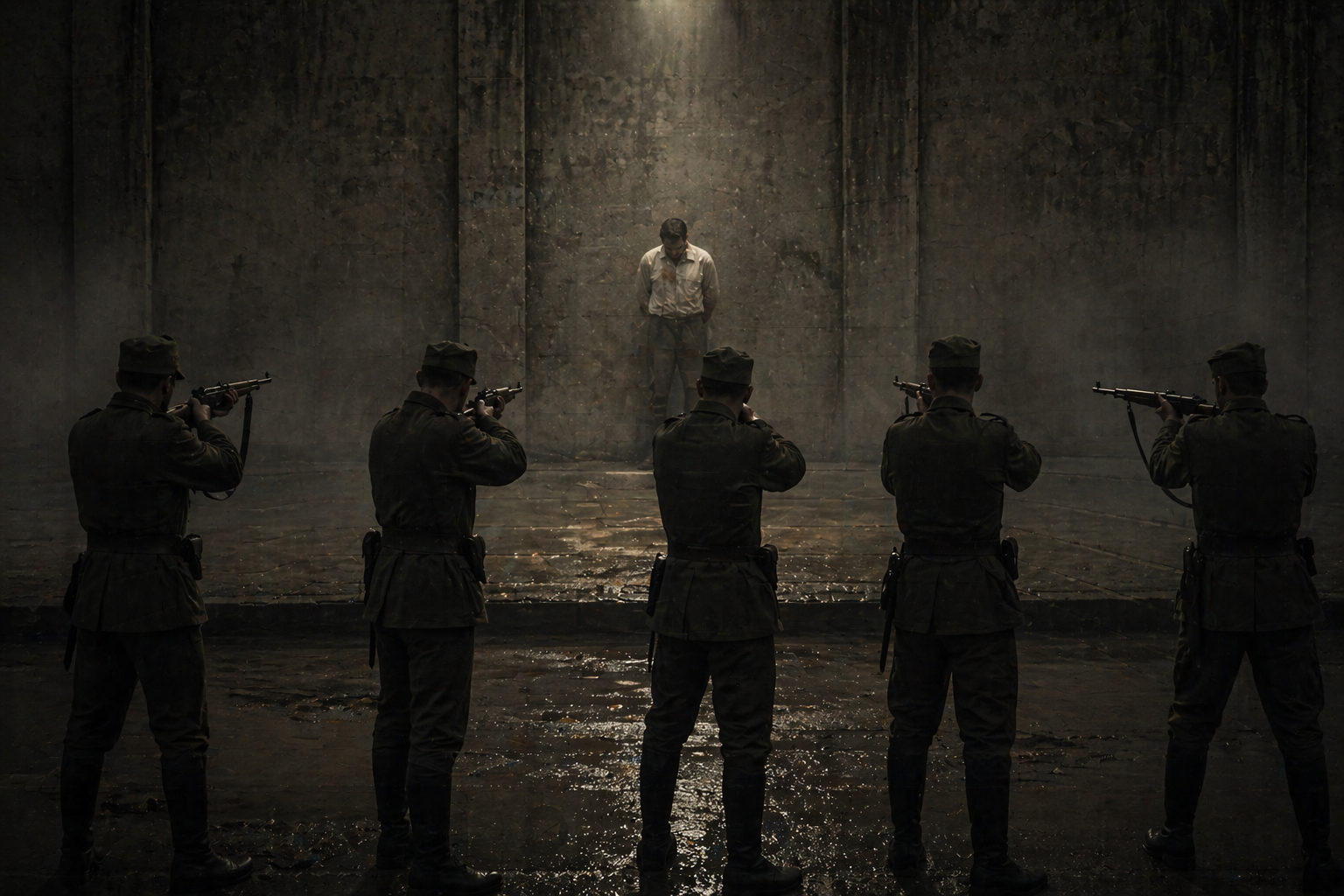
Capital punishment in the United States is administered through a shifting set of methods, and firing squad executions are once again at the center of that conversation.
For decades, lethal injection dominated the landscape of death penalty methods U.S. courts and legislatures had to work with. That dominance is eroding. Drug shortages, pharmaceutical boycotts, and sustained legal challenges have pushed several states to revive or formally authorize the firing squad death penalty as a primary or backup option.
This is not simply a story about execution logistics. It is a story about federalism, constitutional law, and the democratic mechanisms that govern how the United States carries out its most irreversible legal act. Voters who care about criminal justice, the role of courts, and the limits of state power will find this issue worth understanding in depth.
What is a firing squad execution?
Firing squad executions involve a team of trained marksmen firing rifles at a condemned individual. Shots are aimed at the heart to cause rapid death through blood loss and cardiac failure. Standard protocols include a blindfold, physical restraints, and a target marker placed on the prisoner’s chest.
The method is valued by proponents for one core quality: mechanical reliability. It does not depend on pharmaceutical supply chains, IV access, or precise drug chemistry. When protocols are followed by trained personnel, death is typically rapid.
Critics raise two objections. First, the visual character of the method strikes many observers as more disturbing than clinical alternatives. Second, errors in marksmanship, though uncommon in documented cases, can cause prolonged suffering. Courts weigh both considerations against the constitutional standard established by the Supreme Court.
Legally, firing squad executions have survived every Eighth Amendment challenge brought against them. Federal courts have consistently found that the method, when properly administered, does not constitute cruel and unusual punishment under the standards the Supreme Court has articulated.
U.S. Execution Methods History: From Hanging to Lethal Injection
Understanding why firing squad executions are returning requires a grounding in U.S. execution methods history.
Colonial America relied primarily on hanging, the dominant method from the earliest settlements through the 19th century. Firing squads were used in military justice contexts throughout this period and into the 20th century, most notably for soldiers convicted of serious offenses during wartime.
The late 19th and early 20th centuries brought successive attempts to modernize execution. New York introduced electrocution in 1890, promoted as more humane than hanging. Nevada adopted the gas chamber in 1924. Both methods spread across state systems before facing their own legal and practical difficulties.
Lethal injection emerged in Oklahoma in 1977 and was first used in Texas in 1982. By the 1990s, it had become the default method across most of the United States. Its appeal was largely cosmetic and procedural: it resembled a medical procedure, relied on clinical-looking equipment, and minimized visible distress in the execution chamber.
Utah conducted what became the last widely recognized firing squad execution in the modern era in 2010. For roughly 15 years after that, the method existed mainly in statute, unused in practice, until South Carolina resumed it in 2025.
Why states are reconsidering the firing squad
The renewed interest in firing squad executions is largely a response to mounting difficulties with lethal injection — the method that has dominated American capital punishment for four decades.
Drug shortages and supplier boycotts
Many pharmaceutical companies, including European manufacturers, have refused to allow their products to be used in executions. This has led to widespread shortages of the drugs required for lethal injection protocols, leaving some states unable to carry out court-ordered sentences.
Legal challenges over botched procedures
Several high-profile cases of prolonged or visibly painful deaths during lethal injections have prompted Eighth Amendment litigation. Courts scrutinize whether a method presents a substantial risk of serious pain and whether a readily available alternative exists. These legal obstacles have stalled executions in multiple states for years at a time.
Legislative pressure to carry out sentences
In response, some state legislatures have passed laws authorizing alternative methods — including the firing squad — to ensure that death sentences can be carried out even when lethal injection is unavailable or legally blocked. This reflects both a practical and a political calculus: elected officials face pressure from constituents who view prolonged delays as a failure of the justice system.
Which states currently authorize the firing squad
As of the mid-2020s, five states have enacted statutes authorizing firing squad executions. Their approaches vary in how central the method is to their protocols.
Idaho – Primary method
Enacted legislation in 2025 making the firing squad the default method effective July 2026, with lethal injection as a backup.
South Carolina – Inmate’s choice
Conducted the first U.S. firing squad executions in 15 years in 2025. Inmates may choose it alongside electrocution or lethal injection.
Utah – Conditional
Authorized as a backup when lethal injection drugs are unavailable; the method with the longest modern history in the state.
Mississippi – Conditional
Authorized as an alternative when other methods face legal or logistical obstacles.
Oklahoma – Conditional
Authorized as a third option after lethal injection and nitrogen hypoxia, with specific conditions triggering its availability.
Firing squad vs. lethal injection: key comparisons
The debate between these two methods involves trade-offs across several dimensions — reliability, constitutional risk, logistics, and public perception.
| Factor | Lethal injection | Firing squad |
| Reliability | Variable; depends on drug quality, dosage, and IV access. Has resulted in prolonged procedures. | Mechanically consistent when carried out by trained marksmen; does not rely on pharmaceutical supply. |
| Drug/supply issues | Significant; manufacturer bans have created chronic shortages in multiple states. | None; relies on standard firearms and ammunition. |
| Legal vulnerability | High; frequent Eighth Amendment challenges, especially after visible complications. | Lower; courts have consistently upheld it based on historical use and speed of death. |
| Public perception | Seen as clinical and less graphic; broadly accepted in policy discussions. | Viewed by many as more visceral; raises concerns about optics even among death penalty supporters. |
| Speed of death | Designed to be rapid, but complications can extend the process significantly. | Typically causes near-immediate unconsciousness from cardiac disruption. |
Lethal Injection vs Firing Squad: The Core Trade-offs
The lethal injection vs firing squad debate involves trade-offs that lawmakers, courts, and the public evaluate differently depending on their priorities.
Reliability and consistency favor the firing squad under current conditions. Lethal injection depends on a supply chain that has become unpredictable and on clinical administration that has proven error-prone in practice. The firing squad death penalty relies on firearms and trained personnel, both of which are reliably available and subject to straightforward quality control.
Constitutional risk currently favors the firing squad as well. Every failed or prolonged lethal injection procedure generates potential litigation. The firing squad has a long track record of surviving Eighth Amendment review, largely because courts measure methods against the historical baseline of accepted practices and assess the risk of serious pain relative to known alternatives.
Public and institutional perception favors lethal injection among those who view the clinical appearance of the method as meaningful. Many corrections officials, legislators, and members of the public find the firing squad more difficult to accept on psychological or optics grounds, even if they intellectually accept its constitutional and practical arguments.
Cost and infrastructure tend to favor the firing squad. Lethal injection protocols, including procurement, quality testing, litigation management, and staff training, have become expensive administrative undertakings in states with active death rows. Firearm-based protocols are considerably simpler to administer.
There is no objectively correct resolution to the lethal injection vs firing squad comparison. It is ultimately a values-laden policy question that democratic institutions are designed to resolve through legislation, executive action, and judicial review.
What the Constitution Actually Says
All capital punishment methods United States law authorizes must satisfy the Eighth Amendment’s prohibition on “cruel and unusual punishments.” The Supreme Court has never held any specific method to be categorically unconstitutional, but it has developed a legal framework that governs how courts evaluate methods.
The key cases are:
Baze v. Rees (2008): The Court upheld Kentucky’s three-drug lethal injection protocol, establishing that a method does not violate the Eighth Amendment unless it presents a “substantial risk of serious harm.” The plurality held that an inmate challenging a method must identify a known and available alternative that would significantly reduce that risk.
Glossip v. Gross (2015): The Court reaffirmed and sharpened the Baze framework. An inmate must propose a specific, available alternative. Identifying a problem with the current method without offering a solution is constitutionally insufficient.
Bucklew v. Precythe (2019): Justice Neil Gorsuch, writing for the majority, explicitly cited the firing squad as an example of a “known and available alternative” an inmate challenging lethal injection might plausibly propose. This reference effectively signaled that firing squad executions occupy a constitutionally comfortable position within Eighth Amendment doctrine.
The historical depth of U.S. execution methods history works in the firing squad’s favor. Courts applying the evolving-standards-of-decency test look to tradition and legislative acceptance. A method used continuously in American military and civil justice for centuries carries significant historical weight.
The Federal Government’s Role: Department of Justice Executions Policy
While states govern their own capital cases, the federal government maintains a parallel system for offenses prosecuted under federal law. Department of Justice executions policy sets the procedural rules for federal death sentences, and those rules have shifted considerably across administrations.
The federal government executed no prisoners under President Obama and conducted a historic 13 federal executions in the final months of President Trump’s first term (2020 to 2021), ending a 17-year federal moratorium. President Biden reimposed a moratorium on federal executions and ordered a review of protocols, leaving the question of method and scheduling to future administrations.
Federal regulations permit alternative methods, including the firing squad, when primary protocols are unavailable. No modern federal execution has used the firing squad, but the legal architecture exists to allow it.
The practical significance of Department of Justice executions policy extends beyond federal death row. Federal signals about acceptable methods, federal drug scheduling decisions that affect pharmaceutical availability, and federal court appointments all shape the environment in which state-level execution debates occur. The presidency, Senate, and federal judiciary collectively exert meaningful indirect influence over how capital punishment methods United States law evolves at the state level.
Frequently Asked Questions
Is the firing squad legal in the United States? Yes. Five states have active statutes authorizing firing squad executions, and courts have consistently upheld the method as constitutional under the Eighth Amendment.
When was the last firing squad execution before 2025? Utah carried out a firing squad execution in 2010. South Carolina resumed the practice in 2025, ending a 15-year gap.
Can a condemned inmate choose the firing squad? In South Carolina, yes. Inmates may select from lethal injection, electrocution, or the firing squad. In Idaho, the firing squad is the default, with lethal injection as the backup. Other states vary in whether the choice rests with the inmate or the state.
Does the federal government use firing squads? No federal execution has used the firing squad in the modern era. Federal regulations permit alternative methods, including the firing squad, when primary protocols fail, but this authority has not been exercised.
Why did lethal injection become the dominant method? Lethal injection was adopted beginning in the 1980s because it resembled a medical procedure and minimized visible distress, making it more acceptable to the public, corrections personnel, and courts. Drug supply problems and litigation over botched executions have since undermined its operational advantages.
References:
Death Penalty Information Center. Methods of Execution.
Oyez. Baze v. Rees (2008).
Oyez. Glossip v. Gross (2015).
Oyez. Bucklew v. Precythe (2019).
Congressional Research Service. Federal Capital Punishment: Recent Executive Action.
Idaho Statesman. Idaho builds toward firing squad execution method in 2026.
Associated Press. South Carolina carries out first U.S. firing squad executions in 15 years.
U.S. Department of Justice. Federal Death Penalty Cases.

- Five Myths About How the Electoral College Actually Works - September 29, 2026
- Why Does the President’s Party Almost Always Lose Seats in the Midterms? - September 9, 2026
- Why Is Congress Racing to Fund the Government Before the Midterms? - August 31, 2026