
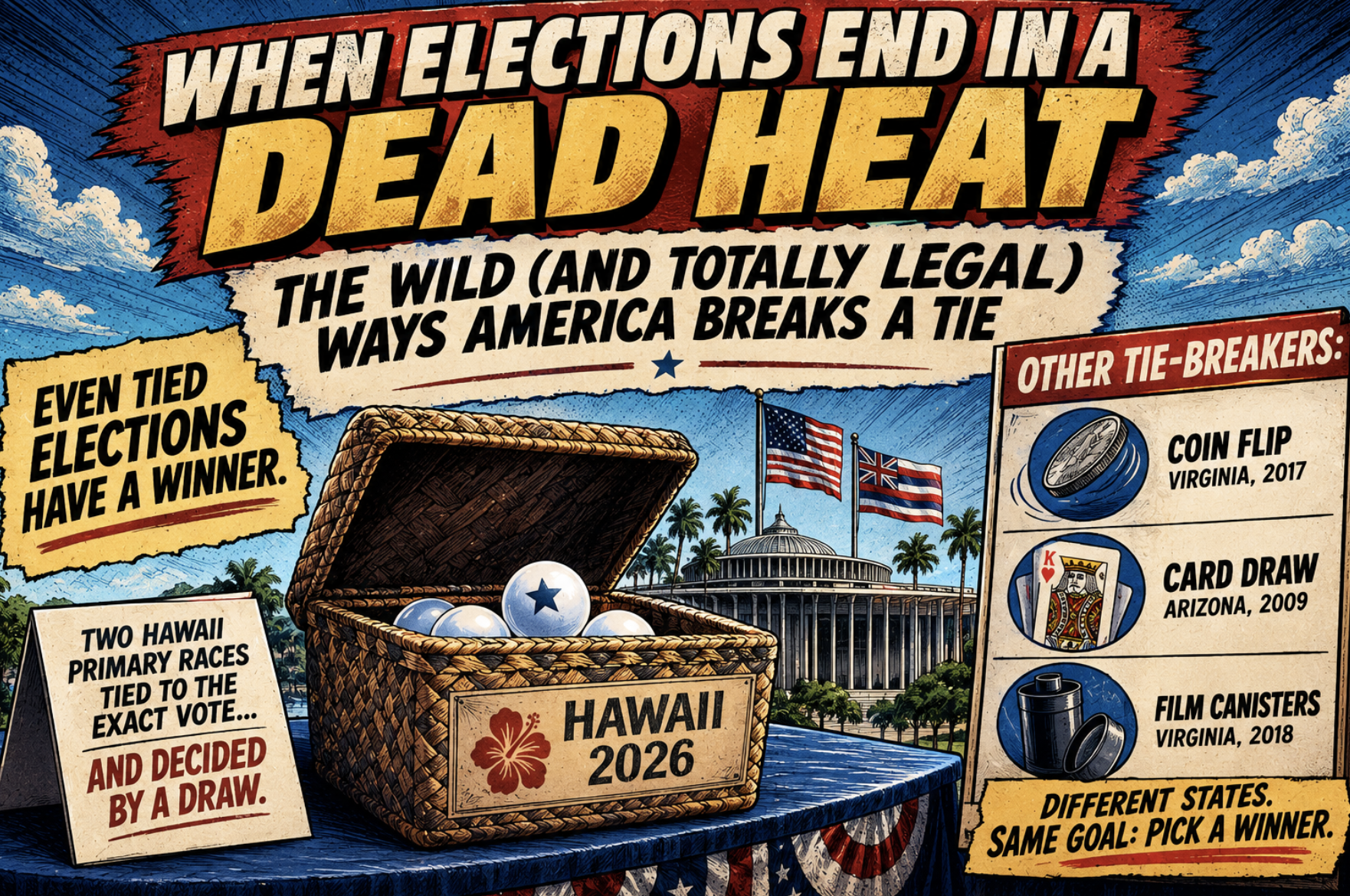
On August 16, 2026, election officials in Honolulu did something that sounds more like a raffle than a government proceeding: they wrote candidates’ names on slips of paper, sealed each one inside a plastic ball, dropped the balls into a woven lauhala box, gave it a shake, and had the state’s chief election officer pull one out to decide who’d won. Not once, but twice — two separate Republican primary races in Hawaii ended in an exact tie this year, and state law says the fix is a literal lottery. If that sounds like a strange way to run a democracy, buckle up, because it’s nowhere near the weirdest example on record.
The short answer: yes, tied elections really do get settled by coin flips, card draws, and lottery-style drawings, and it’s completely legal. More than half of U.S. states have a law on the books specifying exactly which game of chance to use when a race ends in a dead-even tie, because recounts can only get you so far: sometimes the votes are just, genuinely, equal.
Hawaii’s tie, twice, in one primary
The two 2026 Hawaii races that tied were Senate District 20 in Ewa Beach, where challenger Bob McDermott and incumbent Kurt Fevella each pulled exactly 1,212 votes, and House District 43 in Kapolei/Makakilo, where challenger Sheila Medeiros and incumbent Kanani Souza each landed on exactly 842 votes. Under Hawaii Revised Statutes Section 11-157, the state’s Office of Elections ran both tiebreakers as a public drawing at the Capitol. Both challengers ended up winning the draw.
Reactions were mixed, which is sort of the whole story of tie-breaking-by-chance in miniature. McDermott, who won his draw, called it “gambling, right?” and credited a bit of luck. Medeiros, who also won hers, was less enthusiastic about the process itself, arguing that deciding an election with something “like gambling” undercuts the people who actually cast the votes. State officials called it the first time Hawaii has ever had to resolve a legislative primary this way.
The most consequential coin flip in recent memory: Virginia, 2017–2018
Hawaii’s ties settled individual seats. Virginia’s tie once nearly decided control of an entire state legislative chamber. In the 2017 race for Virginia’s 94th House of Delegates district, Republican incumbent David Yancey initially appeared to win by ten votes. A recount flipped that to a one-vote win for Democrat Shelly Simonds. Then a three-judge recount court reviewed a single disputed ballot — one with marks for both candidates, including a slash through Simonds’ bubble — and ruled it should count for Yancey after all. Final tally: 11,607 votes apiece.
Because that seat was the difference between a 51–49 Republican majority and a 50–50 tie in the full House of Delegates, the entire balance of power in Virginia’s legislature came down to what happened next. On January 4, 2018, officials placed each candidate’s name in its own film canister, dropped both into a ceramic bowl, and drew one out. Yancey’s name came up, and Republicans kept their majority by literal luck of the draw.
It gets even stranger than that
Virginia and Hawaii are far from alone. A roundup by Governing of past tie-breaking methods reads like a county fair:
In Cave Creek, Arizona, a 2009 city council race between Thomas McGuire and Adam Trenk tied at 660 votes each. A town judge pulled a deck of cards from a cowboy hat, shuffled it, and had both candidates draw. Trenk pulled the king of hearts and won the seat.
A 2014 Florida city council tie was settled through a multi-step process involving both a coin flip and a bag of numbered ping-pong balls.
New Mexico law doesn’t leave the game up to local officials’ imagination — it specifically requires tied candidates to settle the race with games of chance like drawing high card from a poker deck.
Nevada’s caucus rules similarly call for a card draw, high card wins.
Some jurisdictions have used top hats, tricorn hats, and other headwear as the drawing vessel of choice, apparently for reasons of tradition as much as function.
Perhaps the darkest entry: a 2006 Alaska school board race was decided by a coin flip after ending in a tie — the winner was a candidate who had died on Election Day itself, her name having already been locked in on the ballot before the tie was discovered.
Why states actually do this
It sounds flippant, but there’s a real logic behind it. Recounts can resolve miscounted or ambiguous ballots, but if the votes genuinely land dead even after every ballot is accounted for, there’s no additional vote left to count. The alternatives — a costly special runoff election, or handing the decision to a judge or legislative body to pick a winner by fiat — each bring their own problems: runoffs cost money and delay taking office, and letting an official simply choose a winner replaces the voters’ tied verdict with someone else’s opinion. A neutral game of chance, several state election codes reason, is the option that doesn’t let anyone’s thumb tip the scale after the fact. Virginia’s drawing procedure, for what it’s worth, is rooted in a lot-drawing tradition state election law traces back centuries, long before anyone imagined it deciding control of a modern legislature.
Why this matters to voters
It’s tempting to read all of this as a fun trivia footnote, but there’s a real point underneath it: in low-turnout local and primary elections, a single vote genuinely can be the entire margin, and “genuinely” is doing real work in that sentence — Virginia’s and Hawaii’s ties weren’t rhetorical, they were mathematically exact. If you’ve ever wondered whether your one vote actually matters, the honest answer is that in enough elections to fill a “wild but true” article, it has come down to precisely that — and when it does, the outcome may quite literally be a coin flip. It’s also a good reminder to check your own state’s specific tiebreaker rule, since as this list shows, there’s no single national standard — just a patchwork of coins, cards, bowls, and boxes, each backed by its own state statute.
“Virginia’s Random Drawing For Tied House Of Delegates Race” — NBC News
References
Republican races end in ties, will be decided by drawing — Hawai’i Public Radio
The Crazy Ways Americans Break Election Ties — Governing
A Single Vote Has Flipped Control Of Virginia’s House Of Delegates — NPR
Virginia Republican David Yancey Wins Tie-Breaking Drawing — NPR
Coin flips, poker hands and other crazy ways America settles tied elections — CNN

- Early Voting Just Started for the 2026 Midterms, and the Story Behind It Goes Back Further Than You’d Think - September 18, 2026
- When Elections End in a Dead Heat: The Wild (and Totally Legal) Ways America Breaks a Tie - August 19, 2026
- China vs America AI 2026: The Race That Closed Overnight and the Election Claim That Divides Washington - July 21, 2026