
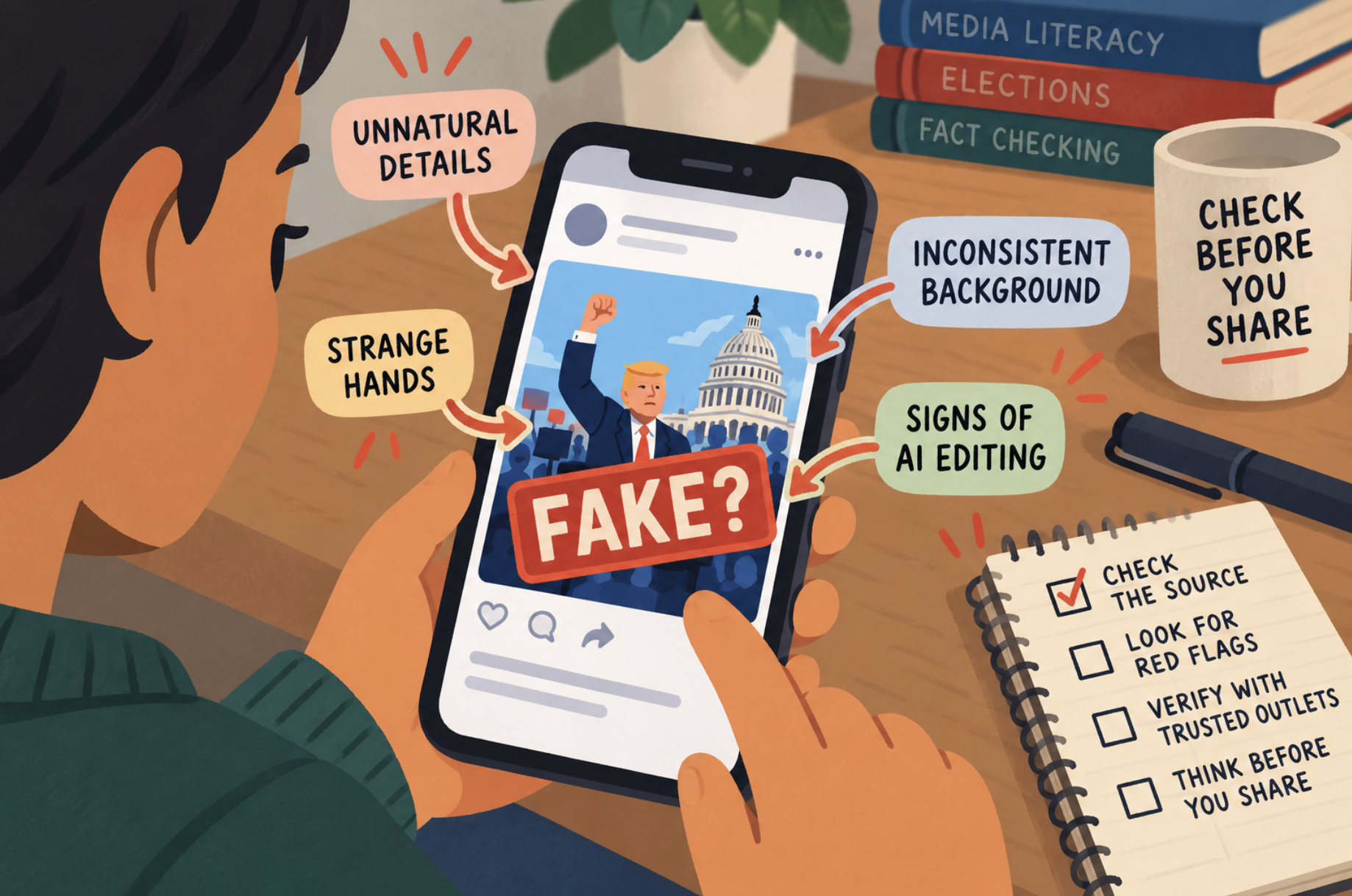
With Election Day on November 3 just days away, the fake content you should probably worry most about this cycle is not a leaked recording or a doctored quote. It is a photo, video, or voice message generated from scratch that never happened at all. Pew Research Center has found that most Americans have heard of AI generated media, but few feel confident they could actually spot it, and controlled studies out of Stanford’s Internet Observatory and other universities back that uncertainty up: people in testing performed only slightly better than random chance at identifying AI generated faces, voices, and video clips.
Why this has gotten harder to catch
Earlier this year, the Brennan Center ran its own test of six widely used AI image and video tools, including ChatGPT, Gemini, Grok, Meta AI, Runway, and Flux.2, asking them to generate a batch of election misinformation images. All six produced convincing results on the first try, often adding unrequested realistic touches like official looking government seals. Safeguards varied widely between tools and were easy to work around in several cases. Separately, researchers have also tied foreign influence campaigns, including a network of thousands of inauthentic accounts researchers linked to Chinese actors and a Russian connected network researchers say has spread AI manipulated celebrity videos, to coordinated efforts aimed at the midterms specifically.
Where this has already shown up
Some of this year’s fakes rode on top of real breaking news. After a pair of high profile incidents this year involving federal immigration enforcement in Minneapolis, AI generated photos and video depicting events that never actually occurred spread within hours, including fabricated arrest records and footage of confrontations that researchers confirmed were fabricated. Researchers tracking this trend also warn, as a plausible tactic rather than something already documented at a polling site, that a fake video showing armed responders outside a community center, or a fake voice message impersonating a county election office, could easily be used to scare specific communities away from voting on Election Day itself.
How to actually tell
A few habits go a long way. Go straight to the source: your state or county election office’s own website, not a screenshot of it, will always have the real information about hours, locations, and deadlines. Treat unusual realism with suspicion rather than reassurance, since testers found that AI tools often add convincing extra details, like a government seal or a web link that looks legitimate but leads nowhere real, specifically because that realism is what makes a fake persuasive. Reverse image search a suspicious photo before you share it. Check whether any mainstream outlet, not just one anonymous account, is reporting the same thing. And treat your own strongest emotional reaction as a signal worth pausing on. Researchers call this “rage bait” for a reason: content engineered to make you angry or afraid is also content you are less likely to fact check before resharing.
What is actually being done about it
A handful of policies are starting to catch up. The European Union’s AI Act now requires AI generated content to carry provenance data identifying it as synthetic, a requirement that took effect in August. California’s AI Transparency Act will require social media labels on AI generated content starting in 2027 and device level signing for capture devices starting in 2028, and Utah and Washington have passed similar laws. On the federal side, the debate cuts the other way: the administration’s proposed fiscal year 2027 budget would eliminate the Cybersecurity and Infrastructure Security Agency’s election security program, which currently shares threat information with state and local election officials.
Why this matters to voters
None of this means you should assume everything you see about this election is fake. It means the burden has shifted: a piece of content looking real, or even looking official, is no longer good enough evidence that it is. Going straight to your own state or county election office for anything that actually affects how, where, or whether you vote, rather than trusting whatever version of a story crosses your feed first, is the single most reliable habit heading into results night.
References
Brennan Center for Justice, AI, disinformation, and election security ahead of the 2026 midterms
Biometric Update, AI fakery is turning fear into a voter suppression tool ahead of U.S. elections
- How to Actually Spot an AI Generated Election Fake Before You Share It - October 28, 2026
- Early Voting Just Started for the 2026 Midterms, and the Story Behind It Goes Back Further Than You’d Think - September 18, 2026
- When Elections End in a Dead Heat: The Wild (and Totally Legal) Ways America Breaks a Tie - August 19, 2026