
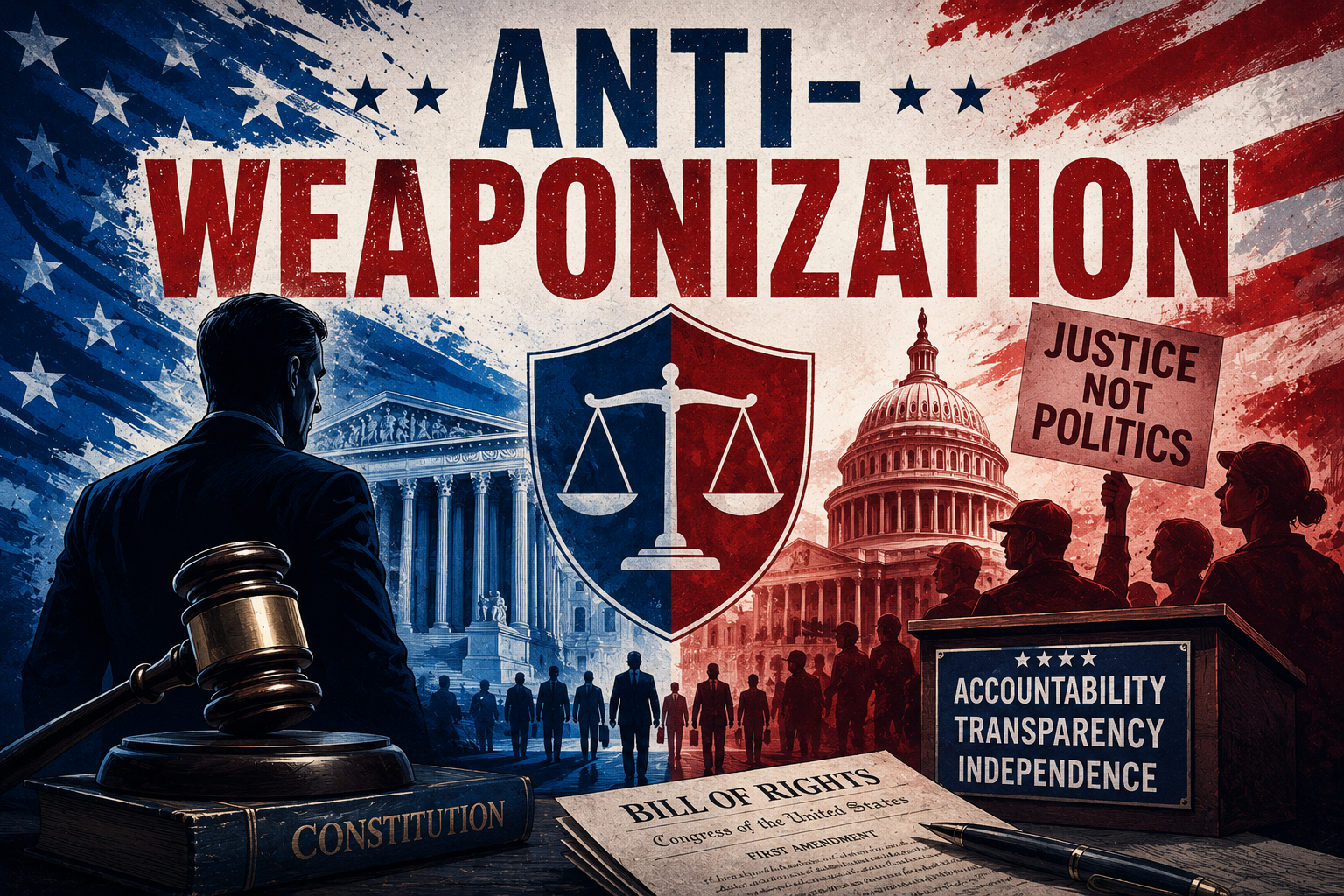
Every so often, a government action arrives that is not simply a policy decision but a stress test of how democratic institutions are supposed to function.
The DOJ anti-weaponization fund, announced by the Department of Justice in May 2026, is one of those moments. On the surface, it is a $1.776 billion compensation program for individuals who claim the federal government targeted them for political reasons.
Underneath that description are questions that cut to the core of American governance:
Who controls the Justice Department, and how independent should it be from the president’s personal interests?
When can a sitting president use taxpayer money to resolve his own lawsuits?
What legal protections exist against government overreach, and who enforces them when the overreach comes from the government itself?
This article answers those questions with facts, legal context, and frameworks that apply beyond any single administration or news cycle.
Why DOJ Independence Matters First
Before examining the DOJ anti-weaponization fund specifically, it helps to understand why Department of Justice independence is a foundational principle of American governance, not just a bureaucratic norm.
The DOJ does three things that directly affect every American:
It prosecutes federal crimes.
It defends the United States in civil lawsuits.
It enforces federal law against individuals, corporations, and state governments.
For those functions to carry legitimacy, the decisions behind them must follow evidence and legal standards, not the president’s personal or political interests. The alternative, a law enforcement agency that acts as an arm of whoever holds executive power, is precisely what most democratic systems are designed to prevent.
Historically, presidents from both parties have maintained formal distance from DOJ prosecutorial decisions, even when those decisions affected their allies or opponents. That norm has been tested at various points in U.S. history, but it has also been consistently reasserted through congressional oversight, court rulings, and the professional culture of the department’s career attorneys.
The DOJ anti-weaponization fund challenges that norm in a specific structural way: it was created as part of a settlement in a lawsuit filed by the sitting president, in his personal capacity, against a federal agency he controls. That arrangement placed the president on both sides of the same negotiating table simultaneously.
How the Fund Came to Exist: The IRS Lawsuit
The DOJ anti-weaponization fund did not originate as legislation or a policy initiative. It came out of a lawsuit.
The Original Case
In early 2026, President Trump filed a $10 billion lawsuit against the Treasury Department and the IRS in federal court in Florida. The core allegation: the IRS failed to protect the confidentiality of his tax returns, which were leaked to journalists by a government contractor between 2018 and 2020.
Key background facts:
The contractor, Charles Edward Littlejohn, pleaded guilty and received a five-year prison sentence.
The leaked returns, published by The New York Times and ProPublica, revealed Trump paid $750 in federal income taxes in his first year as president and no federal income taxes in some prior years.
Trump’s sons Donald Trump Jr. and Eric Trump, along with the Trump Organization, were named co-plaintiffs.
Two Immediate Legal Problems
Legal scholars flagged two structural problems with the case before any substantive proceedings occurred.
| Problem | Details |
| Statute of limitations | Federal law gives a taxpayer two years from learning of an improper disclosure to file suit. Trump’s personal attorney attended Littlejohn’s October 2023 plea hearing. House Democrats calculated the filing deadline passed before the lawsuit was even submitted. |
| President suing himself | A sitting president controls the executive branch. Suing an agency within that branch, then negotiating a settlement as both plaintiff and the head of the defendant’s chain of command, has no clear precedent in American legal history. Trump acknowledged it directly: “I am supposed to work out a settlement with myself.” |
How the Settlement Was Structured
Rather than litigating those questions, the case was settled. The DOJ agreed to drop three of Trump’s pending claims in exchange for creating the fund:
The IRS tax return lawsuit.
An administrative claim for damages from the 2022 FBI search of Mar-a-Lago.
A claim related to the federal investigation into Russian interference in the 2016 election.
What Trump and his co-plaintiffs received: a formal government apology and no direct monetary payment. What the settlement created: a $1.776 billion fund to compensate future third-party claimants.
What the Fund Actually Does: The Structural Breakdown
Here is every key element of the DOJ anti-weaponization fund, drawn directly from the DOJ’s official press release.
Funding
Source: The DOJ judgment fund, a permanent congressional appropriation managed by the U.S. Treasury. Congress created it to allow the government to pay court-ordered judgments and approved settlements without requiring case-by-case appropriations. It is taxpayer money, pre-appropriated by Congress for settling legitimate federal legal obligations.
Amount: $1.776 billion.
Remaining funds: Any money unspent when the fund closes reverts to the federal government, not to outside organizations.
Who Can File
Any individual who believes they were targeted by government “weaponization” or “lawfare” may submit a claim.
Submission is voluntary.
The DOJ stated there are no partisan requirements to file.
The commission evaluates each submission and determines eligibility.
What Claimants Can Receive
Monetary relief (dollar amounts are determined by the commission on a case-by-case basis).
A formal government apology.
Governance
| Element | Detail |
| Commission size | Five members |
| Who appoints them | The Attorney General |
| Congressional input | One member chosen in consultation with congressional leadership |
| Presidential removal | The president may remove any member at will |
| Court oversight | None. No judge reviews commission decisions. |
| Reporting | Quarterly reports to the Attorney General identifying recipients and relief awarded |
| Audit authority | The Attorney General may direct an audit |
Timeline
The fund stops accepting new claims by December 15, 2028.
That deadline spans two federal election cycles from the fund’s creation.
“Lawfare” and “Weaponization”: Why the Undefined Terms Matter
The fund’s entire purpose rests on two terms the DOJ uses without providing statutory definitions.
What They Mean in Practice
Lawfare refers to the alleged use of legal processes as political weapons, bringing prosecutions, investigations, or civil actions not to enforce the law but to harm an ideological opponent. The term has been used by groups across the political spectrum when they believe legal processes are being deployed in bad faith.
Weaponization of government refers more broadly to using federal agencies, their investigative powers, their prosecutorial authority, or their access to personal information to target individuals for political, ideological, or personal reasons rather than for legitimate law enforcement or regulatory purposes.
Why the Lack of Legal Definitions Is Significant
Neither term has a statutory definition in U.S. law. That means:
No federal statute specifies what conduct qualifies for compensation.
The commission decides what counts as “weaponization” using its own judgment.
There is no independent court review of those decisions.
No adversarial process requires the government to defend its prior conduct before a neutral party.
No statutory standard of proof applies to individual claims.
The practical result: the fund’s output is almost entirely determined by who the Attorney General appoints to the commission and what interpretive guidance those appointees receive. The Attorney General is a presidential appointee. The president can remove commission members at any time.
The FACE Act Cases: The Clearest Picture of Who the Fund Is For
The DOJ’s April 2026 Weaponization Working Group report, based on a review of more than 700,000 internal DOJ records, provides the most concrete example of the claimants the administration had in mind.
What the Report Found
The report examined Biden-era prosecutions under the Freedom of Access to Clinic Entrances (FACE) Act, a 1994 law that makes it a federal offense to obstruct access to reproductive health facilities. It also protects places of worship and pregnancy resource centers from similar interference.
The DOJ’s key findings:
Pro-abortion advocacy organizations, including the National Abortion Federation and Planned Parenthood, were given access to internal DOJ information and effectively directed enforcement targeting.
Prosecutors in some cases withheld evidence relevant to affirmative defenses and attempted to screen out religiously observant jurors.
The Biden DOJ requested an average sentence of 26.8 months for pro-life defendants, compared to 12.3 months for pro-abortion defendants under the same statute.
A lead prosecutor served as a reference on a private grant application for the National Abortion Federation while that organization was actively involved in the prosecutions as a complainant.
Corrective Actions Already Taken
Before the fund was created, the Trump administration had already responded to these findings:
Issued full pardons to many pro-life defendants on the first day of Trump’s second term.
Dismissed three pending civil FACE Act lawsuits with prejudice.
Restricted future FACE Act enforcement to cases involving extraordinary circumstances or significant aggravating factors.
Took personnel action against DOJ attorneys identified in the report.
These cases are the clearest window into how the administration defines “weaponization” in practice, and by extension, who the fund is designed to serve.
The Legal Challenges: Three Structural Problems
The DOJ anti-weaponization fund faces serious legal scrutiny on three distinct grounds. These are not simply political objections. They are structural questions about whether the fund was lawfully created.
Challenge 1: Was the Judgment Fund Properly Used?
The judgment fund exists to pay “actual or imminent litigation.” That is a legal standard with defined requirements.
The problem:
Critics argue a lawsuit voluntarily dismissed before any court ruling on jurisdiction does not constitute “actual or imminent litigation.”
If Trump’s claims were time-barred, as multiple legal scholars contend, then the government faced no genuine legal liability.
Without genuine liability, there may have been nothing legally qualifying as a dispute to settle.
Drawing $1.776 billion from the judgment fund without a qualifying dispute may exceed the attorney general’s statutory authority.
Challenge 2: Inconsistency With Prior DOJ Policy
This challenge has a specific historical irony.
Attorney General Jeff Sessions, in Trump’s first term, issued a 2017 memo explicitly prohibiting DOJ from creating payment programs for parties not in the underlying dispute.
Current DOJ policy publicly states that any settlement creating a payment fund for non-parties must have “a strong connection to the underlying violation or violations of federal law at issue in the enforcement action.”
Most potential anti-weaponization fund claimants have no direct connection to the IRS tax return leak that generated the original lawsuit.
Whether those claimants meet the “strong connection” standard has not been adjudicated by any court.
Challenge 3: The Keepseagle Comparison Does Not Hold
The DOJ cited the Obama-era Keepseagle v. Vilsack settlement as its primary legal precedent. Here is why legal scholars say the comparison fails.
| Feature | Keepseagle Fund | Anti-Weaponization Fund |
| Court oversight | Full judicial supervision | None |
| Settlement approval | Judge approved criteria and distribution | No court record of settlement |
| Connection to original plaintiffs | Required by court | Not required |
| Remaining funds | Returned to court for redistribution | Revert to federal government |
| Governing precedent | Approved class action settlement | Voluntarily dismissed personal lawsuit |
Joseph Sellers, the attorney who represented the Native American plaintiffs in Keepseagle, made the critical distinction: “You have to serve the same community whose interests were at stake in the litigation that was brought.” No comparable requirement exists in the anti-weaponization fund.
What Legal Experts and Former Judges Are Saying
Observers across the ideological spectrum have raised concerns about the fund’s creation, focused primarily on structural and procedural questions.
Retired Judge William Smith (George W. Bush appointee): Called the fund “a fairly thinly veiled attempt to funnel federal money to people that are sympathetic to the president’s cause and points of view without following the kind of usual procedures.” Also said: “I would be shocked if there isn’t some kind of an effort to stop it in its tracks.”
Gregory Sisk (University of St. Thomas law professor, former DOJ attorney): Said the arrangement illustrates “the consequences of having an Executive Branch in which the president is much more involved in the activities of the Department of Justice” and noted that prior presidents kept distance from similar situations to avoid the appearance of corruption.
Adam Zimmerman (USC Gould School of Law professor, mass litigation specialist): Said the deal is “leaps and bounds away” from any prior precedent given who the parties are, noting Trump was “leveraging his private persona and his status as a private litigant to accomplish all of these public goals associated with his administration.”
Stacey Young (former longtime DOJ attorney): Said the arrangement is “so preposterous” that “any ethical-thinking lawyer at DOJ should know that.”
The Standing Problem for Challengers
Even critics who want to challenge the fund face a significant legal hurdle: standing.
Supreme Court precedent severely restricts taxpayer standing to challenge government spending in most circumstances.
To sue, a challenger must show they are specifically harmed by the fund in a way that a court can redress.
Legal theories being explored include the Constitution’s Emoluments Clause and the Administrative Procedures Act.
No successful challenge had been mounted as of the fund’s announcement.
Why This Matters for Voters and Democratic Governance
The lasting significance of the DOJ anti-weaponization fund is not the fund itself. It is the constitutional questions it leaves open and the precedents it asserts.
On Executive Power
The fund represents a claim that a president can use a personal lawsuit against his own government to generate a multi-billion-dollar program.
That program is funded with existing appropriations, controlled by presidential appointees, and operates without court oversight.
If that claim is not successfully challenged, it establishes a template any future administration, of any party, can replicate or expand.
On DOJ Independence
Every administration since Watergate has maintained, to varying degrees, a structural separation between the president’s personal legal interests and the DOJ’s decision-making.
Acting Attorney General Todd Blanche, who oversaw the settlement, was previously on Trump’s personal legal team for the criminal prosecutions brought against him by Special Counsel Jack Smith.
The principle at stake is not partisan: DOJ independence serves the public interest regardless of who the president is, because it is what makes prosecutorial decisions credible.
On Congressional Authority
The judgment fund is a congressional appropriation.
Congress did not specifically authorize the creation of the DOJ anti-weaponization fund or the expenditure of $1.776 billion for this purpose.
The DOJ’s position is that existing statutory authority covers the action.
Whether that position holds legally is a separation of powers question with implications for how broadly future administrations can use pre-existing appropriations without a new congressional vote.
On Elections
The fund’s operation runs through December 2028. That timeline has direct electoral implications:
Members of Congress elected in November 2026 will hold oversight authority over DOJ spending.
They have the power to pass legislation that constrains, modifies, or defunds programs like this one.
The Senate confirms future attorneys general, who appoint future commission members.
Voters who care about DOJ independence, executive power, or the separation of powers have direct influence through every federal election in this window.
Frequently Asked Questions
Can anyone file a claim, or is it limited to Trump supporters? The DOJ stated there are no partisan requirements. In practice, however, the commission evaluates what constitutes “weaponization” or “lawfare” without any independent review of those determinations. The commission is made up entirely of presidential appointees.
Does Trump or his family receive money from this fund? No. Per the settlement, Trump and his co-plaintiffs receive a formal government apology and no monetary payment. The fund compensates third-party claimants only.
What happens to unspent money? Any funds remaining after December 15, 2028 revert to the federal government. This is structurally different from the Keepseagle fund, where unclaimed money was redistributed to outside organizations.
Is the fund permanent? No. The commission stops processing claims by December 15, 2028. Whether a future administration can extend, modify, or dissolve it early is a legal question not yet resolved.
Who is most likely to receive compensation? Based on the DOJ’s own public statements and the Weaponization Working Group report, the most clearly intended beneficiaries include:
Pro-life activists prosecuted under the FACE Act during the Biden administration.
Individuals caught up in the Trump-Russia investigation.
January 6 supporters who were prosecuted and have since been pardoned.
Whether pardoned individuals can also receive monetary compensation from the fund has not been publicly clarified by the DOJ.
Is there real legal precedent for this? The DOJ cited Keepseagle v. Vilsack as precedent. Legal scholars and an attorney directly involved in that case say the comparison is fundamentally flawed because Keepseagle was court-supervised, judicially approved, and required compensation to serve the same communities who brought the original lawsuit. None of those features apply here.
References:
U.S. Department of Justice. Justice Department Announces Anti-Weaponization Fund.
U.S. Department of Justice. Justice Department Reveals the Biden Administration’s Weaponization of Federal Law Against Pro-Life Americans.
PBS NewsHour. Justice Department announces a $1.7 billion “Anti-Weaponization Fund” to compensate Trump allies.
CNN Politics. What to know about Trump’s $1.8 billion taxpayer-fueled fund for his allies.
NBC News. DOJ sets up $1.8B “anti-weaponization” fund after Trump drops IRS lawsuit.
Time. What to Know About the DOJ’s New “Anti-Weaponization Fund”.

- What Is Actually Happening in France Right Now, and Why It Matters for the Race to Replace Macron - October 19, 2026
- How a 1971 Supreme Court Case Still Decides Who Makes Your Local Ballot - October 14, 2026
- The Supreme Court Is About to Decide a Major Voter Roll Case. Here Is the Timeline That Got Us Here - September 24, 2026