
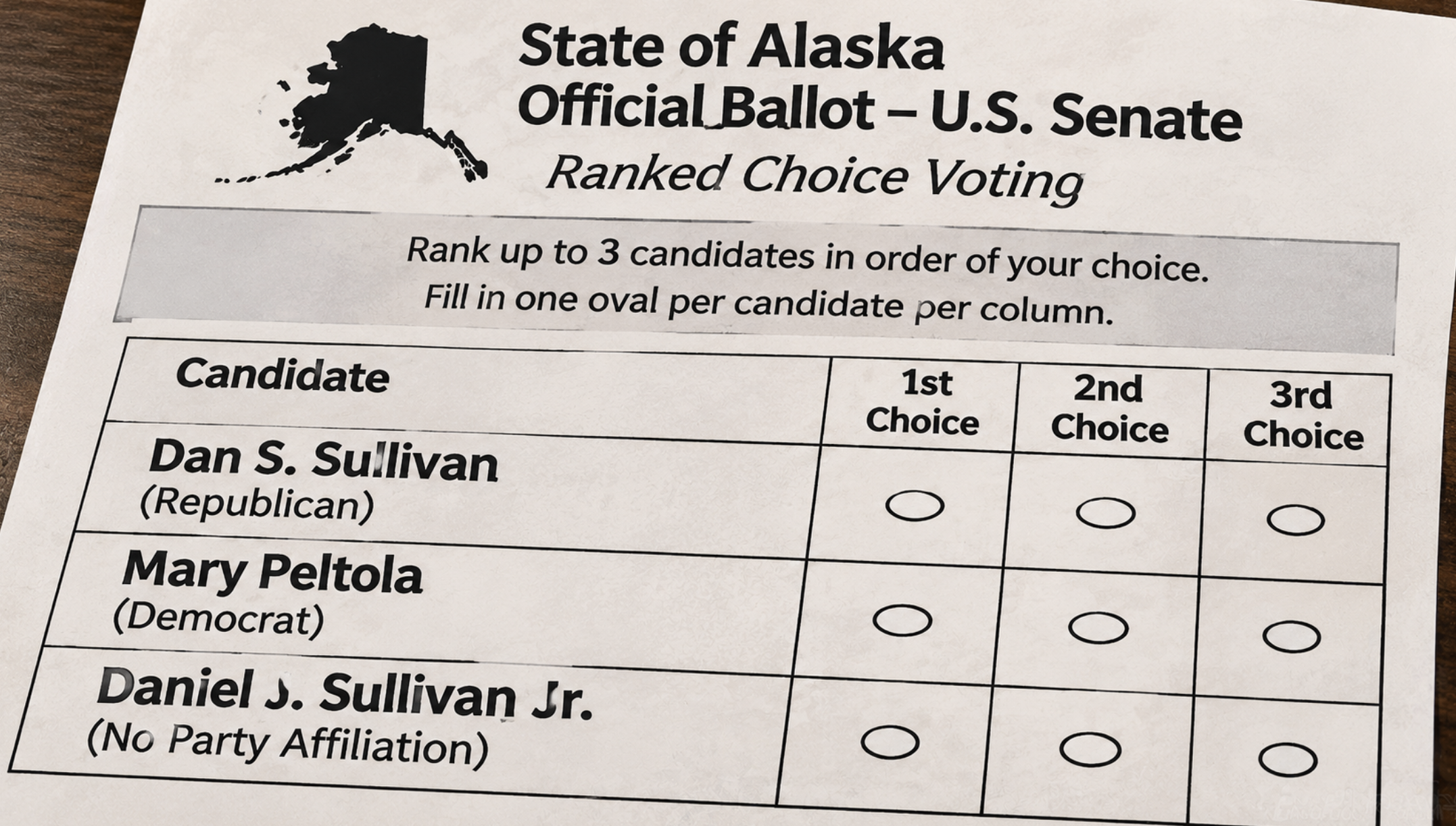
Most of the country’s close Senate races got sorted out within a few days of the polls closing. Alaska’s did not, and the reason involves one of the stranger ballot disputes of the entire cycle: a second candidate named Dan Sullivan running against the Republican incumbent senator of the same name. Here is how the story actually unfolded.
1. A retired teacher from Petersburg enters the race
In late May, Daniel J. Sullivan Jr., a retired teacher from Petersburg, Alaska, filed to run as a Republican for the same Senate seat held by incumbent Sen. Dan Sullivan, challenging Democratic candidate Mary Peltola alongside him. National Republican groups quickly accused him of entering the race specifically to confuse voters and dilute the incumbent’s support.
2. The state opens an investigation
Alaska’s lieutenant governor opened a formal investigation in June, writing to the Petersburg candidate that the state had received credible allegations his filing was intended to confuse and manipulate voters by matching the incumbent’s name and party.
3. Alaska’s elections division removes him from the ballot, then courts put him back on
The Division of Elections pulled him from the ballot in mid June. Alaska’s Superior Court and state Supreme Court both sided with him on appeal, and he was reinstated just one day before the ballot printing deadline, listed as Daniel J. Sullivan Jr. with no party affiliation shown.
4. Voters get a first real signal in the August primary
The nonpartisan primary gave Peltola just under half the vote, the incumbent Sullivan a little over forty percent, and the Petersburg Sullivan a small but real slice of the remainder, enough to keep alive genuine uncertainty about which candidate his presence on the ballot might ultimately help or hurt.
5. The Trump administration sues to challenge the result before it even happens
In October, the Justice Department sued the state, asking a federal court to hold off certifying any outcome that might have been affected by voter confusion and to determine what the result would have been without the Petersburg candidate on the ballot at all. The suit alleged his campaign was designed to draw votes away from the incumbent, pointing to a campaign consultant who has also supported Democratic candidates, while acknowledging no direct evidence of coordination with Peltola’s campaign. Peltola’s campaign called the suit an attempt to overturn an election before it had even been decided, and Senator Lisa Murkowski, a fellow Alaska Republican not on this year’s ballot, publicly said the Justice Department should never have filed it.
6. A federal judge throws out the lawsuit, days before the election
A federal judge dismissed the suit two days before Election Day, not by ruling on whether voter confusion was real, but by finding the government had offered no workable way to identify or set aside affected ballots without violating the secrecy every voter’s ballot is entitled to. The Justice Department filed notice of an appeal within the hour.
7. Election day arrives with neither candidate clearing a majority
Because no candidate crossed fifty percent of the vote, Alaska’s ranked choice system kicked in automatically, the mechanism state law requires whenever a multi candidate race fails to produce an outright majority winner.
8. A week later, the outcome still depends on that ranked choice count
As of this week, reporting on the race’s exact margin has shifted by the day as additional ballots were processed, and the contest remains too close to call. A separate federal criminal investigation into whether the Petersburg candidacy itself involved any crime also remains open, apart from and unresolved by the dismissed civil suit.
Why this matters to voters
Running a candidate who shares a well known opponent’s name to split votes is not a new idea in American politics, and this year’s version of it in Alaska shows both how seriously that tactic still worries campaigns and how limited the legal tools actually are to stop it once a candidate qualifies for the ballot. Courts upheld the Petersburg candidate’s right to run twice, and the one federal lawsuit built around undoing the result after the fact failed for a practical reason as much as a legal one: there was no way to figure out which votes were supposedly confused without unmasking a secret ballot.
a { color: black; }
References
Alaska’s News Source, Trump sues to disqualify votes for Petersburg’s Dan Sullivan

- What Actually Happens at Alaska’s Ranked Choice Tabulation This Week - November 17, 2026
- Why Alaska’s Senate Race Still Isn’t Decided, and Why There Were Two Dan Sullivans on the Ballot - November 10, 2026
- France’s Budget Standoff Just Escalated. Here Is How We Got to This Week - October 26, 2026