
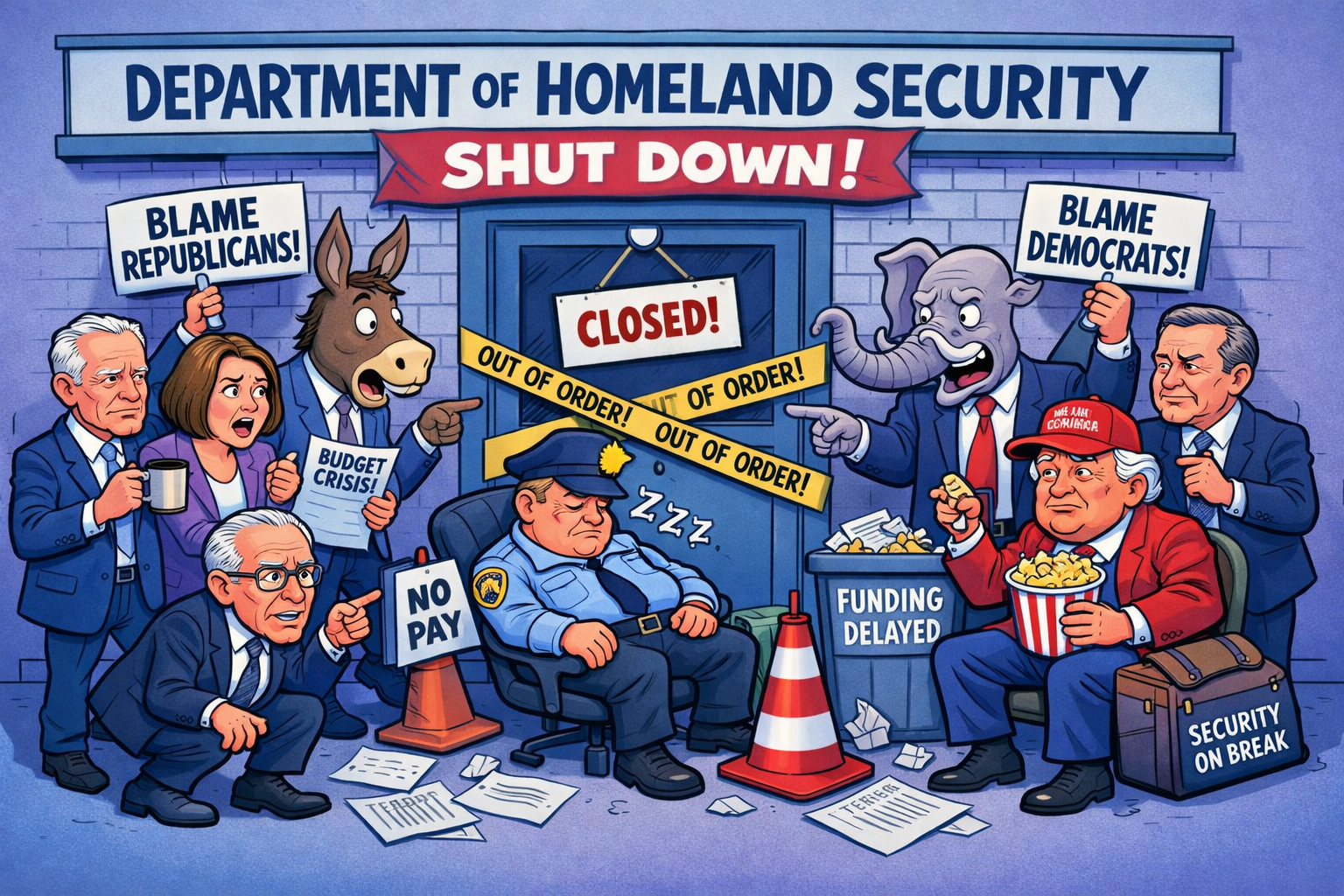
As Congress approaches a federal funding deadline, lawmakers are again facing the possibility of a DHS Shutdown. Recent live political coverage has reported heightened tension over appropriations negotiations that could result in a lapse in funding for the Department of Homeland Security if no agreement is reached. While political debate unfolds, the operational consequences of a shutdown are immediate and practical.
A DHS Shutdown does not close airports or seal borders overnight. Instead, it changes how essential agencies operate, affects federal employees, and places strain on national security systems.
What Is the Department of Homeland Security Responsible For
The Department of Homeland Security oversees several of the most visible federal security agencies in the United States. According to the official overview provided by DHS.gov and the federal government directory at USA.gov’s agency profile for DHS, the department includes:
Transportation Security Administration
U.S. Customs and Border Protection
Federal Emergency Management Agency
U.S. Citizenship and Immigration Services
U.S. Secret Service
Because DHS touches travel, border control, disaster response, and immigration processing, any funding lapse has wide operational implications.
Current Funding Standoff and Shutdown Risk
Recent national reporting, including live coverage of federal budget negotiations, has highlighted the risk that DHS funding could lapse if Congress does not pass appropriations legislation before the deadline. During these standoffs, DHS is sometimes funded under separate legislation, making it particularly vulnerable to political impasse.
The operational mechanics of this process have been explained in detail by the Committee for a Responsible Federal Budget in its analysis of what happens if DHS shuts down.
Under federal law:
Essential employees continue working
Non-essential employees are furloughed
Pay for active employees may be delayed
Administrative services slow or pause
TSA During a DHS Shutdown
The Transportation Security Administration continues screening passengers because it is classified as essential. However, previous shutdowns have shown that:
Officers may work without guaranteed immediate pay
Absenteeism can increase
Passenger wait times may lengthen
Airport checkpoints remain open, but prolonged funding lapses create operational strain.
Border Patrol and Immigration Enforcement
U.S. Customs and Border Protection officers remain active during a Department of Homeland Security shutdown.
However, impacts may include:
Delays in paperwork processing
Slower review of visa or immigration applications
Reduced staffing in administrative offices
Frontline enforcement continues, but internal systems may experience backlogs.
Because border security is often central to funding disputes, DHS negotiations frequently influence broader policy discussions that surface in election updates in the US.
FEMA and Emergency Response
The Federal Emergency Management Agency continues responding to active disasters during a DHS Shutdown.
However:
New disaster funding approvals may be delayed
Recovery planning processes can slow
Administrative coordination becomes more difficult over time
Emergency response remains operational, but long shutdowns create cumulative effects.
Federal Workers and Political Debate
A DHS funding crisis places direct pressure on federal employees. Essential workers continue working without guaranteed immediate pay. Furloughed employees stop working entirely until appropriations are restored.
Shutdown debates often become political flashpoints. RTTE has previously explored how funding standoffs affect national security and constitutional authority in Can You Protect the Constitution Without Compromising Gun Rights and Public Safety?, examining how security priorities intersect with legislative conflict.
Why a DHS Shutdown Matters
The Department of Homeland Security oversees agencies that protect transportation systems, enforce immigration laws, respond to disasters, and safeguard national infrastructure. A DHS Shutdown does not halt these missions, but it strains the people and systems responsible for carrying them out.
Understanding how a shutdown works helps separate political rhetoric from operational reality. Essential services continue, yet prolonged funding lapses test the resilience of federal institutions designed to protect the public.
References
Committee for a Responsible Federal Budget. What Happens If DHS Shuts Down
U.S. Department of Homeland Security. Official DHS Website
USA.gov. U.S. Department of Homeland Security Agency Overview
The Guardian. U.S. Politics Live Coverage on Federal Funding Negotiations

- Five Myths About States Banning ICE From Polling Places - October 12, 2026
- The Secret Ballot Is Newer Than You Think, and It Took a Body Count to Get Here - October 6, 2026
- Why Is Election Day Always a Tuesday in November? - September 4, 2026