
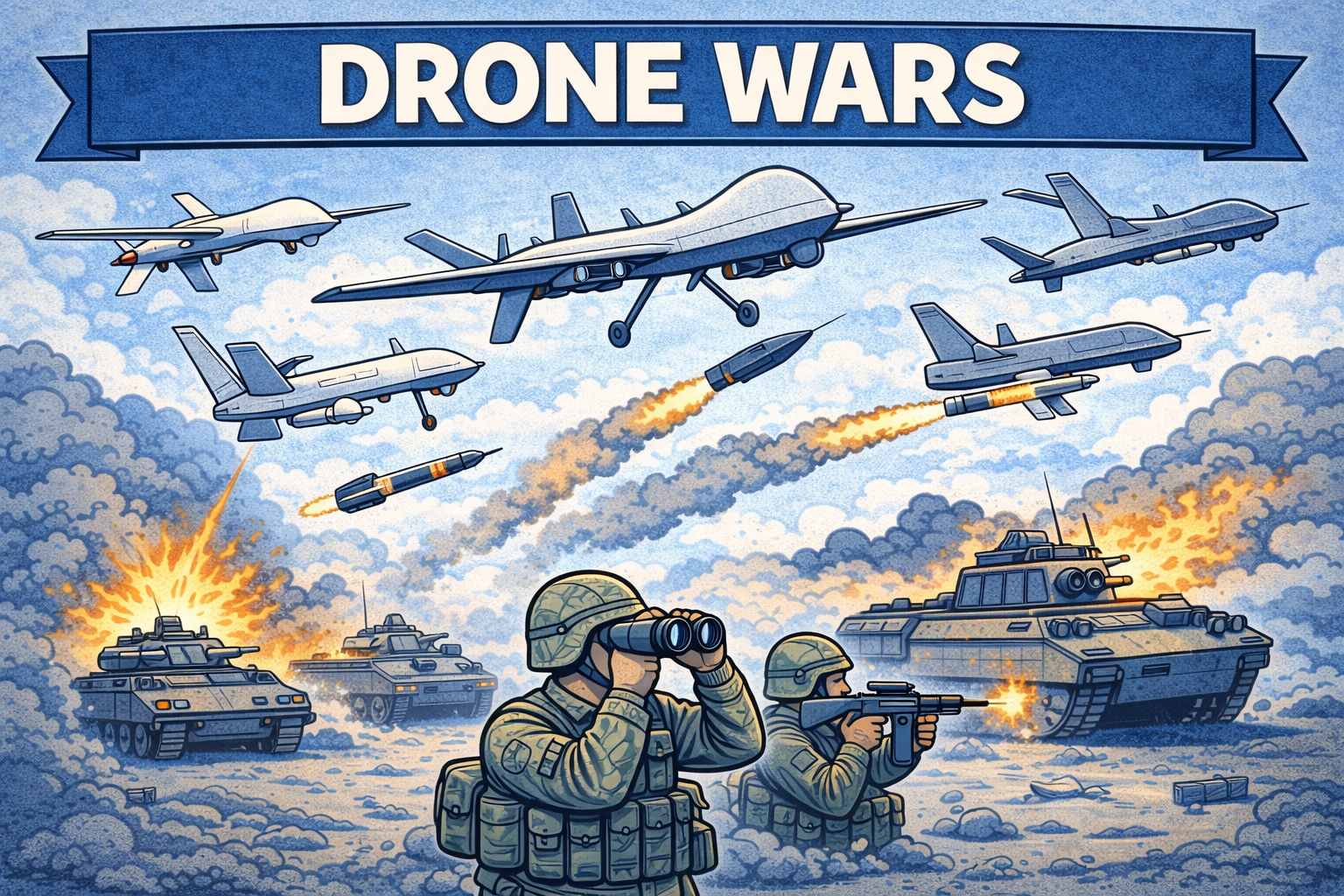
Modern conflict has shifted. Nations no longer rely only on troops, tanks, or traditional air power. Today, Drone wars define how military operations are planned and executed. Military drones now conduct surveillance, gather intelligence, and carry out precision strikes across regions without placing soldiers directly in harm’s way.
The rise of drone warfare reflects a broader transformation in national security strategy. Governments invest heavily in unmanned aerial vehicles to gain faster response times, reduce operational risk, and expand global reach. As these systems evolve, Drone wars are reshaping not only the battlefield but also legal frameworks, ethical debates, and geopolitical power.
Understanding Drone wars is essential for anyone studying U.S. policy, defense strategy, and modern global conflict.
What Are Drone Wars
Drone wars refer to the use of military drones or unmanned aerial vehicles in combat operations. These systems operate remotely or through automated systems and perform missions traditionally handled by human pilots.
Core Functions of Military Drones
Surveillance drones monitor targets and gather intelligence
Combat drones carry out drone strikes
UAV military use includes reconnaissance, targeting, and communication support
These capabilities allow governments to conduct remote warfare with minimal physical presence on the ground.
According to Drone Warfare and Strategic Implications, unmanned systems provide persistent surveillance and rapid strike capability, making them central to modern operations.
The Evolution of Drone Warfare
The development of drone warfare did not happen overnight. It evolved through decades of military innovation.
Early Development
20th century: Basic unmanned systems used for reconnaissance
Late Cold War: Expanded use of aerial surveillance platforms
Post-9/11 Expansion
The United States significantly expanded UAV military use after 2001. Drone strikes became a key tool in counterterrorism operations.
Increased reliance on combat drones
Real-time intelligence combined with strike capability
Deployment across multiple regions
Research from The Evolution of Drone Warfare explains how modern warfare drones enabled continuous monitoring and faster operational decision-making.
How Military Drones Work
Understanding drone warfare technology requires looking at how these systems function.
Key Components
Remote control stations operated by trained personnel
Satellite communication systems
Sensors and cameras for aerial surveillance
Weapons systems for precision strikes
Operational Flow
Intelligence identifies a target
Surveillance drones confirm activity
Command authorizes action
Combat drones execute drone strikes
This process allows for highly targeted operations with reduced risk to personnel.
Why Countries Use Drone Warfare
Governments adopt Drone wars strategies because of clear operational advantages.
Strategic Benefits
Reduced risk to soldiers
Continuous monitoring of targets
Faster decision-making cycles
Expanded reach without large troop deployment
Economic Efficiency
Compared to traditional aircraft, military drones often:
Cost less to operate
Require smaller crews
Reduce long-term deployment costs
Analysis from Drone Strikes Analysis highlights how drone strikes reduce operational complexity compared to traditional air missions.
Drone Wars and U.S. Military Strategy
The United States plays a central role in the development of Drone wars.
Policy and Expansion
U.S. policy has integrated drone warfare into national defense planning. The government continues to invest in defense technology focused on unmanned systems.
The White House initiative Unleashing American Drone Dominance outlines efforts to strengthen U.S. leadership in national security drones and advance defense technology.
Key Strategic Uses
Counterterrorism operations
Intelligence gathering
Support for allied operations
Border and regional surveillance
Congressional Oversight
U.S. drone operations operate under:
Executive authority
Congressional funding approvals
Oversight related to national security
These frameworks shape how Drone wars are conducted within U.S. policy.
Legal Framework and International Law
The rise of Drone wars has raised complex legal questions.
Key Legal Principles
Sovereignty of nations
Laws of armed conflict
Proportional use of force
Legal Challenges
Cross-border drone strikes
Accountability in remote warfare
Identification of lawful targets
The U.S. Army War College discusses how drone warfare challenges traditional definitions of combat zones and legal jurisdiction.
Ethical Concerns in Drone Warfare
While Drone wars provide operational advantages, they also raise ethical issues.
Major Concerns
Civilian casualties
Distance between operator and battlefield
Use of automated systems in decision-making
Accountability Issues
Difficulty in assigning responsibility
Transparency in drone strikes
Public access to operational data
These concerns continue to shape policy discussions around autonomous weapons and battlefield automation.
Advantages and Risks of Drone Wars
Advantages
High precision in targeting
Reduced military casualties
Continuous surveillance capability
Lower operational cost
Risks
Civilian harm in misidentified targets
Escalation of conflict without physical presence
Dependence on technology
Vulnerability to counter-drone systems
Real-World Examples of Drone Warfare
United States Operations
The U.S. has used military drones in:
Middle East counterterrorism missions
Surveillance operations in conflict zones
Global Use
Other countries have adopted drone warfare strategies:
Expansion of combat drones programs
Increased investment in aerial surveillance systems
Development of battlefield automation
These trends show that Drone wars are now a global reality.
The Future of Drone Wars
The next phase of Drone wars will involve advanced technologies.
Emerging Developments
Artificial intelligence in targeting systems
Autonomous drone operations
Swarm drone technology
Enhanced defense technology integration
These innovations will further expand the role of modern warfare drones in global conflict.
Connection to Energy and Geopolitical Strategy
Military strategy does not operate in isolation. Drone wars often intersect with economic and resource-based conflicts.
Energy infrastructure, supply chains, and trade routes are frequent targets of surveillance drones and precision strikes. Control over these assets influences geopolitical power.
To understand how energy resources shape global conflict, see this related analysis:
Energy Warfare: How Nations Use Oil and Gas as Political Weapons
Roadtotheelectionroadtotheelection.org/energy-warfare-how-nations-use-oil-and-gas-as-political-weapons
This connection highlights how national security drones support broader strategic objectives beyond direct combat.
References:
War Department. Drone Dominance
U.S. Army War College. Drone Warfare and Strategic Implications
Air University. The Evolution of Drone Warfare
Lawrence Livermore National Laboratory. Drone Strikes Analysis
White House. Unleashing American Drone Dominance

- What Is Actually Happening in France Right Now, and Why It Matters for the Race to Replace Macron - October 19, 2026
- How a 1971 Supreme Court Case Still Decides Who Makes Your Local Ballot - October 14, 2026
- The Supreme Court Is About to Decide a Major Voter Roll Case. Here Is the Timeline That Got Us Here - September 24, 2026