

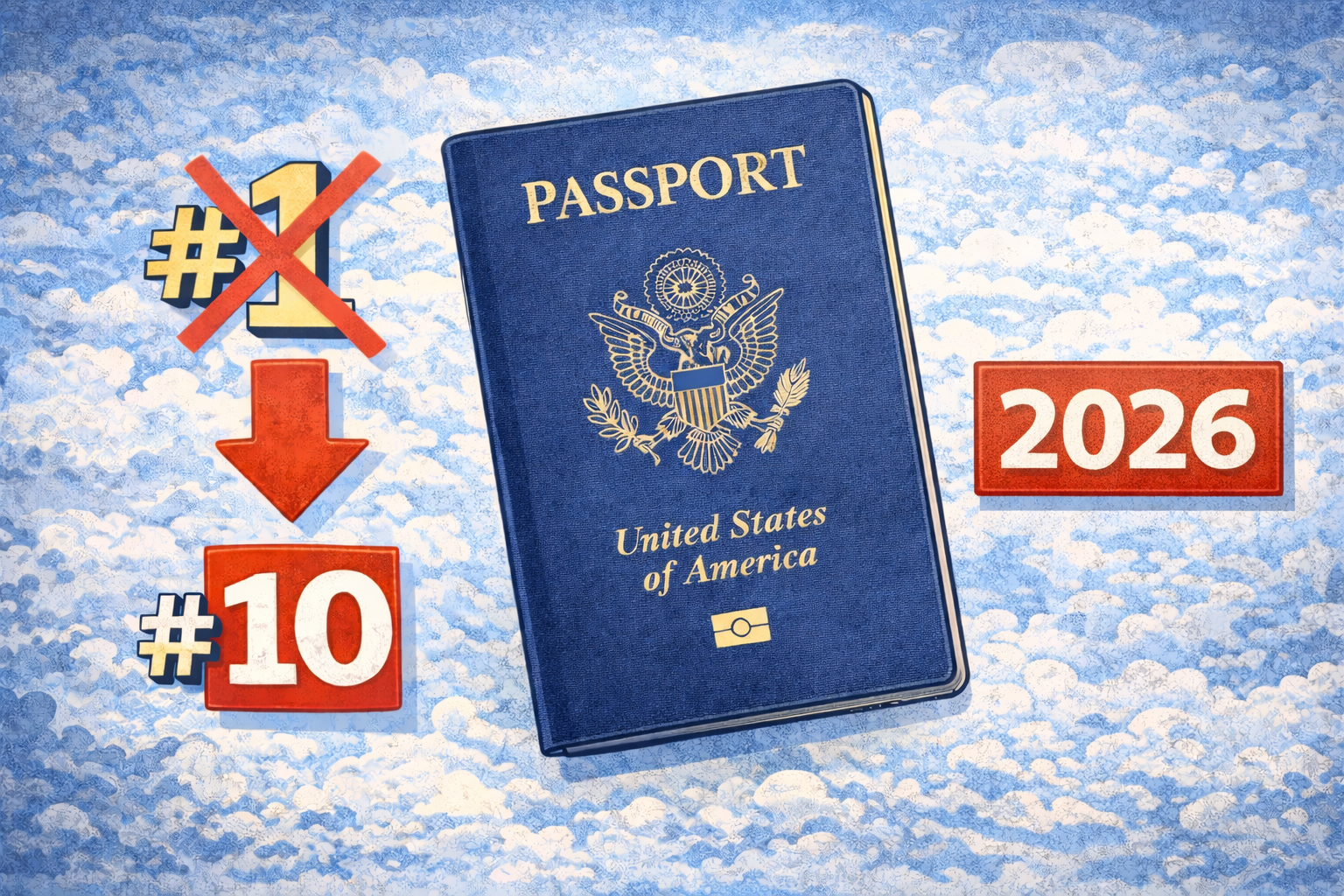
The U.S. passport ranking 2026 reflects ongoing changes in global mobility. According to the Henley Passport Index, the United States ties for 10th place with Iceland, granting visa-free or visa-on-arrival entry to 179 destinations. Singapore leads with 192 destinations, followed by Japan, South Korea, and the United Arab Emirates at 187 each. Several European nations rank ahead with 185 or 184 destinations.
This placement keeps the American passport in the global top tier. However, it marks a measurable long-term slide of roughly six positions since the United States shared first place with the United Kingdom in 2014. A brief drop to 12th in late 2025 was followed by a return to 10th, yet the broader trend shows slower growth in accessible destinations compared with competitors.
The Henley Passport Index evaluates 199 passports using exclusive data from the International Air Transport Association. It counts destinations reachable without a prior visa or with visa on arrival and updates monthly. Other trackers, including the Passport Index by Arton Capital, align closely and place the American passport ranking in the same high range.
Current Global Passport Ranking 2026
The global passport ranking 2026 features tight competition at the top, dominated by Asian and European passports.
Singapore holds 1st place with 192 destinations.
Japan, South Korea, and the United Arab Emirates share 2nd with 187 each.
Sweden ranks 3rd with 186.
Multiple European countries, including Germany, France, Italy, and Spain, follow with 185.
The United States and Iceland tie for 10th with 179.
The strongest passports in the world 2026 demonstrate how small differences of five to ten destinations can determine final positions in this crowded field. The U.S. passport global mobility remains high in absolute terms but trails the leaders.
How Strong Is the U.S. Passport
How strong is the U.S. passport for everyday American travelers? The passport continues to provide reliable access to the most common destinations.
It enables straightforward entry to the full Schengen Area, the United Kingdom, Japan, South Korea, Australia, New Zealand, Canada, Mexico, and much of the Caribbean and Latin America without advance visas. The U.S. passport visa-free travel options cover the routes used by the vast majority of U.S. citizens for tourism, business, and family visits.
Limitations appear mainly in certain countries in Africa, the Middle East, and parts of Asia. There, U.S. holders may need advance visas or extra documentation while holders of higher-ranked passports face fewer requirements. These gaps can add planning time and costs, especially for complex or last-minute trips.
The passport power index confirms that U.S. passport strength meets core needs yet no longer delivers the widest advantage.
Factors Behind the Shift in U.S. Passport Strength
Several diplomatic and policy factors explain the relative decline in American passport ranking.
Nations such as the United Arab Emirates and Malaysia have pursued aggressive visa-liberalization campaigns to promote tourism and trade. European Union passports gain from coordinated regional agreements. The United States has prioritized security screening and reciprocity, which can lengthen the timeline for new pacts.
Reciprocity dynamics also play a role. When one country imposes stricter entry rules, others often respond similarly. Geopolitical tensions and enhanced border measures have added further friction to negotiations.
The Henley Passport Index U.S. data illustrates these patterns month after month. The result is slower expansion of the visa-free countries U.S. passport list compared with more agile competitors.
Visa-Free Access Realities
U.S. passport holders maintain broad practical mobility. The visa-free countries U.S. passport covers essential global regions efficiently for most trips.
Popular business and leisure routes across Europe, the Americas, and key Asian and Oceanic markets function with minimal barriers. Electronic travel authorizations simplify access to additional destinations such as Australia and New Zealand.
The U.S. passport visa-free travel experience remains strong for routine journeys. However, the gap with top performers means occasional extra administrative steps for less common destinations.
Passport Rankings and U.S. Governance
Passport performance reflects the effectiveness of foreign policy and institutional operations. The U.S. Department of State manages passport issuance, renewals, and international visa negotiations. Efficient services and strategic diplomacy help sustain U.S. passport global mobility and national soft power.
These topics connect to domestic democratic priorities. Election updates in the US often focus on citizenship verification, voter identification, and documentary proof of citizenship for federal elections. Proposals such as the SAVE Act highlight the U.S. passport as one of the most reliable forms of proof.
Passport ownership and renewal patterns vary across states and demographics. Shifts in accessibility or value can influence debates over equitable voting access and electoral integrity. The U.S. passport ranking 2026 thus provides context for how international outcomes and internal governance interact.
Practical Considerations for Americans

U.S. passport holders can take several straightforward steps to maximize utility.
Renew passports well before expiration to avoid State Department processing delays via the official passport status portal.
Review official entry requirements for each destination through government resources.
Consider trusted traveler programs such as Global Entry for faster border crossings.
The current ranking does not significantly restrict typical travel. Awareness of global trends, however, supports better preparation in a competitive mobility environment.
Implications for U.S. Democracy and Policy
The U.S. passport ranking 2026 serves as one indicator of diplomatic and institutional performance. It highlights the results of choices in foreign relations, security, and economic engagement.
For voters and policymakers, the ranking encourages evaluation of policies that balance openness with protection. Sustained U.S. passport strength benefits individuals directly while contributing to the credibility of governance structures.
While passport strength reflects global mobility, it is also influenced by policy decisions at home. U.S. leadership, foreign policy priorities, and international agreements all affect visa access over time. These decisions often connect to broader political cycles, including local and national elections. To understand how these processes work, read Spring Elections in the U.S.: What They Are and Why They Matter, which explains how elections affect policy direction and government action.
In the context of ongoing election updates in the US, passport issues tie into larger discussions of citizenship documentation and tools that support democratic participation. Understanding these trends helps inform engagement with policies that shape America’s position both at home and abroad.
References:
Henley & Partners. The Official Passport Index Ranking
Passport Index. Global Passport Power Rank 2026
U.S. Department of State. Passport Status
U.S. Department of State. Travel.State.Gov Passport Information
Visas News. Which Passports Are the World’s Most Powerful in 2026?

- Five Myths About States Banning ICE From Polling Places - October 12, 2026
- The Secret Ballot Is Newer Than You Think, and It Took a Body Count to Get Here - October 6, 2026
- Why Is Election Day Always a Tuesday in November? - September 4, 2026