
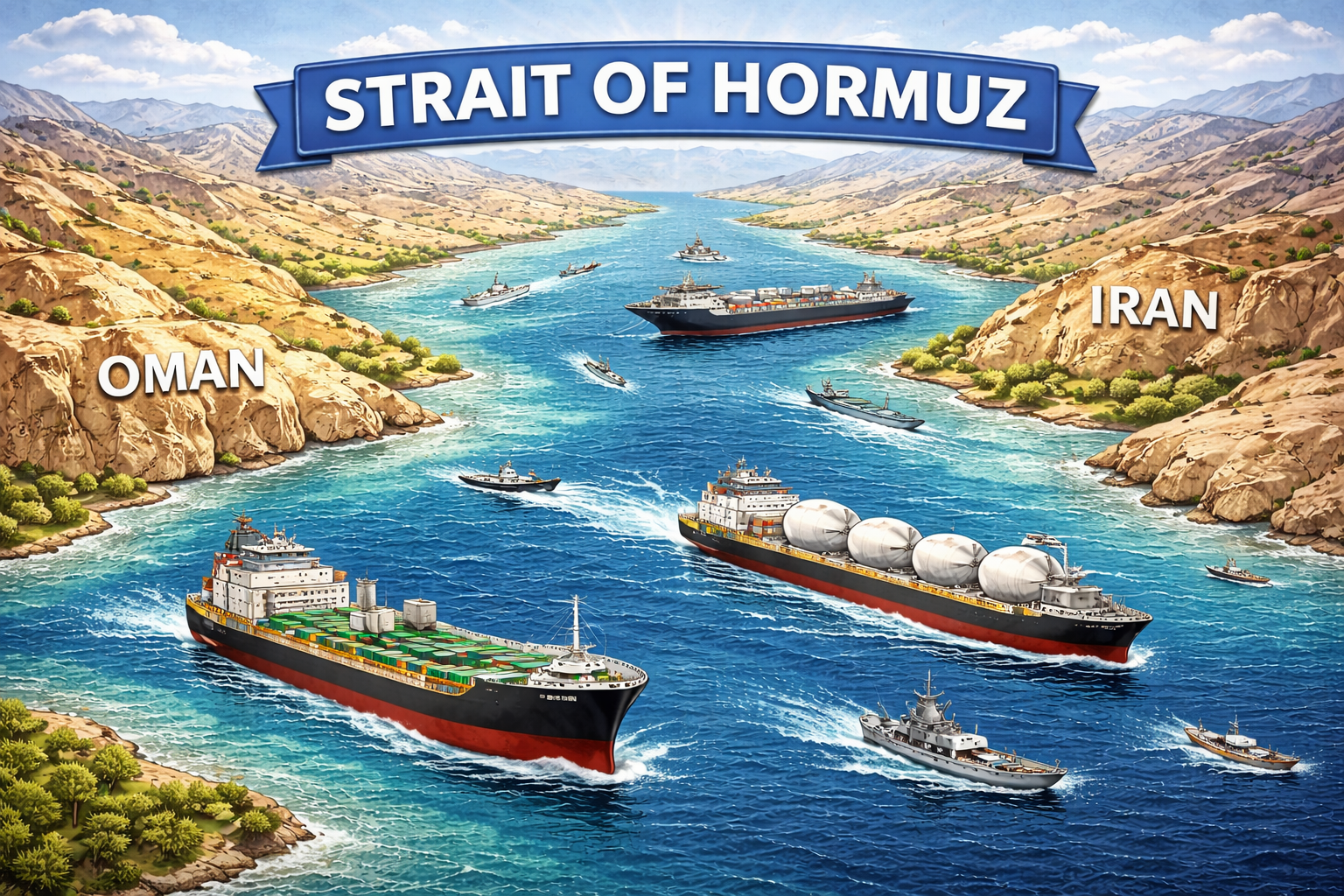
The Strait of Hormuz is one of the most important waterways in the world. It connects major oil producers in the Persian Gulf to global markets.
A large share of the world’s energy supply moves through this narrow passage. Any disruption can raise oil prices, slow trade, and affect economies worldwide.
Understanding this route explains why it remains a constant focus in global policy and security planning.
What Is the Strait of Hormuz, Where Is It Located, and Who Controls It
The Strait of Hormuz is a narrow waterway linking the Persian Gulf to the Arabian Sea. It lies between Iran to the north and Oman to the south, with the United Arab Emirates close to key shipping lanes.
At its narrowest point, the strait is about 33 kilometers wide. The lanes used by oil tankers are much tighter, which makes navigation sensitive and highly regulated.
It is an international waterway. No country owns it.
However, geography gives certain countries more influence:
Iran controls the northern coastline
Oman controls part of the southern coastline
The United Arab Emirates sits near critical routes
According to Strauss Center’s Strait of Hormuz Geography, Iran’s position allows it to monitor traffic closely and influence movement through the strait.
Major oil exporters rely on this route, including Saudi Arabia, Iraq, Kuwait, Qatar, and the UAE. Major importers such as China, India, Japan, and South Korea depend on it for energy supply.
This defines the Strait of Hormuz importance as global.
Why the Strait of Hormuz Matters to Global Oil Supply
The Strait of Hormuz oil trade serves as the main exit point for Gulf energy exports.
Without it, large volumes of oil and gas cannot reach international markets efficiently.
According to Strait of Hormuz, a significant share of the world’s petroleum supply flows through this route. This creates a direct link between the strait and global energy stability.
The Strait of Hormuz global impact is immediate:
Oil prices react to any disruption
Supply chains adjust quickly
Energy-dependent economies face pressure
Even minor incidents in the region can trigger market responses.
How Much Oil Passes Through the Strait of Hormuz
The scale of traffic through the strait is unmatched.
Data from Congress in CRS Report R45281 shows:
Around 20 percent of global oil consumption passes through the strait
Tens of millions of barrels move daily
It is the most critical oil transit chokepoint in the world
Liquefied natural gas exports, especially from Qatar, also pass through this route.
This concentration means a single disruption can affect a large portion of global supply at once.
Why the Strait of Hormuz Is a Strategic Chokepoint
The Strait of Hormuz strategic chokepoint status comes from its physical limits and lack of alternatives.
The waterway is narrow. Shipping lanes are tightly defined. Traffic flows in controlled directions.
According to the University of Western Australia’s analysis, What Will It Take to Get Ships Going Through the Strait of Hormuz Again:
Tankers must follow specific lanes
Military forces monitor the area closely
Disruptions can halt movement quickly
This makes the strait a high-risk zone.
The Strait of Hormuz geopolitical significance comes from this vulnerability. Control over a narrow route with global impact gives the region strategic weight.
Can the World Replace the Strait of Hormuz
The world has alternatives, but none can match the scale of the Strait of Hormuz.
Existing Options
Pipelines in Saudi Arabia and the UAE that bypass the strait
Smaller regional export routes outside the Gulf
These options move some oil, but not enough to replace the full flow. Capacity is limited, access is uneven, and infrastructure cannot expand quickly during a disruption.
The Strait of Hormuz oil trade is closely tied to the global financial system, especially how oil is priced and traded in U.S. dollars. Much of the energy that passes through this route is bought and sold using a system that reinforces the dollar’s role in global markets. To understand how this works, read What Is the Petro Dollar? Understanding the World’s Most Powerful Financial System, which explains how oil trade and currency systems are connected.
References:
University of Western Australia. What Will It Take to Get Ships Going Through the Strait of Hormuz Again
Congress.gov. CRS Report R45281
Brookings Institution. The Global Implications of the U.S. Strikes on Iran
Wikipedia. Strait of Hormuz
Strauss Center. Strait of Hormuz Geography

- What Is Actually Happening in France Right Now, and Why It Matters for the Race to Replace Macron - October 19, 2026
- How a 1971 Supreme Court Case Still Decides Who Makes Your Local Ballot - October 14, 2026
- The Supreme Court Is About to Decide a Major Voter Roll Case. Here Is the Timeline That Got Us Here - September 24, 2026