
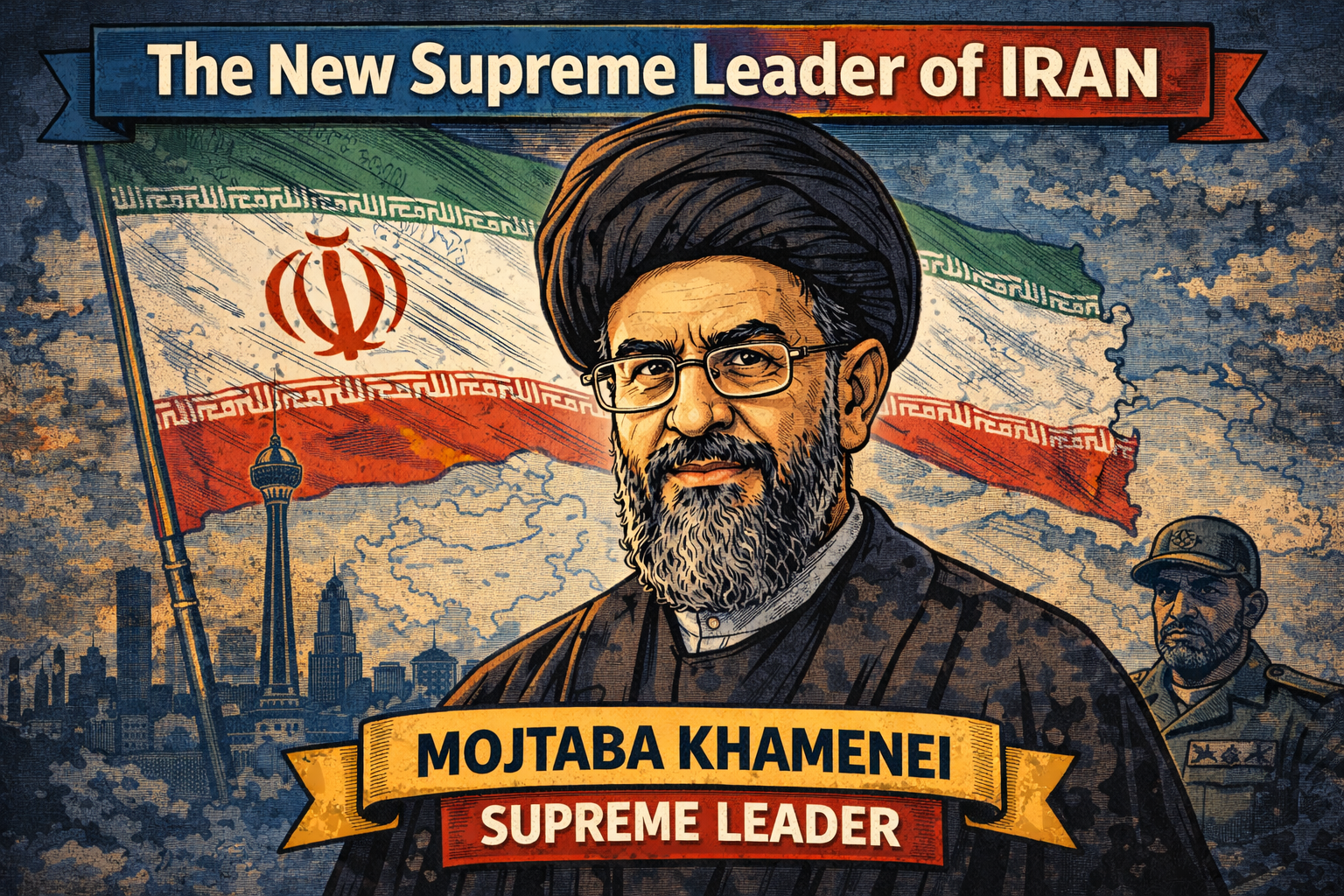
A Major Leadership Transition in Iran
Iran entered a new political era in March 2026 after the appointment of the new supreme leader of Iran, Ayatollah Mojtaba Khamenei.
The leadership change followed the death of his father, Ayatollah Ali Khamenei, who ruled the Islamic Republic for more than three decades. His leadership shaped Iran’s foreign policy, military strategy, and regional alliances.
Under Iran’s constitution, the responsibility for choosing a new supreme leader belongs to the Assembly of Experts, an 88-member clerical body elected by Iranian voters.
Following deliberations held in early March, the Assembly selected Mojtaba Khamenei as the country’s third supreme leader since the 1979 Islamic Revolution. Details of the succession process are outlined in 2026 Iranian supreme leader election.
For readers interested in the political legacy of the previous leader, see Supreme Leader Ali Khamenei Dead: The Life and Power of Iran’s Most Powerful Man.
Who Is the New Supreme Leader of Iran?
The new supreme leader of Iran, Mojtaba Khamenei, is a Shiite cleric born in Mashhad in 1969.
He studied Islamic theology in the religious seminaries of Qom, the country’s leading center for Shiite scholarship. His early life was shaped by Iran’s revolutionary political environment and the Iran-Iraq War.
According to the BBC analysis Iran’s new supreme leader: what we know about Mojtaba Khamenei, Mojtaba Khamenei maintained close relationships with powerful clerical networks and security institutions inside Iran.
Although he rarely held public political office, analysts frequently described him as a key figure behind the scenes within Iran’s conservative establishment.
For years, his name appeared in discussions of potential successors to his father.
Profile of the New Supreme Leader of Iran
| Category | Details |
| Full Name | Mojtaba Hosseini Khamenei |
| Born | 1969 |
| Birthplace | Mashhad, Iran |
| Religion | Shia Islam |
| Father | Ayatollah Ali Khamenei |
| Education | Islamic seminaries in Qom |
| Position | Supreme Leader of the Islamic Republic of Iran |
| Selected By | Assembly of Experts |
| Date of Appointment | March 2026 |
Sources: Iran’s new supreme leader: what we know about Mojtaba Khamenei, 2026 Iranian supreme leader election.
How Iran Selects Its Supreme Leader
Iran’s political system combines elements of republican government with clerical authority.
The supreme leader is the highest authority in the state and holds powers that extend across military, judicial, and political institutions.
When the position becomes vacant, the Assembly of Experts convenes to select a successor. Members debate potential candidates and vote until a majority agrees on a new leader.
This mechanism was created after the Islamic Revolution to ensure continuity of leadership within the clerical system.
The process that led to Mojtaba Khamenei’s appointment followed these constitutional procedures.
Powers of the Supreme Leader of Iran
| Authority | Description |
| Commander in Chief | Direct control over Iran’s armed forces |
| Security Policy | Authority over national defense strategy |
| Judicial Appointments | Power to appoint the head of the judiciary |
| Media Oversight | Control of state broadcasting networks |
| Guardian Council Influence | Indirect influence over election oversight |
| Foreign Policy Direction | Ability to shape strategic diplomatic decisions |
These powers make the supreme leader the most influential figure in Iran’s political system.
Why the Succession Attracted Global Attention
The appointment of Mojtaba Khamenei has drawn international scrutiny for several reasons.
First, the succession occurred during a period of heightened geopolitical tension involving Iran, Israel, and the United States.
Second, Mojtaba Khamenei’s selection represents the closest example of hereditary succession in the Islamic Republic since the revolution ended Iran’s monarchy in 1979.
In the analysis What the selection of Iran’s new leader might mean for the war, experts note that the leadership choice reflects Iran’s desire for continuity during a period of conflict.
Rather than introducing a new political direction, the appointment suggests stability within the country’s ruling institutions.
Iran’s Political System and Power Structure
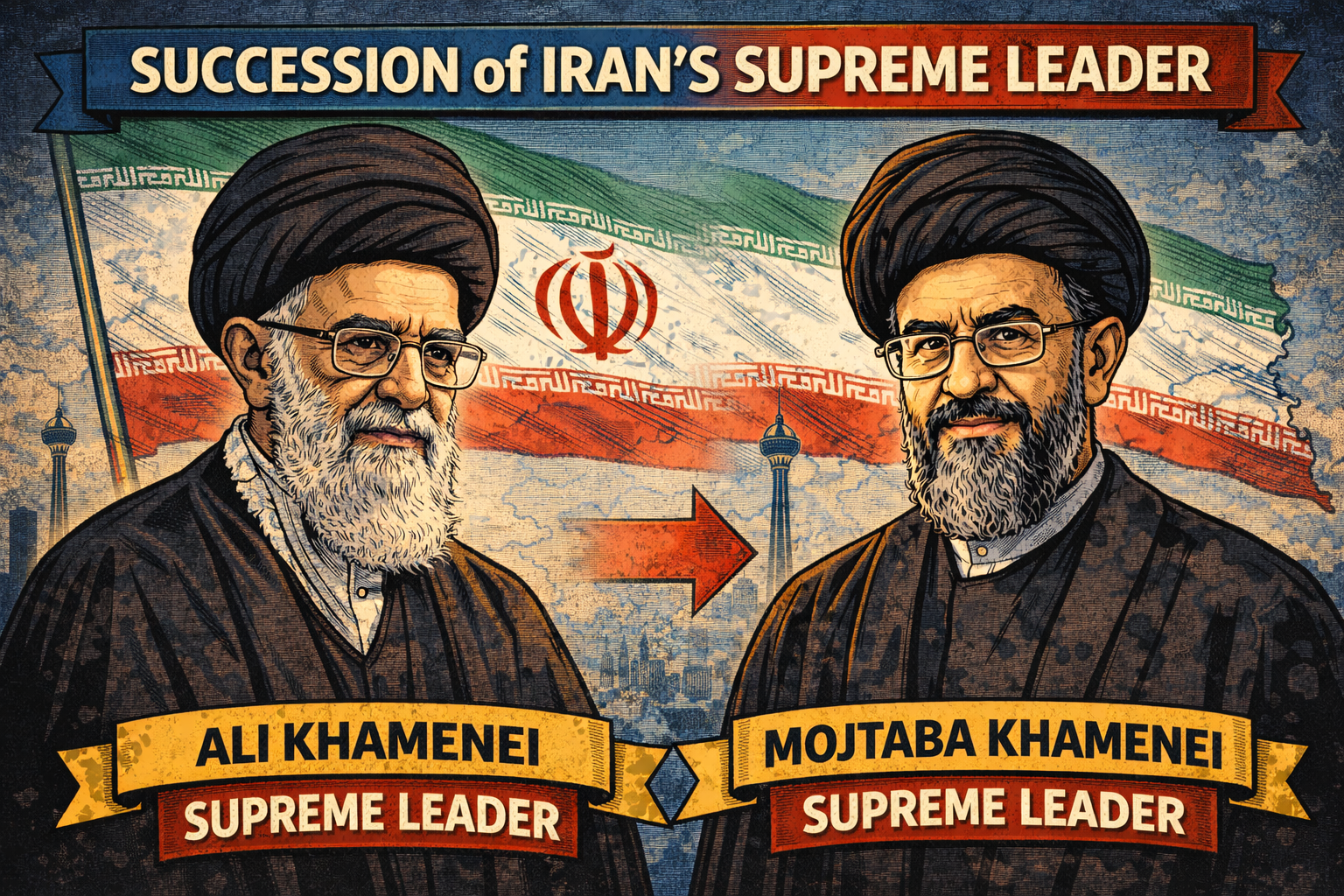
Iran’s government operates through several institutions that share authority with the supreme leader.
These include:
the president
the parliament (Majlis)
the Guardian Council
the Islamic Revolutionary Guard Corps
However, the supreme leader sits at the top of the system and holds final authority on key security and foreign policy decisions.
Research from Brandeis University’s analysis Inside Iran: The political and economic road ahead explains that Iran’s political system blends religious leadership with state institutions, creating a complex balance of power.
Leadership During Regional Conflict
The emergence of a new supreme leader of Iran comes at a time when tensions across the Middle East remain high.
Iran’s strategic relationships with regional actors, including groups in Lebanon, Syria, and Iraq, play a central role in the country’s foreign policy.
Changes in leadership can influence how Iran manages these alliances and responds to international pressure.
Because of these dynamics, Iran’s leadership transition is closely watched in global policy circles and often appears in discussions connected to election updates in the U.S., particularly when foreign policy becomes part of domestic political debate.
Why the Leadership Change Matters
Iran’s supreme leader holds one of the most powerful positions in the Middle East.
The leader determines strategic decisions on military policy, diplomacy, and national security.
The appointment of Mojtaba Khamenei as the new supreme leader of Iran therefore represents a critical moment for the country and the region.
His leadership will shape Iran’s role in ongoing regional conflicts and influence geopolitical dynamics across the Middle East.
References:
BBC. Iran’s new supreme leader: what we know about Mojtaba Khamenei (BbcWho is Mojtaba Khamenei, Iran’s new supreme leader?).
The New Yorker. What the selection of Iran’s new leader might mean for the war (NewyorkerWith the Appointment of Mojtaba Khamenei as Supreme Leader, Iran Signals Defiance).
Brandeis University. Inside Iran: The political and economic road ahead (BrandeisInside Iran: The political and economic road ahead).
Wikipedia. 2026 Iranian supreme leader election (Wikipedia2026 Iranian supreme leader election – Wikipedia).
- Five Myths About States Banning ICE From Polling Places - October 12, 2026
- The Secret Ballot Is Newer Than You Think, and It Took a Body Count to Get Here - October 6, 2026
- Why Is Election Day Always a Tuesday in November? - September 4, 2026