
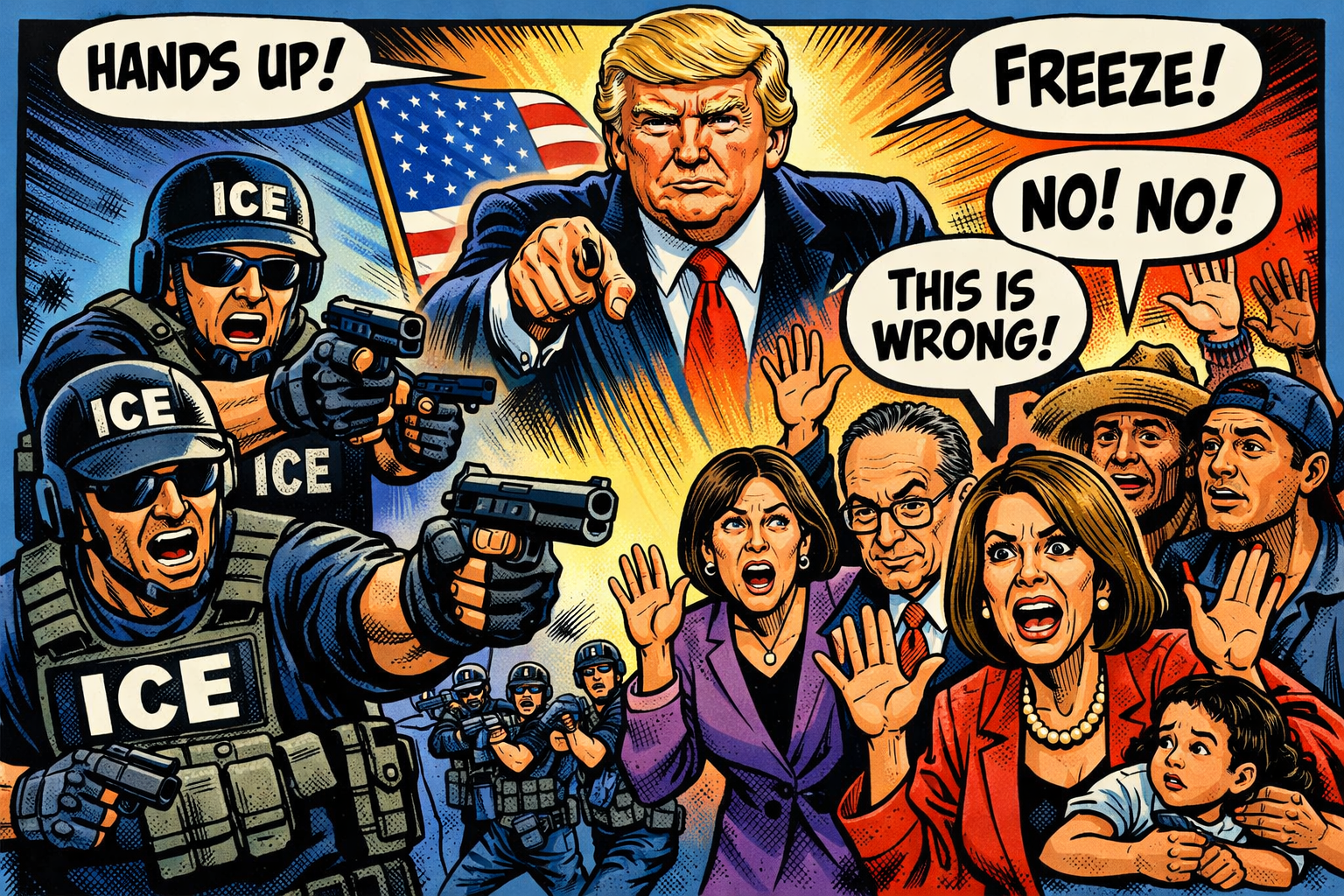
In January 2026, tensions in Minnesota escalated after a federal immigration enforcement operation led to the fatal shooting of Renee Nicole Good, a U.S. citizen, during an encounter with an Immigration and Customs Enforcement officer in Minneapolis. The incident triggered protests, public anger, and sharp political reactions. As demonstrations continued, President Donald Trump warned that he could invoke the Insurrection Act if unrest spiraled beyond the control of state and local authorities. He later said he did not believe invoking the law was necessary “at this time,” while still keeping the option open, according to The Guardian’s live coverage of the unfolding situation (The Guardian, live Minnesota ICE coverage).
That warning alone was enough to reignite a national debate. For many Americans, the idea of the military operating inside U.S. cities feels unsettling. For others, it represents a last line of defense when public order collapses. The power behind that decision rests in a little-known but far-reaching law: the Insurrection Act
.
What the Insurrection Act Is
The Insurrection Act is a federal statute first enacted in 1807. It gives the president legal authority to deploy active-duty U.S. military forces or federalize the National Guard within the United States under certain conditions. According to a detailed legal reference published by the Brookings Institution, the law was designed for moments when civilian authorities cannot enforce federal law or protect constitutional rights (Brookings Institution, Reference Sheet on the Insurrection Act and Related Authorities).
Under normal circumstances, federal troops are barred from domestic law enforcement by the Posse Comitatus Act. The Insurrection Act functions as a statutory exception, allowing the president to temporarily lift those restrictions when conditions meet the law’s requirements.
When a President Can Invoke It
Legal experts at the Brennan Center for Justice explain that the Insurrection Act allows presidential action in three broad situations (Brennan Center, The Insurrection Act Explained):
When a state formally requests federal assistance to suppress an insurrection
When domestic violence or obstruction makes enforcement of federal law impracticable
When constitutional rights are being denied and state authorities cannot or will not protect them
Notably, the law does not always require consent from a governor. That feature is one of the reasons the Act remains controversial. Once invoked, courts have historically given presidents wide latitude, often declining to intervene while deployments are underway.
Why the Power Feels So Heavy
What makes the Insurrection Act feel especially powerful is how quickly it can be used. Unlike declarations of war or emergency spending, invoking the Act does not require prior approval from Congress.
A legal overview published by the U.S. Department of Defense confirms that once invoked, federal troops may perform law enforcement functions ordinarily reserved for civilian agencies (Department of Defense, Insurrection Act Overview).
This speed is intentional. The law was written for moments when delay could allow disorder to spread. At the same time, speed leaves little room for public debate or political compromise once troops are deployed.
How Often the Insurrection Act Has Been Used
Despite its sweeping authority, the Insurrection Act has been used sparingly.
Brookings documents show that presidents have invoked it mainly during periods of extreme national strain, including enforcement of civil rights during desegregation and response to major urban unrest. One of the most prominent modern examples occurred during the 1992 Los Angeles riots, when federal troops were deployed to support overwhelmed local law enforcement (Brookings Institution, Reference Sheet on the Insurrection Act and Related Authorities).
Its rarity is part of its impact. When a president even threatens to invoke the Act, it signals that normal systems are viewed as insufficient.
Why Minnesota Put the Law Back in Focus
In Minnesota, protests followed a major federal immigration operation known as Operation Metro Surge, which brought thousands of ICE agents and federal personnel into the Twin Cities. The shooting of Renee Good intensified tensions and drew condemnation from local leaders, while federal officials defended the operation and warned against attacks on federal agents (The Guardian, Minnesota ICE shooting coverage).
President Trump’s public references to the Insurrection Act introduced a constitutional question into what began as a law enforcement crisis. State leaders argued that invoking the Act would escalate the situation, while federal officials insisted that protecting federal personnel and enforcing immigration law remained a national responsibility.
Is the Insurrection Act the Same as Martial Law?
The Insurrection Act is often confused with martial law, but the two are not the same.
Martial law refers to a situation where the military replaces civilian government entirely, suspending ordinary courts and civil authority. The United States has never formally declared nationwide martial law, and there is no single federal statute that defines it.
By contrast, the Insurrection Act operates within civilian government, allowing military forces to assist with law enforcement while civilian courts and elected officials remain in place. According to legal analysis from the Brennan Center for Justice, the Act does not authorize the suspension of the Constitution or civilian governance, even though it permits extraordinary federal intervention (Brennan Center, The Insurrection Act Explained).
Congress and Calls for Reform
Concerns about the breadth of the Insurrection Act have prompted lawmakers to seek clarification and limits. A proposal introduced in Congress aims to reform the law by adding reporting requirements and tightening standards for invocation (Congress.gov, Insurrection Act Reform Proposal S.2070).
Supporters of reform argue that clearer guardrails would protect civil liberties while preserving the president’s ability to respond to genuine emergencies. Critics warn that limiting the Act too heavily could slow federal response during moments of real national danger.
The Insurrection Act sits at the crossroads of public safety, executive power, and civil liberty. It exists for moments when order breaks down and constitutional rights are threatened, but its broad language means it can also become a flashpoint in politically charged situations.
The Minnesota episode shows why understanding this law matters. Even when the Act is not invoked, the possibility alone can reshape public debate, heighten fear, and signal how seriously federal leaders view unrest. Written more than two centuries ago, the Insurrection Act remains one of the most powerful tools a U.S. president can wield at home, a safeguard in theory, and a warning in practice.
References
Brookings Institution. Reference Sheet on the Insurrection Act and Related Authorities.
Brennan Center for Justice. The Insurrection Act, Explained.
United States Congress. Insurrection Act Reform Proposal, S.2070.
U.S. Department of Defense. Insurrection Act Legal Overview.

- Early Voting Just Started for the 2026 Midterms, and the Story Behind It Goes Back Further Than You’d Think - September 18, 2026
- When Elections End in a Dead Heat: The Wild (and Totally Legal) Ways America Breaks a Tie - August 19, 2026
- China vs America AI 2026: The Race That Closed Overnight and the Election Claim That Divides Washington - July 21, 2026